




Books
Nov. 17, 2025
A new biography of Thomas More allows readers to be their own judge
Thomas More chose conscience over the king, paying with his life and teaching that law, faith and principle must sometimes defy authority.


John J. Kralik
Judge (ret.)
University of Michigan Law School, 1979
John J. Kralik has been a judge of the Los Angeles County Superior Court for sixteen years. He is the author of "A Simple Act of Gratitude," a memoir, and "Three Bodies by the River," a novel. For further information, see www.johnjkralik.com.
The reign of Henry VIII began with great hope in 1509: An
athletic, educated, and enlightened monarch whose house promised respite from
the English War of the Roses willingly married into Spanish royalty. Together,
Henry and Catherine of Aragon raised the hope for a European peace that would
also eclipse the memory of the Hundred Years' War. Henry VIII's promise ended
in the ignition of unspeakable religious violence when he divorced Catherine to
marry Anne Boleyn. More than a century of bloody religious warfare erupted
between the reformed churches, thought of as Lutheran and Evangelical
(eventually categorized as Protestant), and the remnants of what is now called
the Roman Catholic Church. Never again would there be a common understanding of
what Christians refer to in their Apostles' Creed as "the holy catholic
church." Many would leave England and Europe seeking the freedom to worship God
according to their conscience, resulting in a country whose founders aspired to
protect both the freedom to worship and the freedom from being compelled to
worship in any specific way, or at all.
At the crucial moment of this pivotal drama stood a
distinguished scholar, lawyer, and judge, Thomas More, who had resigned as
Chancellor realizing that his morals could no longer be reconciled with the
King's desire to annul his marriage to Catherine. He refused to sign an oath
developed by the new Chancellor, Thomas Cromwell, reciting that Henry, and not
the Pope, was the supreme authority over the churches in England. His refusal
to sign the words of the oath led to his imprisonment in the Tower of London
and eventually his execution simply for maintaining his silence about the
King's assertion of divine power.
Wildly opposing views of More have appeared in the popular
culture through which we know him today. More was canonized as a saint by the
Roman Catholic Church in 1935, on the 400th anniversary of his execution, and
anyone who has watched the 1966 film "A Man for All Seasons," would agree with
his sainthood. More, as portrayed by Paul Scofield, is an exemplary man of
impeccable morals with a powerful argument for his faith. He dominates every
scene, towering above every other character. The picture won the 39th Academy
Award for Best Picture. Scofield won for best actor. Yet in Hilary Mantel's
2009 novel, "Wolf Hall" (New York: Henry Holt & Company, 2009), More
comes across as a small, hypocritical and "shabby" man. He demeans and mocks
the women in his life, especially his second wife, Alice. Dame Mantel portrays
More as a zealous persecutor of heretics, from whose cellar there is a "sound
of screaming." Mantel describes More as a "vain and dangerous man ... a killer."
In the 2015 BBC series based on "Wolf Hall," More is portrayed by Anton Lesser,
a great actor to be sure, but best known to today's audiences by his role as
the scheming Qyburn who perverts a "maester's" scientific knowledge in service
of the evil Cersei Lannister in "Game of Thrones."
Given these conflicting portraits of More, I was eager to read Dr.
Joanne Paul's new biography of More, entitled "Thomas More: A Life" (London,
Pegasus Book, 2025). As Paul begins by noting, More is
not only "worshipped as a saint," he is also "condemned as a vicious murderer."
Her new biography is the best place to look for an unbiased presentation of the
evidence for either proposition.
First off, it bears noting how well Paul has written the book.
Her narrative unfolds chronologically, intermixing the political and physical
events into a coherent dramatic story that maintains its pace even while it
deals with intellectual controversies that may seem puzzling and much less
critical to modern secular readers than they did to More and his theological
antagonist, Martin Luther, and the European communities who lived through the
debate. Paul presents these controversies and helps the modern reader
understand why they were so important in their time. Paul includes a clear
"Cast of Characters" and a Glossary, as well as extensive sources for those who
doubt any aspect of her account. She provides thousands of footnotes to these
primary sources.
Unlike the dramatizations of More's life and unlike previous
biographers, Paul does not dramatize the story; she provides her own relatively
mild opinion of the events in a scant few sentences at the beginning of the
narrative and then lets the facts speak for themselves. After all, More's life has plenty of drama on its own: How did
England's leading intellectual, the King's beloved friend and the country's
highest-ranking executive, come to be convicted and executed for treason?
Paul presents More in the context of his times, and she portrays
those times with enough detail that the context comes alive and can be
understood clearly, even by those not versed in English history or the
Protestant Reformation. The Lutheran reformation occurred in a time when there
was near universal belief in final salvation or damnation. In that context, one
can better understand why the unity of the Catholic Church, transmutation of
the communion host, the possibility of justification by good works, and
existence of free will were matters that both More and
Luther's adherents treated as issues of ultimate consequence, worth killing and
dying for.
While Paul's method for avoiding bias may be unique to her, its
success argues for broader use in biographies of public figures, especially
those who suffer violent death as apparent martyrs to a cause. As she explains,
she largely avoided posthumous sources. She recognizes that most of these
sources, and the warring biographies, novels, and films that have resulted from
them, were designed to portray More as either a Catholic saint or a Protestant
heretic, and so she uses them only with qualification or corroboration. She
also portrays More's story in his own words, and it turns out there are a lot
of them: There is as much a written record of More's thoughts as there is of any X (formerly known as Twitter) addict. Although the
printing press had been invented less than a century before, More's
writings and letters, especially his debates with Luther, were nearly all in
print and defied Cromwell's efforts to destroy them. As collected by Yale
University, they consist of 15 volumes. While More
wrote verbosely (apparently More's publishers did not dare edit him), Paul
permits an understanding of More's writings for those of us who lack the time
to read 15 volumes of 16th century theology.
The result of Paul's disciplined method is instructive for the
presentation of unbiased history. Her method cannot be universally employed,
especially for historical persons whose lives predate the printing press. For
example, the life of Jesus would be a blank page, as there is virtually no
evidence of him predating his death, and he left no writings. On the other
hand, it would be an interesting exercise to apply her method to the life of
more recent figures, even in our own time, whose sudden violent deaths inspire
hagiographies designed to sanctify or vilify them.
As a reader, I felt free to form my own opinions of More as the
events unfolded in Paul's telling, and to feel confident that my opinions were
based on admissible evidence, as that is largely all that is presented. Not
every reader will share my opinions; different readers might reach different
conclusions, which they could also support with the evidence.
More's pursuit of heretics cannot be disputed, as even he would
not dispute it. He replied to his critics in book form in his own lifetime,
admitting each thing he did and setting forth his justification. As Paul points
out, most of these actions were not unusual in the context of More's time. He
did indeed arrest heretics while he was in power, imprisoning them in his own
home and even putting them in stocks. His goal was to reform them
and, in some cases, he succeeded. More felt that he was saving them from
eternal fire. Several of these alleged heretics were conspicuously executed by
burning at the stake during More's short term as Chancellor. He did not
personally order or carry out the executions, but he did heartily approve of
some of them. The executions continued after Cromwell replaced More as
Chancellor, and Cromwell, a Lutheran sympathizer,
did not risk his position with the King to stop them.
In hounding these heretics, More
carried out the policy of Henry VIII, who at the time regarded himself as the
chief defender of the faith against the Lutheran heretics. Some of his
takedowns of Luther were made at Henry's behest, but More
did not lack enthusiasm for the enterprise as he and Luther sunk to a level of debate
worthy of the vituperative chaos unfolding on X and similar platforms. Just as
More was uncompromising in his own religious convictions, he was likewise
uncompromising in his belief that a government that drew its power from God
must enforce those beliefs. He was an adherent to Catholic doctrine, and so it
is unfair to judge him in the context of our own time, in which the Catholic
Church opposes capital punishment for any crime, much less for heresy.
More accurately perceived that by placing ultimate authority in
scripture alone, Luther's rebellion threatened the Catholic Church's unity and
power, which was the source of order and the power of kings in the Western
world. Understanding this, More regarded Luther's
doctrines as threats to Western civilization, amply illustrated for him by the
Peasants' Revolt in Germany or the sack of Rome by German troops. He thought
that Luther's rejection of the concept of justification by good works was
operating to grant his followers "a license to do whatever they pleased ...." In
retrospect, he was correct that the power of the Church and the power of Kings
would never be the same -- consider the fate of Charles I or the remaining power
exercised by Charles III.
As to More's treatment of women, Dame Hilary Mantel's "Wolf Hall"
novel is decidedly unfair, especially in the context of his time. He educated
his daughters and the other women in his household, believing that women had
equal abilities to learn and should be given an equal opportunity to do so. His
daughter Margaret was an impressive intellectual in her own right. He had
endearing relationships with both his wives. He knew that his views on Henry
VIII's divorce from Catherine of Aragon would inevitably bring him ruin, no
matter what he did, and he sought to prepare his family and protect them as
best he could. His connections on the European continent might have allowed him
to flee the country, but any family who had remained would have suffered
instead. In the end, they suffered anyway.
While Henry had initially styled himself as a defender of the
Pope and the faith against Lutheranism, More could see
that the King's desire for a divorce was dearer to the King than any
theological debate. More knew that Cromwell's facilitation of the King's wishes
for a divorce gave Cromwell and other advocates of the Reformation the ability
to manipulate Henry.
The King's desire to put away his first wife Catherine could not
be honestly justified, theologically or intellectually. Henry had submitted
Catherine's testimony that she did not consummate her marriage to his brother
Arthur in support of original his petition to the Pope to marry her. Later, he
claimed her testimony was false -- but she protested that she had told the
truth. As King, Henry did not feel obligated to moral or intellectual
consistency. Cromwell knew that More had spent a lifetime creating an identity
of such consistency, and there were 15 volumes of writing setting forth his
consistent views.
When More agreed to enter Henry's
service, initially as a secretary and counselor, More had Henry's assurance
that he could look first to God for guidance, and only after God, to the King,
an assurance Henry would betray. More's "Utopia," written just as he decided to
enter Henry's service, reflects that he knew he would be out of place and in
potential danger, yet he felt an obligation to engage in public service and to
try to turn public policy to the good:
"You must strive to guide policy indirectly, so that you make
the best of things, and what you cannot turn to good, you can at least make
less bad. For it is impossible to do all things well unless all men are good,
and this I do not expect to see for a long time."
Thomas More, "Utopia" 23 (New York: Crofts Classics,
1949). While he saw it as his moral obligation to steer Henry in the right
direction, he understood the idealistic monarch who had been his youthful
friend had become a dangerous man who maintained power through brutal force.
More's execution was not a matter of his hypocritical insistence
on a few meaningless words: It seems highly unlikely he could have stopped it
by his mere agreement with the Oath of Supremacy. Cromwell had fashioned the
oath in Parliament specifically to ensnare and neutralize More and the Catholic
priests and bishops who maintained loyalty to the Pope. Even if he had signed
the oath, Cromwell would have found another way to irreversibly silence the
chief intellectual opposition to the Reformation. The King was aware of More's
views from their private conversations, and so was Anne Bolyn. Even More's
silence regarding the marriage was so eloquent that the King and Cromwell felt
it was necessary to execute him to let all know there could be no opposition. After
imprisoning him for a year in the Tower of London, Cromwell passed a new law
that enabled More's execution for treason based on a mere refusal to speak what
he felt was a lie. Cromwell and the King had read "Utopia," where More said, "Whether a philosopher can speak falsely, I do
not know, but certainly I can't." "Id." supra at 23. They knew
his entire identity required that he speak truthfully and act consistently.
In his final stand at trial, More
presented a legal rather than a religious defense. In that moment, More stood for freedom of thought and belief against the
power of the state, a liberty that heretics of Catholic or Protestant origin
could both admire, and which even today we must protect against the continuing
threats presented by an era in which some see free speech as only an ideal
rather than an absolute, subject to interpretation in favor of the reigning
political party. Cromwell had designed a law to ensnare More for his silence.
In doing so, Cromwell went beyond the previous reach of criminal law, as More
so eloquently pointed out to the jury Cromwell had rigged:
"'I clearly respond to you,' he declared, 'that it is not lawful
for me to be judged to death for such silence on my part, because neither your
statute nor anything in the laws of the whole world can rightly afflict anyone
with punishment unless he has committed a crime in word or deed.'"
In essence, More articulated the right
to remain silent as fundamental to the tradition of criminal law, a tradition
reawakened centuries later in Miranda v. Arizona, 384 U.S. 436 (1964).
Though seriously ill and without a lawyer, More
brilliantly defended himself at his trial, impeaching the lone perjurious
witness against him. Had there been a fair jury, it would have been a runaway
verdict for the defense. Of course, had any jurors voted for More, they would
have shared his fate.
As Cromwell would eventually find out for himself, when pleading
with Henry for his own head a few years later, More
could not have been saved by any late appeal for mercy. The only mercy he would
receive would be his quick beheading. Numerous others who refused to sign the
oath were not even given show trials, and suffered the full fate for treason:
hanging, though not till death, disembowelment, burning of one's intestines,
and only then the mercy of beheading, followed by quartering of the finally
dead body. Cromwell probably feared that carrying out this sentence in public
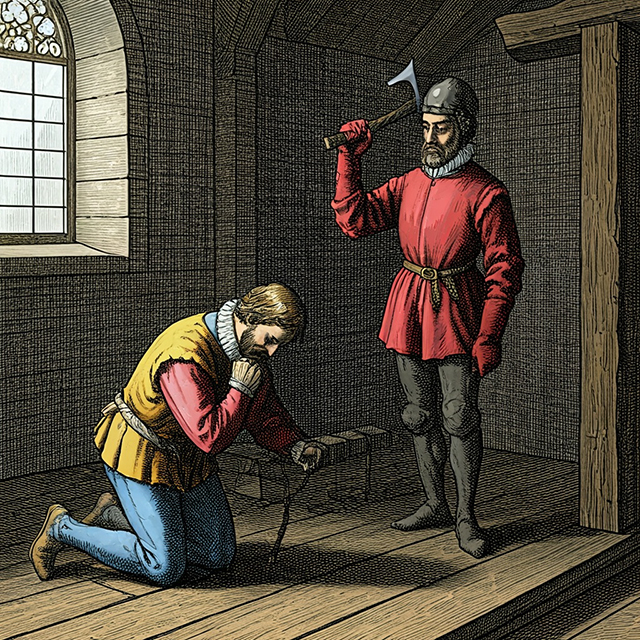
might have provoked a riot, and so More was given a quiet, dignified beheading
in the Tower. Cromwell posted More's head on London Bridge with the others.
Though Paul sees More as having "little immediate significance,"
he inspired continued Catholic resistance, and his intellectual arguments
helped preserve a greatly weakened Catholic Church. The power of Luther's
rebellion stemmed from a force that could not be stopped, unleashed by the
sudden availability of the Bible's text to the commoner in his native language.
More could not have stopped people from noticing that there is nothing in the
Bible about popes, purgatory or indulgences.
The religious war that both Catholics and Protestants felt was
worth killing and dying for teaches an historical lesson that cannot be
forgotten. Whatever you think of religious belief, we cannot use a citizen's
religious belief as a basis for civil penalty or criminal punishment. When we
do so, we are wielding the power of government in support of or against
religious belief, even when we attempt to impose anti-religious beliefs or
secularly cloaked, woke ideologies through the operation of civil and criminal
law.
Our own time is marked by such fundamental divisions that
civilization again seems to be splitting apart due to irreconcilable
ideologies. Paul correctly points out that More's story contains a timeless
lesson on the importance of principled judging and lawyering within a legal
system buffeted by such times. Lawyers and judges who do have morals and
conscience must risk entering the fray to participate in the system despite the
danger of disagreement with prevailing popular belief systems. Otherwise, the
only lawyers or judges in the system will be those who have no conscience, or
who lack the courage to adhere to it in the face of ideological exercise of
executive or legislative power. Lawyers and judges must resist the temptation
to view themselves as mere servants of clients, the law or the legal system.
Of course, it is decidedly not the role of a judge to change or
bend the law to suit one's individual desires or conscience. Yet even an
ordinary career in practicing law or serving as a judge will inevitably bring
conflicts between a client's wishes and a lawyer's conscience, or between the
law imposed by single-party governance and a judge's conscience. As Paul notes,
there will be things you are asked to do for a client, or which our
increasingly ideologically influenced law will require you to do as a judge, to
which you must say a quiet and respectful, "No." At least in our country, you
will not be beheaded, but you may lose clients, a law license or a judicial
office. How many of us are ready to make that sacrifice? As More wrote in his
"Prayer for Lawyers," a prayer posted outside my office, we must not lose our
souls to win a point.
Each fall, the Catholic Church celebrates the Red Mass in which
judges of all faiths march wearing red judicial robes and attend Mass. As a
judge, I walked in this march and was proud to do so. To me, it was a reminder
to be guided by the principle stated by More just a moment before the axe
severed his head: "I die the king's good servant, and God's first." His words
reminded me that my service to the United States of America and the State of
California was a part of my service to God, and that when the two were in
irreconcilable conflict, God must come first. In that regard, More will always be a patron saint to me.
Submit your own column for publication to Diana Bosetti
For reprint rights or to order a copy of your photo:
Email
Jeremy_Ellis@dailyjournal.com
for prices.
Direct dial: 213-229-5424
Send a letter to the editor:
Email: letters@dailyjournal.com