


Military Law
Jan. 9, 2026
Department of Labor misinterprets VEVRAA, weakening veteran hiring requirements
Federal contractors are supposed to give hiring preferences to veterans, but the Department of Labor lets them off the hook.


4th Appellate District, Division 3
Eileen C. Moore
Associate Justice
California Courts of Appeal
A statute first passed to assist
Vietnam veterans in getting jobs has been amended several times over the
decades. Today, the statute's protections extend to all veterans who served
during a war, campaign or expedition for which a campaign badge has been
authorized or who separated from the military within the previous three years,
not just Vietnam veterans. The statute is supposed to require federal
contractors to hire veterans. But the Department of Labor has either
intentionally or negligently misinterpreted the statute by issuing a regulation
and instituting procedures that excuse contractors and federal agencies from
following the law.
The Vietnam Era Veterans'
Readjustment Assistance Act (VEVRAA)
In 1971, just prior to the first
version of the Vietnam Era Veterans' Readjustment Assistance Act, 38 U.S.C. §
2012 (now § 4212), President Richard Nixon issued Executive Order 11598,
stating: "Large numbers of veterans are now leaving the Nation's armed forces,
and many of them have been encountering severe difficulties in making the
transition to civilian life--in particular, many have found it difficult to
locate and secure a job. The Nation owes these veterans not only its deepest
thanks for their sacrifice and their service, but also its assistance in their
efforts to resume normal civilian activities."
VEVRAA states that any contract of
a certain amount entered into by any department or
agency of the U.S. for the procurement of personal property and nonpersonal
services, including construction, for the United States, shall contain a
provision requiring that the party contracting with the United States take
affirmative action to employ and advance in the employment of "covered
veterans." VEVRAA is one of the few remaining federal statutes permitting
affirmative action in hiring by federal contractors since Executive Order 14173
was enacted last Jan. 21.
Those words "covered veterans" are
in quotes because that's the heart of the problem caused by the Department of
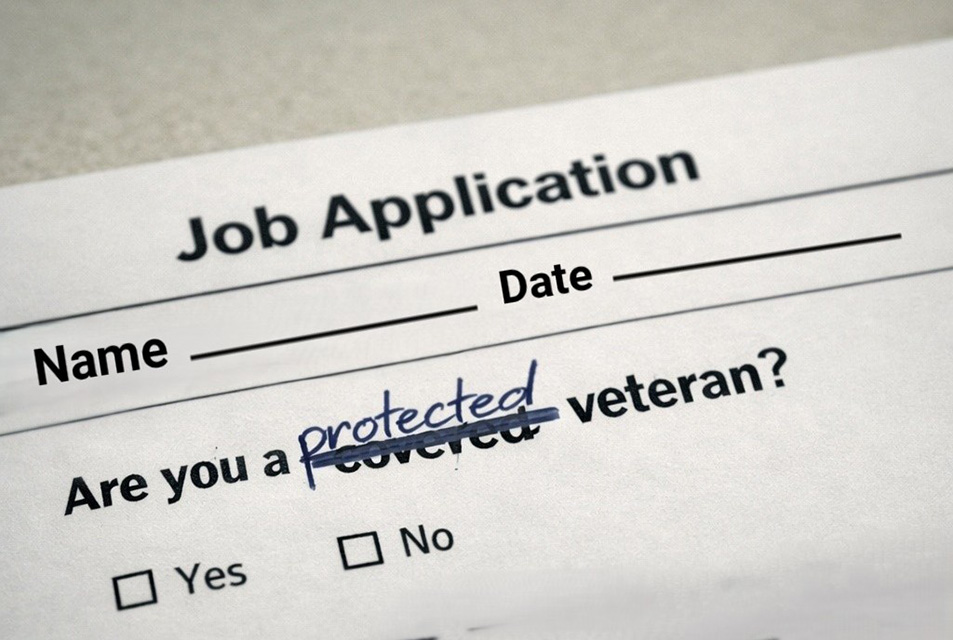
Labor. It has substituted the words "protected veterans" for the statutory
words "covered veterans" in its regulation and procedures.
The Department of Labor's regulation
and procedures
The very first sentence of the
Department of Labor's regulation implementing VEVRAA, 41 C.F.R. § 60-300.1,
completely misstates the statute and is misleading to both veterans and
employers. It states that VEVRAA "prohibits discrimination against protected
veterans." Note that the statute does not contain the words "discrimination" or
"protected."
There's a huge difference between
a statute mandating affirmative action to employ "covered" veterans and a
regulation that prohibits "discrimination" against "protected" veterans.
Why the regulation and procedures
make a difference
There are several reasons why the
Department of Labor's wrong and misleading regulation and procedures harm
veterans, including:
1. Employers are not applying the
statute
The Department of Labor's language
change from the VEVRAA statute to its regulation has obviously confused
employers. The agency's language also provides cover for employers who do not
follow VEVRAA because it puts the federal contractor in the position of simply
passing the misinformation of the Department of Labor on to the veteran
applying for a job.
Let's look at the job application
language of a few federal contract employers.
Meta
"Information will be kept
confidential, used only for legitimate business purposes, and will never be
used in making any employment decisions.
Indicate your Protected Veteran
Status:
• I identify as one or more of the
classifications of protected veteran listed
• Other
veteran
• I am not a protected veteran
• I choose not to disclose."
It is
clear that Meta is following the defective regulation and not the
statute in its use of the word "protected" instead of "covered." Also, Meta's
use of the category "Other veteran" is confounding. Who knows what that means?
And for Meta to say the
applicant's veteran status "will never be used in making any employment
decisions" is clearly contrary to the statutory intent of VEVRAA, which is that
federal contract employers must use the applicant's veteran status in making employment
decisions. That is, federal contractors are supposed to take affirmative action
to hire qualified veterans.
Lockheed Martin
"Protected Veteran
• I AM NOT A PROTECTED VETERAN/I
PREFER NOT TO ANSWER
• I IDENTIFY AS ONE OR MORE OF THE
CLASSIFICATIONS OF PROTECTED VETERAN LISTED ABOVE."
Once again, it is clear the
employer is following the incorrect language of the regulation and not the
statute. As noted, the word "protected" does not appear in VEVRAA.
Booze Allen
As one of its self-identifying
choices, this employer provides: "I am not a veteran, protected or otherwise."
This employer also uses the
non-statutory language "protected" preferred by the Department of Labor over
the statutory language "covered."
2. Both government workers
drafting federal contracts and veterans seeking jobs are given the wrong
information in the Labor Department's Sample Invitation to Self-Identify
The Department of Labor provides a
"Sample Invitation to Self-Identify" for veterans applying to work for a
federal contractor. It misleads government workers who prepare federal
contracts on behalf of the government where it states: "VEVRAA requires Government
contractors to take affirmative action to employ and advance in employment
protected veterans." But what VEVRAA actually says is
that federal contracts "shall contain a provision requiring that the party
contracting with the United States take affirmative action to employ and
advance in employment qualified covered veterans." By eliminating the
responsibility for federal government workers to make sure all federal
contracts contain such a provision, this procedure relieves government workers
of their mandate to make sure veterans are given their rights under VEVRAA.
As to veterans trying to land a
job, the "Sample Invitation to Self-Identify," provided to employers to copy
and use, gives the following choices to veterans when filling out a job
application:
[ ] I
IDENTIFY AS ONE OR MORE OF THE CLASSIFICATIONS OF PROTECTED VETERAN LISTED
BELOW
[ ] I
AM NOT A PROTECTED VETERAN
[ ] I
DO NOT WISH TO ANSWER
Note that the questions do not ask
anything about a "covered" veteran. This change of language from "covered" in
the statute to the Department of Labor's preferred language of "protected"
leaves a lot of room for a veteran applying for a job with a federal contract
employer to assume the veteran must be disabled or discriminated against in order to qualify under VEVRAA. In fact, any veteran who
served during a war, campaign or expedition or who separated from the military
within the previous three years is covered under VEVRAA.
3. While not clear, there is
probably no right to sue
Should a veteran want to sue an
employer for not following VEVRAA, the veteran would probably not succeed,
making it all the more important that the Department
of Labor's regulation and procedures accurately reflect what Congress intended
in the statute.
The VEVRAA statute contains an
administrative remedy in 38 U.S.C. § 4212 (b). Courts are dismissing cases
wherein a veteran contends an employer did not follow VEVRAA, finding veterans
do not have a right to sue under the statute and are limited to making an
administrative claim through the Department of Labor.
A federal circuit court affirmed
dismissal of a veteran's suit under VEVRAA because the statute contains an
administrative remedy in Matula v. Lower Colorado River Authority, 134
F. app'x 715, 716 (5th Cir. 2005). In an
unpublished opinion, the 4th Circuit came to the same conclusion in Armstrong
v. Rolm A. Siemans Co.,
No. 97-1222, 1997 WL 705376.
To exacerbate the problems a veteran faces when trying to claim statutory rights, the
Department of Labor's website creates barriers to even begin an administrative complaint under VEVRAA. The website states:
"You must file your complaint . . . of the employer action(s) that you
think were either discrimination or intimidation and interference." Such
language is completely inapplicable to a veteran who was denied the affirmative
action in hiring. Besides, how is the veteran supposed to know who the company
hires?
An even greater barrier is that
the administrative remedy leaves it up to the Department of Labor to pursue a
veteran's cause. It is highly unlikely the Department of Labor would fight for
a veteran and against an employer who followed the agency's own deficient
regulation and procedures. Plus, the Department of Labor limits its battles to
discrimination claims.
To top that off, there is no
procedure for a veteran to make a claim against the federal agency entering into a contract with a federal contractor, even when
that contract may lack the affirmative action part of VEVRAA. The Department of
Labor only pursues claims against those who contract with the government, not
those who contract on behalf of the government.
Worse yet, when the Secretary of
Labor foregoes an enforcement action on behalf of a veteran, the veteran
usually has no right to judicial review of the agency's decision. 806 F.2d 1402
Conclusion
VEVRAA is supposed to require
government contractors to take affirmative action to hire qualified veterans. But
the statute's requirement is circumvented by the Department of Labor's
substituted-language regulation. The
regulation implies that the main purpose of VEVRAA is to protect certain
veterans from discrimination, which would mean that employers are in compliance with VEVRAA even if they never hire
qualified veterans so long as they don't discriminate against veterans.
The regulation, 41 C.F.R. §
60-300.1, was enacted in 2013 and cites three sources as its authority: 29
U.S.C. § 793 (Employment under Federal Contracts, which deals with persons with
disabilities and is part of the Rehabilitation Act of 1973); Exec. Order No.
11758 (Delegating Authority of the President Under the Rehabilitation Act of
1973); and VEVRAA.
By grouping all veterans with
disabled persons and persons in rehabilitation, it seems obvious why the agency
opted to use the word "protected" instead of the statutory word "covered." But
the two words have entirely different connotations. Webster says "covered"
means being included with a group with respect to which a particular contract
or agreement is in force. The same dictionary says "protected" means guarded or
shielded to prevent accidental contact or injury.
Instead of simply setting forth a
specific regulation for affirmative action in hiring veterans pursuant to
VEVRAA, the Department of Labor tried to pigeon-hole too much into a single
regulation. The result of cramming excessive sources into one regulation is
that all involved, especially veterans, are misled with
regard to veterans' rights under VEVRAA.
This critique of the actions of
the Department of Labor assumes its rule-makers read the statute before setting
forth a regulation to implement VEVRAA. However, its summary of the final rule
creates doubt anyone ever actually read the statute. It falsely states VEVRAA
prohibits employment discrimination against protected veterans. 41 CFR
Parts 60-250 and 60-300, RIN 1250-AA00
Whether or not anyone from the
Department of Labor read the statute before creating a regulation and
procedures to implement VEVRAA, the end result is that
veterans are not getting the affirmative action to which they are entitled.
Congress should toss the
Department of Labor's regulation and procedures, and while it's at it, take a
close look at VEVRAA. One suggestion is that Congress define a veteran in the
way the Veterans Justice Commission recommends for the definition of a veteran:
"A military 'veteran' is defined as a person who: [] Swore an oath and entered
into any branch of the Armed Forces, including the National Guard or Reserve;
and . . . was discharged or released from such service under any
characterization of discharge that was not a dishonorable discharge, unless the
individual receiving the dishonorable discharge has been diagnosed with
Substance Use Disorder, Military Sexual Trauma, Traumatic Brain Injury,
Post-Traumatic Stress Disorder, or a mental health condition."
Submit your own column for publication to Diana Bosetti
For reprint rights or to order a copy of your photo:
Email
Jeremy_Ellis@dailyjournal.com
for prices.
Direct dial: 213-229-5424
Send a letter to the editor:
Email: letters@dailyjournal.com