


Judges and Judiciary,
Construction
Sep. 25, 2017
Court construction projects face cutbacks, criticism
The state would need to identify $1.8 billion in funding to finish 17 pending courthouse construction projects.


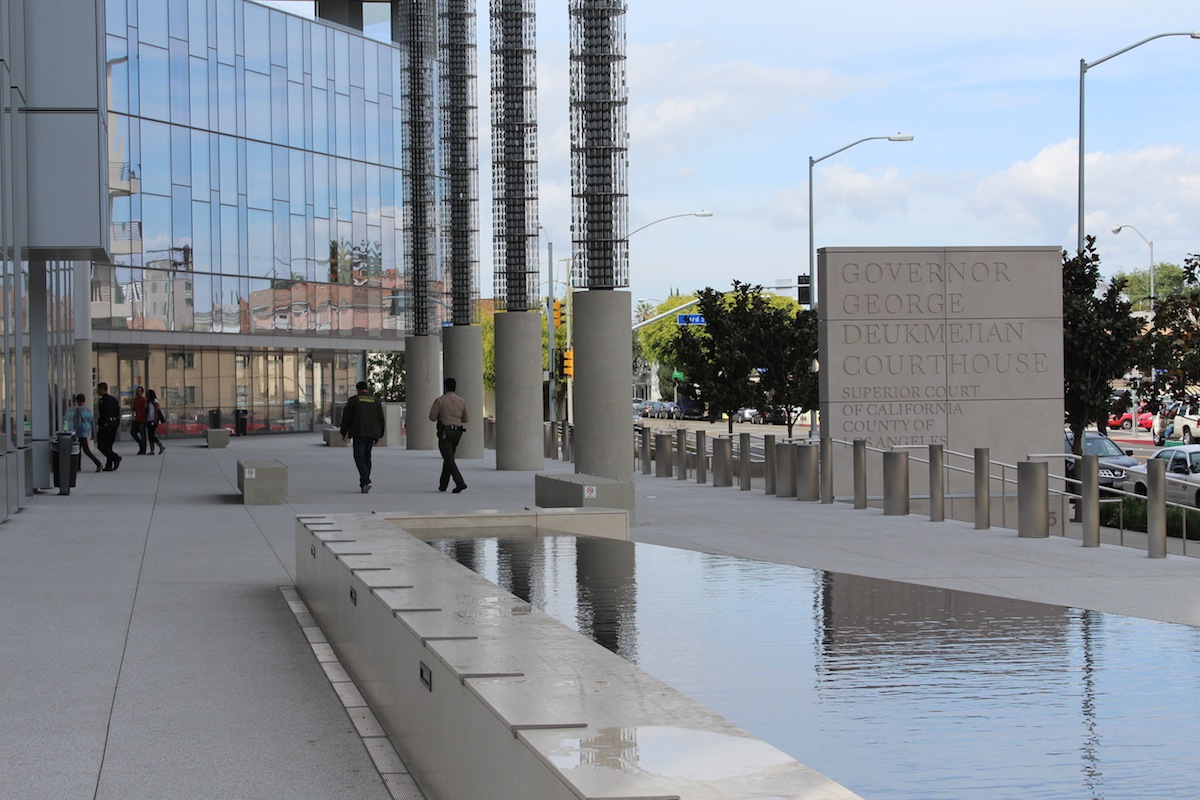
The $490 million courthouse in Long Beach is accessorized with amenities such as a white noise machine for sidebars. In San Jose, the new $233 million courtroom is fitted with Grecian-style columns. And more than half a billion dollars will be spent on the colossal new courthouse in San Diego — the most expensive in the state’s history — which has not yet opened due to delays.
Those are a few of the 29 courthouses built in California over the last 15 years.
Seventeen courthouses are under construction statewide, but they are suspended in various phases of construction as $1.8 billion in funding needs to be identified to finish them, according to the Judicial Council. An additional 10 projects totaling $723.4 million have been indefinitely delayed because of unavailable funds.
Proponents said the explosion of construction over the last decade is a much-needed facelift for the state’s court system, replacing rundown, crowded courthouses and ensuring access to justice. But critics, who are unable to reconcile lavish new multi-million dollar courthouses alongside slashed court services, argue the magnitude of construction is an unnecessary burden the state cannot afford.
San Diego’s new 71-room, 22-story courthouse, has a tab of $555.4 million. Counting only the construction costs, it comes to $606.98 per square foot, under the statewide average of $630.11. Using total costs, the court cost $789 per square foot, still below the average total square foot cost of $884.
It doesn’t have padded jury chairs like the old court, but it’s equipped with an automated system that plays pre-recorded predatory bird calls to keep pigeons and sparrows from defecating on the building. .
“It is an arresting experience to walk by this empty monolithic building and hear the cries of eagles and hawks,” said Dan Lawton of the Lawton Law Firm, whose office is near the new courthouse.
The court’s opening has been delayed twice since its scheduled February launch date, most recently because of a fire system inspection. The court is hoping to receive a certificate of occupancy soon.
Meanwhile, San Diego County Superior Court is eliminating more than 67 positions to meet its budget, including voluntary separation agreements with upper management and commissioners.
Three courts will close, including the Central Courthouse, the Family Law Courthouse and the Madge Bradley Courthouse, which will be consolidated with the new downtown building.
“The attorneys I’ve talked to that practice criminal law and family law have said the existing buildings are decrepit and dated and have problems,” said Lawton. “The question that arises is whether the mammoth cost of this project will deliver the benefits that have been promised by Judicial Council and the principal architect,” he said.
Other recent cuts to services include a Tulare County pretrial facility reducing its courtroom hours by an hour each day. Opened in 2013, the new court in Porterville consists of 100,000-square-feet, costing $93.3 million.
Likewise, Stanislaus County, where a new $262 million Modesto courthouse has no money beyond its preliminary plans, this summer reduced its service hours for its public windows, the Judicial Council said. In Siskiyou County, public service hours for its service window have also been reduced. A $66 million planned courthouse frozen in its drawing phase is to be built there, the Judicial Council said.Justice Jeffrey Johnson of the 2nd District Court of Appeal, who chairs a courthouse construction reduction committee, said building and cutting back are separate issues.
“You can’t confuse the need for viable courthouses with decisions made by individual courts where they have multiple courts in the area,” said Johnson, citing decisions to reduce security or public services.
“Those are local decisions made by the courts. When we make our decisions, we look at courts that are in operation, if they are accessible,” Johnson said.
There have been architectural follies in other courtrooms. A $147.5 million court in Alameda County has elicited complaints that attorneys inside interview rooms couldn’t hear clients through the glass.
Long Beach’s 531,000-square-foot complex has 31 courtrooms spread over 416,000 square feet, averaging about $15.8 million per courtroom in total costs. Its total cost per square foot is about $1,178, including construction, finance and maintenance expenses.
San Bernardino County has also been hit with long lines and reduced staff. This summer, the once-shuttered Needles courthouse, which serviced remote citizens in the Mojave Desert, has reopened with limited service once a month. That is not enough, court observers said.
San Diego County Superior Court Judge Runston Maino , a critic of courthouse construction across the state, said the government overestimated the price of many projects. “I think the Judicial Council and AOC [Administrative Office of the Courts] have demonstrated incompetence now for about a decade,” he said.
But the Judicial Council says its hands became tied when the state skimmed $1.4 billion designated for court construction to help plug budget shortfalls during the recession. A slow-moving plan beginning in 2003 to approve 40 new projects in 34 counties coincided with the largest economic downturn since the Great Depression of the 1930s.
The Judicial Council took responsibility for court construction in 2002 and then built a majority of the 29 courtrooms after 2008 with funding from two bills, SB1732 and SB14078.Around the time of the September 2008 financial collapse, SB1407 was signed into law, launching a courthouse rebuilding program the likes of which the state had never seen before. It authorized $5 billion in lease-revenue bonds with the intention that they would be paid by some court fines and fees. The bill was estimated to generate $275 million annually to pay for the program but the statewide fiscal crisis caused construction to be delayed and canceled, the Judicial Council said.
Almost all of the initial construction funding was authorized during the height of the recession, in fiscal year 2009-10. No new courthouse construction has been provided in fiscal years 2016-17 and 2017-18, the Judicial Council said.
“It’s like telling my wife we’re going to Spain next year and Ireland the year after that, but then we have no money at all to do this,” said Maino.
In response to the economic downturn, the Judicial Council canceled two projects, delayed seven, and initiated cost reductions. The Legislature directed courthouse construction funds to pay for the courthouse in Long Beach, rather than money from the state’s general fund as originally planned, the Judicial Council said. Four more projects were delayed as a result, the council said.
Johnson, chair of the court reduction committee, said, “The government and Legislature recognized the need for these buildings. We expect the money will be allocated to complete the projects. $1.4 billion were swept from our projects in order to balance the state budget. That hasn’t been replaced,” said Johnson, who argues the court costs, adjusted for inflation, are in line with the state average.
Since the forming of the subcommittee in 2011, the council said it has saved $324 million in construction costs.
The Judicial Council continues “to advocate for adequate funding for maintaining and constructing necessary facilities to ensure the public has safe and secure access to the court system,” Blaine Corren, spokesman for the Judicial Council, wrote in an email.
In the meantime, case filings have decreased, though not the overall workload, as high-workload cases have gone up over the last several years, affecting the amount of court fees collected, Corren said. Traffic fines have also gone down, and over the past seven years, revenues from the state’s Immediate and Critical Needs Account have gone down almost 23 percent, Corren said.
Asked how the court reconciles new courthouses being built during a time of simultaneous cuts to court staff and services, the Judicial Council said in an email: “Funding for court construction and court operations come from different state funding sources. For example, SB 1407 was designed to funnel a portion of court fines and fees collected specifically to fund new courthouse construction projects. Court operations and safe, secure, and accessible courthouses are both essential for access to justice and the delivery of essential court services. Court users and court staff should be able to conduct their business in safe, secure, and accessible courthouses.”
Justin Kloczko
justin_kloczko@dailyjournal.com
For reprint rights or to order a copy of your photo:
Email
Jeremy_Ellis@dailyjournal.com
for prices.
Direct dial: 213-229-5424
Send a letter to the editor:
Email: letters@dailyjournal.com