


Jul. 21, 2025
Service before self: Marine turned attorney champions the underrepresented
See more on Service before self: Marine turned attorney champions the underrepresented


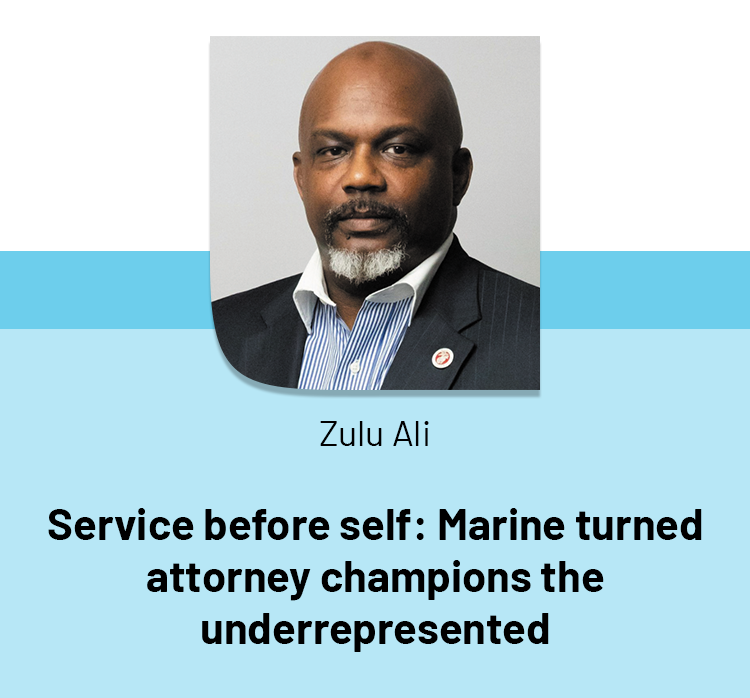
When Zulu Ali decided to become a lawyer, he had already lived several careers. The Tennessee native had served four years on active duty in the Marine Corps, spent more than a decade as a police officer, and raised four children.
Ali established the Law Offices of Zulu Ali in 2007, immediately after passing the California bar exam.
"I always wanted to be a business owner to begin with. I just felt like it has always been something that's really important to me. Entrepreneurship was just as important to me as actually being an attorney," he explained.
The firm focuses on criminal defense, immigration law, and civil litigation--practice areas Ali chose based on community need and personal experience. His background as a police officer from 1989 to 2000 gives him unique insight into the criminal justice system, while his Muslim faith connects him to immigrant communities seeking legal help.
"I think it's one of the areas that a lot of people within my community need representation, especially with the disparity among African Americans who are ultimately convicted of crimes," he said. "My prior career, I was a police officer for some time, so I knew how the system worked ... within the Muslim community, there's a lot of immigrants, obviously, and that got me interested in that area, because I felt that that was something that I could do that would be of assistance to people within my religious community."
Ali's military discipline shapes his approach to practice. He joined the Army Reserves at 17, completing basic training the summer after his junior year of high school. After graduating, he switched to the Marine Corps, enduring basic training twice in consecutive summers.
"Having that kind of background shaped my personality. I'm pretty disciplined, and I believe in dotting the i's and crossing the t's and I'm pretty serious about what I'm doing," he said.
Ali's motivation to become an attorney traces back to his grandfather's respect for prominent Black civil rights attorneys, sparking an early desire to change the world through law.
"I thought at that young age that that's really what I wanted to do. I wanted to change the world," he said. "And at six or seven years old, you really feel that you can do that."
The firm has grown steadily since 2007, starting with Ali's oldest daughter as his assistant. Within six months, he began hiring legal assistants, and after about a year, brought on additional attorneys. His daughter remains with the firm.
Running a Black law firm comes with unique challenges that Ali says haven't diminished over time. He believes African American attorneys face heightened scrutiny from courts, opposing counsel, and licensing agencies--a reality supported by statistics showing Black attorneys are targeted for disciplinary action at higher than their white counterparts.
"I think there's a lot more scrutiny, I believe, that you have to deal with when you're running a Black law firm in comparison to other firms," Ali said.
Ali operates a mentorship organization called the Stop and Frisk Academy and regularly speaks to young people about pursuing legal careers. His advice centers on service over profit.
"I see myself as a social entrepreneur, being that I feel that I'm in this for the purpose of benefiting my community, as well as anyone else that's unrepresented," he said. "I encourage someone getting into the profession to focus more on how you can benefit society and how you can give to society, as opposed to making the money."
"Every day you get a chance to really touch somebody and help them," he said. "Whether you're helping an immigrant to be with their family, or a guy who has been in prison come home to his family, or somebody who's wronged civilly--every day, you get a chance to really touch somebody and help them."
For reprint rights or to order a copy of your photo:
Email
Jeremy_Ellis@dailyjournal.com
for prices.
Direct dial: 213-229-5424
Send a letter to the editor:
Email: letters@dailyjournal.com