


Dec. 3, 2025
A decade after San Bernardino: A reporter reflects on the day violence hit home
The San Bernardino terrorist attack on Dec. 2, 2015 left 14 dead and shattered the sense of safety in the Inland Empire. Daily Journal reporter and former Army soldier Douglas Saunders reflects on the harrowing hours he spent inside the police perimeter -- and how the tragedy blurred the lines between battlefield instincts and journalistic duty.


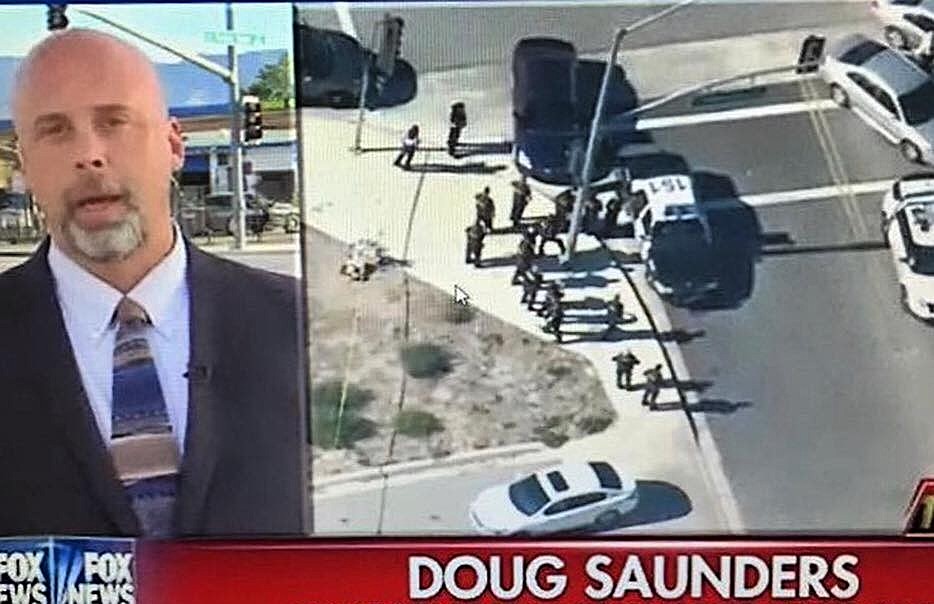
Ten years after the San Bernardino terror attack -- still one of California's deadliest mass shootings and the deadliest act of terrorism on U.S. soil since 9/11 -- the images remain sharp.
As a reporter and former Army soldier who served in Iraq, I thought I understood violence. But the chaos in that Inland Regional Center parking lot on Dec. 2, 2015, felt alarmingly familiar -- a scene that echoed the urgency and uncertainty of a battlefield.
The first alert hit the scanner just before 11 a.m.: Active shooter. Multiple victims. Inland Regional Center. Roughly 80 San Bernardino County Public Health employees were inside for a holiday training event when the gunfire began. Investigators would later say the attackers -- Syed Rizwan Farook and Tashfeen Malik -- unleashed between 65 and 75 rounds and left behind a trio of pipe bombs rigged to a remote control. The explosives failed to detonate.
When that first call went out, I felt something I hadn't felt since Iraq: my body bracing before my mind caught up.
I reached the scene within minutes -- fast enough that a police sergeant waved me through seconds before the yellow tape went up, sealing off what remained an active and volatile situation. For a time, I was the only reporter inside the perimeter.
I reached a warehouse across from the north parking lot and watched from the second floor, with a bird's-eye view as the response unfolded. Officers took cover behind vehicles in the north lot. Armored rescue vehicles moved into position. A Sheriff's Department helicopter circled overhead while two snipers trained on the IRC.
Survivors emerged with their hands raised, escorted by officers moving with a focused urgency I hadn't seen since clearing buildings in Mosul. But here, the civilians weren't just nearby -- they were the targets.
The immediate police response would later be cited as a model of how agencies must act to save lives during mass-casualty attacks. But in that moment, none of that felt certain.
Covering the attack became an exercise in double vision. The soldier in me recognized the patterns: perimeter control, search grids, intelligence scramble, the long wait for casualty numbers. The journalist in me had to translate those patterns into clear, accountable reporting. And layered beneath both was the civilian I had been trying to become -- the one who believed mass violence was something fought "over there," not here at home.
By the time the shooting stopped, 14 people were dead. At least 22 others were wounded, several critically. Hours later, the suspects were killed in a rolling gun battle with police on a residential street in San Bernardino. Their SUV was riddled with bullets; an officer was wounded but survived.
Investigators later uncovered a stockpile of weapons, thousands of rounds of ammunition and additional improvised explosive devices inside the couple's Redlands apartment -- a cache that federal agents said demonstrated extensive preparation and confirmed the attack was the product of deliberate planning, not a spontaneous eruption of violence.
In the months that followed, the investigation widened beyond the two assailants. Federal agents arrested Enrique Marquez Jr., the friend who had purchased the rifles used in the attack. Marquez admitted he acted as a straw buyer and had discussed violent plots with one of the shooters years earlier. He eventually pleaded guilty to providing material support to terrorists and to making false statements in connection with the gun purchases.
The case revealed how much planning had gone into the attack. Prosecutors detailed Marquez's role, the weapons he supplied, and the earlier aborted plots he acknowledged. In 2020, he was sentenced to 20 years in federal prison -- the most significant criminal penalty tied to the attack, and a reminder that accountability extended beyond the gunmen killed in the police shootout.
Investigators also uncovered a related immigration-fraud scheme involving a sham marriage connected to the shooters' extended circle. Three people, including one of the gunman's brothers, pleaded guilty to federal charges. While their crimes weren't tied to the attack itself, the convictions underscored how deeply investigators probed the network surrounding the couple as they worked to close every unresolved thread in the case.
Some memories from those first days never blurred: sleepless nights verifying information; first responders stunned by the carnage inflicted by warped ideology; the chilling quiet that settles over a crime scene after gunfire -- a silence that mirrors the ones I remember from Iraq.
A decade later, the nation has moved on to new crises. But for those who were there, some images do not fade. From a distance, terror is measured in tallies -- casualties, armaments, failures in systems. Up close, it becomes personal: one name, one family, one empty chair.
People often ask whether covering San Bernardino pulled me back into combat memories. The truth is more complicated. It didn't take me back. It brought something forward. It forced me to confront how much conflict had shaped me -- and how journalism asks you to return to conflict again and again with no armor except the responsibility to keep writing.
Ten years later, I still believe the law offers structure, accountability, and an imperfect path to justice. But the law cannot measure the psychological distance between a soldier's past and a journalist's present. For me, the San Bernardino attack sits squarely in that narrow space, where two lives collided with unmistakable clarity.
I carry it still -- not because I want to, but because witnessing violence, even in the service of truth, changes a person. The uniform taught me duty. The notebook taught me responsibility. San Bernardino taught me how thin the line can be between a war zone and a hometown.
And that lesson, a decade later, is still the one I write from.
Douglas Saunders Sr.
douglas_saunders@dailyjournal.com
For reprint rights or to order a copy of your photo:
Email
Jeremy_Ellis@dailyjournal.com
for prices.
Direct dial: 213-229-5424
Send a letter to the editor:
Email: letters@dailyjournal.com