


Family
Dec. 9, 2025
Four holidays, one nation: How America builds belonging
From Halloween to New Year's, America's four major holidays form a deliberate cultural scaffold that lifts a diverse nation from welcoming strangers to honoring survival, strengthening intimate bonds, and finally embracing future possibility.


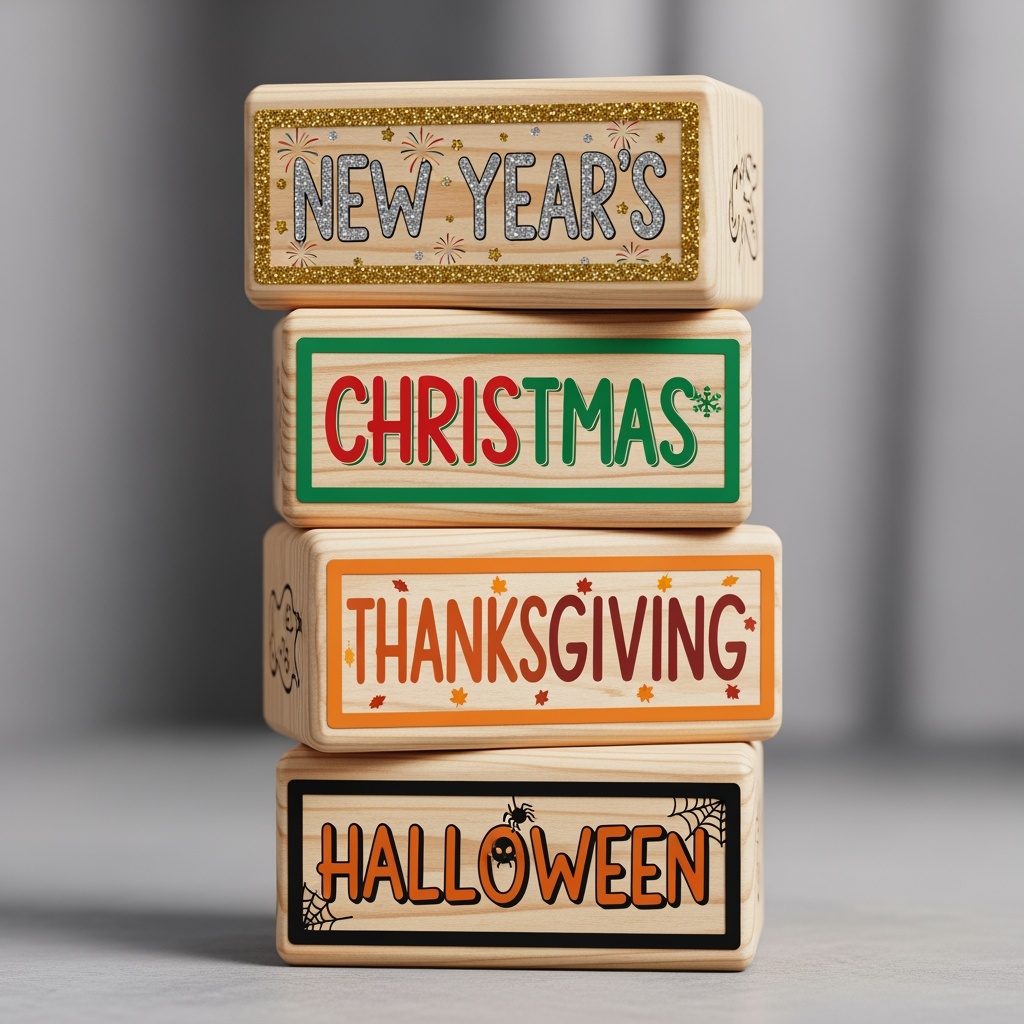
"Holiday Season" is not a random sequence of celebrations. It is a cultural column -- four events stacked vertically, each standing on the shoulders of the one before it. From Halloween to New Year's, America climbs from the unknown to the familiar, from gratitude to intimacy, and finally to aspiration. Together, these events reveal how a nation of immigrants creates unity without a shared past: by building upward.
At each level, the country invites people who do not share bloodline, language, or religion to share something else instead: time. The sequence functions like a carefully staged ascent -- first opening the door to strangers, then pausing to honor survival, then gathering loved ones closer, and finally stepping into the future with intention. It is through this rhythm, more than through any single myth or text, that the New World quietly teaches belonging.
Halloween
Halloween began as the Celtic festival of Samhain
in ancient Ireland and Scotland. It marked the threshold between harvest and
winter, between the living and the dead. Masks, bonfires and ritual protections
were tools for confronting fear and uncertainty. Ancient Zoroastrian rituals
such as Frawardigan (Farvardegan) honored the spirits of the departed. Families
lit fires and welcomed ancestral souls, mirroring Halloween's core theme of the
boundary between worlds temporarily thinning. In that Old World setting, the
night was about managing fear, not entertainment. Communities responded to long
winters, fragile crops and unexplained losses by telling stories and creating
rituals that gave shape to the unknown.
It arrived in the United States in the 19th century. Here, the holiday slid from solemnity to playfulness. Fear became fun. Masks became costumes. Instead of warding off spirits, children knocked on doors for candy. In the American melting pot, that serious edge faded. Post‑war suburbs in particular turned Halloween into a kind of informal civics lesson: if a child approaches your home in costume, you answer with welcome. The old fear of spirits was replaced by an expectation of generosity and a public rehearsal of neighborhood trust.
Today, Halloween is the most inclusive holiday in America. It requires no belief or ancestry -- only participation. Immigrant families especially embrace the ritual of opening the door to unfamiliar neighbors. In our family courts, Halloween disputes reflect belonging, not theology.
For many newly arrived families, that single evening of knocking on doors and being cheerfully received is their first lived experience of social inclusion. Photographs of costumes and overflowing candy bags become proof that the child is woven into the neighborhood. When disputes reach family court, parents sometimes point to Halloween -- who went where, with whom, and who was seen -- as evidence of connection or exclusion.
Thanksgiving
Rooted in European harvest traditions and the 1621 meeting
between settlers and the Wampanoag, Thanksgiving began as a ritual of gratitude
for survival. Its meaning was simple: we made it through another year. The
historical record, especially from Indigenous perspectives, is far more complex
than the simplified schoolbook story. Yet beneath the politics lies a familiar
human impulse: to pause at the edge of hardship and say, at least for this
season, that there is enough to continue. Thanksgiving captured that fragile
passage from scarcity toward "enough."
By the 19th century, Thanksgiving evolved into a secular national holiday. Lincoln recognized it as a unifying pause during the Civil War. Immigrants adopted it because it demanded no creed -- only recognition of the passing year. By transforming Thanksgiving into a national, largely secular observance, the United States offered newcomers a ready‑made moment to mark their own survival. A first Thanksgiving in America often coincides with a first steady job, a first modest apartment, or the first time a family can host others. It becomes a quiet milestone: we are still here, and we are beginning to belong.
Modern Thanksgiving reflects the diversity of American homes. For those who arrived with little more than survival in mind, it transformed a vague, often whimsical idea of a dreamed future into something concrete and repeatable gathered around a real table, at a fixed time, with others doing the same. Iranian families serve baghaleh polo. Mexican-American households add tamales. Filipino families bring lechon. Advertisers now promote lamb, halal poultry, and global dishes under slogans like "however you gather." The dish changes. The meaning does not. Thanksgiving honored the act of building. It celebrated the construction of a pyramid of hope above an iceberg of hardship.
Christmas
Christmas originated as a Christian holy day
layered onto older winter-solstice festivals. For centuries, it was tied to
doctrine, symbol and sacred ritual. Across Europe, that narrative was
reinforced through church liturgy, nativity scenes, hymns and family customs.
The date on the calendar pointed back to a specific account of divine action in
history, and the holiday's authority flowed from that sacred storyline. The
winter solstice festival Yalda Night (Shab‑e
Yalda), rooted in Zoroastrian belief, marked the rebirth of light after the
longest night. Families welcomed the victory of brightness over darkness -- a theme later echoed in Christmas's symbolism of renewal and hope.
In America, Christmas softened. Commercial culture -- most famously Coca-Cola's Santa -- turned it into a secular symbol of joy, reunion and generosity. As these practices entered the American melting pot, they met a society formally committed to religious freedom and increasingly shaped by commerce. The result was a hybrid season that borrowed imagery from Christianity, logistics from industrial work schedules and sentiment from advertising campaigns.
For many immigrant families, Christmas is cultural rather than religious. Trees without churches. Gifts without creed. Travel because the country has paused. Courts see Christmas disputes not as theological battles but as scheduling conflicts. Christmas now stands for connection more than faith. In many households today, the negotiation is no longer about orthodoxy but about children's expectations -- trees, lights, photographs and presents. Interfaith and nonreligious parents often agree to maintain the outward ritual while privately holding different beliefs. When Christmas appears in litigation, it typically does so as a test of flexibility and respect: can the adults share the season in a way that keeps the child connected to both sides of the family?
New Year's
Every society marks a new year. Rituals such as Nowruz (Iran), Lunar New Year (China), or Rosh Hashanah (Judaism) tied the turning of the year to the turning of the heavens, to agricultural cycles and to ancestral memory. Marking the new year correctly is a way of staying in alignment with a universe assumed to be ordered and continuous. Among Iranians, the ritual of Chaharshanbe Suri (fire-jumping before Nowruz) or Haft-Seen (collecting seven fruits/vegetables beginning with S) reinforced continuity--heritage, memory, cosmic cycles.
The United States followed Britain and other Western nations in recognizing Jan. 1 as the start of the civic year after the shift to the Gregorian calendar in the 18th century. It arrived largely stripped of sacred history, which made it an ideal container for a different emphasis: not continuity, but possibility. For immigrants, that apparently neutral date quickly aligned with private timelines: the year a degree would finally be completed, a business opened, status secured, or a long‑deferred case filed. Jan. 1 became a civic permission slip to imagine a different version of oneself without betraying where one came from.
Reinvention, not repetition, defines the holiday. Modern New Year's celebrations emphasize fresh starts. Families celebrate possibility. Courts see new calendars, filings, new plans, new directions. The American New Year is an invitation to motion, not memory. The jokes about resolutions that never accomplish only underscore how widely shared this hope has become. Beneath the humor lies a stubborn belief that the next layer of life has not yet been poured and that, at least once a year, people are entitled to try again.
Conclusion
From a bird's eye view, the four-holiday scaffold reveals a cultural truth: America builds forward, not backward. Old World societies stand on the iceberg -- deep, inherited, immovable. The New World builds a pyramid -- visible, participatory, rising toward hope.
Halloween welcomes the unknown. It trains a nation of immigrants to open the door to strangers without surrendering caution or dignity, laying the first stone of social trust. Thanksgiving honors survival. It pauses the rush of life long enough for families to reinterpret hardship as progress and to see their own story reflected, however faintly, in the larger national narrative. Christmas strengthens bonds. It draws the circle closer, emphasizing presence over perfection and connection over creed. New Year's opens the future. It offers a sanctioned moment to leave certain burdens behind and to step, however cautiously, into something new. For immigrants and natives alike, it whispers the same promise: you are not entirely trapped by your past.
Together, they create a cultural architecture that lifts a diverse nation from the weight of the past to the promise of tomorrow -- one holiday at a time.
Submit your own column for publication to Diana Bosetti
For reprint rights or to order a copy of your photo:
Email
Jeremy_Ellis@dailyjournal.com
for prices.
Direct dial: 213-229-5424
Send a letter to the editor:
Email: letters@dailyjournal.com