


Litigation & Arbitration
Dec. 12, 2025
The Federal Arbitration Act at 100: An opportunity for reform?
This year marks the 100th anniversary of the Federal Arbitration Act, a cornerstone of American arbitration that has remained largely unchanged since 1925, offering a moment to reflect on its enduring influence and whether U.S. arbitration law should be updated to keep pace with global reforms and evolving best practices.


Hiro N. Aragaki
Hiro N. Aragaki, Esq., J.D., Ph.D, C.Arb, serves as a U.S. and international arbitrator and mediator at JAMS. He has over two decades of experience, having been appointed in more than 300 disputes and practiced at top global law firms prior to joining JAMS. He also holds a tenured professorship at the University of California College of Law, San Francisco, where he teaches arbitration and dispute resolution and serves as faculty director of its Center for Negotiation & Dispute Resolution.
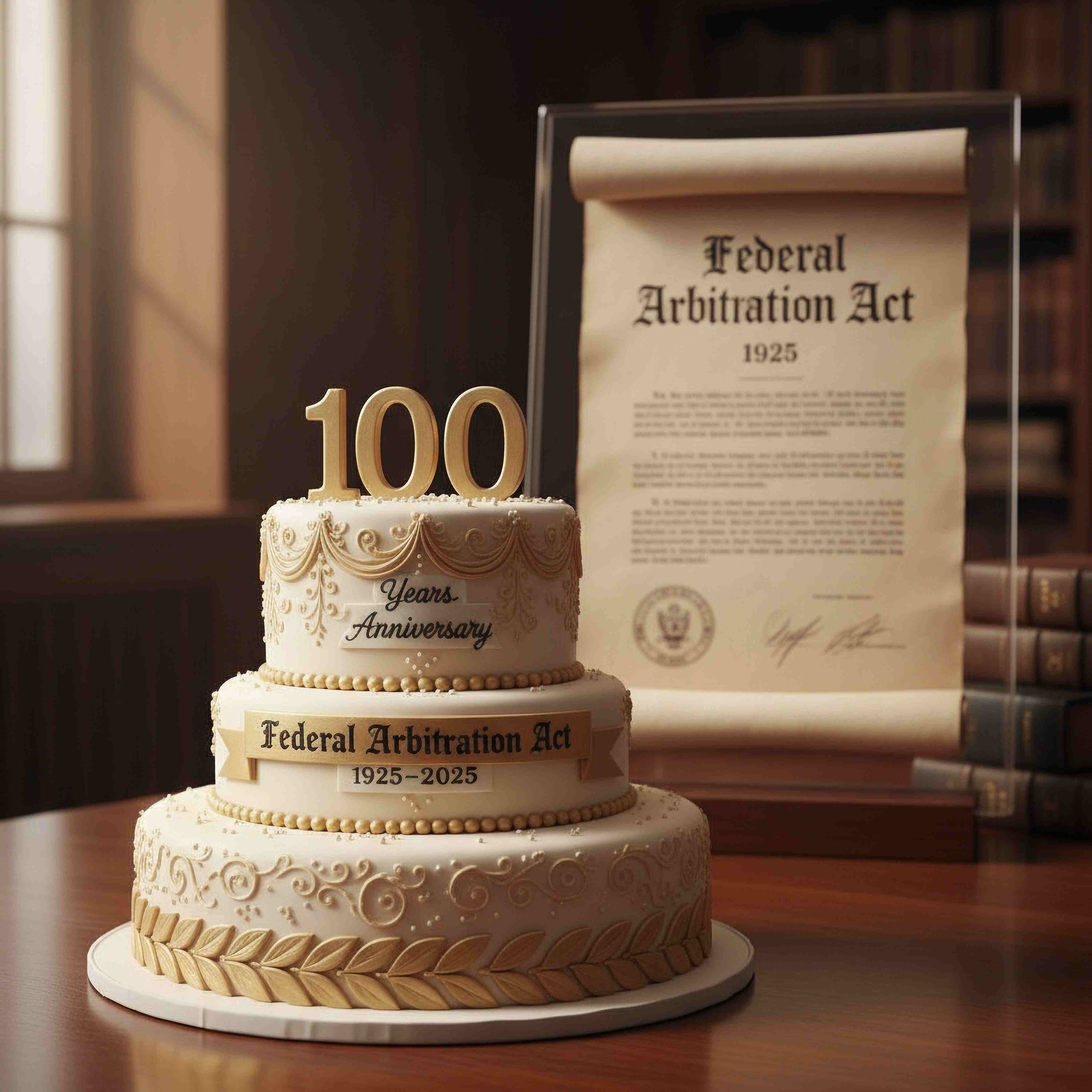
This year marks the 100th anniversary of the Federal
Arbitration Act (FAA). When the statute was enacted in 1925, Calvin Coolidge
was president, the Ford Model T was America's top-selling car and the average
lawyer drafted contracts with a fountain pen. A century later, that same
statute still forms the backbone of American arbitration practice: It governs
everything from complex, cross-border disputes to consumer and employment
cases.
From one perspective, the FAA's longevity is a testament
to its enormous staying power; from another, it is an invitation to consider
whether the U.S. is out of step with international developments.
The third-oldest arbitration act in the world
Most countries have revisited or replaced their
arbitration laws multiple times in the past 100 years. Among the 192 or so
national arbitration acts that I have looked at, the FAA is currently the third
oldest -- surpassed only by Chile's 1865 Code of Commerce (which governs
domestic arbitration--Chile's international arbitration act is of a much newer
vintage) and Eswatini's 1904 Arbitration Act.
Several countries, such as Albania, Greece, Luxembourg,
Japan, Nigeria, Trinidad and Tobago, and the U.K., have amended their
arbitration laws in the last two years. These amendments address issues such as
emergency arbitrators, interim measures, joinder and consolidation and the
realities of digital commerce -- matters that were not on anybody's radar when
the FAA was drafted. Looking just at developed economies, almost all
arbitration acts currently in force were enacted in the mid-1980s or later. And
other than the U.S., each of the G7 countries has replaced or substantially
revised its arbitration statute in the past 40 years.
By contrast, the FAA has never been comprehensively
rewritten. Apart from targeted amendments -- such as those implementing the United
Nations (UN) Convention on the Enforcement of Foreign Arbitral Awards (the New
York Convention) -- it remains substantially the same law Congress passed in
1925.
Should the FAA be updated for the 21st Century?
The statute's centenary certainly seems like an auspicious
moment to pose this question. Although I do not take a position either way, I
suggest that policymakers should at least consider how arbitration law outside
the U.S. has adapted to changing times. Doing so will reveal at least two ways
in which the U.S. has become an outlier over the years.
First, since the 1980s, the U.S. Supreme Court has
interpreted the FAA to apply to nearly all consumer and employment disputes,
subject only to narrow exceptions and case-by-case findings of
unconscionability. But the picture is different in most other countries around
the world. For instance, employment arbitration is outright prohibited in
jurisdictions such as Brazil, Greece, Italy and Germany. The same is true of
consumer arbitration in Bulgaria, Canada, the Czech Republic, the Netherlands
and others. In France, Norway, Poland and Vietnam, arbitration agreements
involving consumers or employees are enforceable, but only if entered after a
dispute has arisen, thus ensuring a measure of knowing consent to arbitration.
In other countries, such as New Zealand, arbitration clauses must still appear
in separate, specially signed documents or disclose explicitly that the
consumer is waiving court rights. In the U.S., by contrast, such limitations at
the state level are routinely struck down as preempted by the FAA.
Second, the FAA predates the 1985 passage of the UN
Commission on International Trade Law's (UNCITRAL) Model Law on International
Commercial Arbitration (the Model Law). The Model Law sought to harmonize
national arbitration statutes and reflect international best practices. For
example, it codifies principles such as kompetenz-kompetenz and
separability, authorizes not just courts but also arbitrators to grant interim
measures, recognizes electronic communications as "writings" and aligns the
grounds for setting aside awards with those for refusing enforcement under the
New York Convention.
Because the FAA is a bare-bones statute that is silent on
many of these issues, case law and institutional rules have been forced to fill
the gaps. This has sometimes created a complex patchwork of doctrines that even
seasoned practitioners struggle to navigate. But there is also a limit to what
can be accomplished through such gap-fillers. For example, although the Model
Law provides for immediate court review of any denial of a challenge to an
arbitrator, the FAA's silence on this topic means that such review can take
place only at the very end of the case, on a motion to vacate. A handful of
U.S. states, including California, Texas and Florida, have passed international
arbitration acts based on the Model Law. But these enactments are of limited
value because they apply only to international arbitrations, over which federal
courts will almost always have subject matter jurisdiction.
Looking to the future
Around the globe, legislators and arbitral institutions
are constantly fine-tuning their systems to make arbitration more transparent,
accessible and globally competitive. For example, in January 2022, the U.K.'s
Law Commission initiated a review of the Arbitration Act 1996, which included
several rounds of reports and public consultations and resulted in amendments
to the act regarding arbitrator disclosures, arbitrator immunity, summary
disposition procedures and emergency arbitrators, among others. In April 2023,
the German Ministry of Justice published a paper outlining 12 proposals for the
reform of German arbitration law, including with respect to arbitration
agreements in electronic form, multiparty arbitrations, publication of awards
and virtual hearings.
Although reasonable minds can disagree about the merits of
these proposed reforms, what is undeniable is that countries around the world
have been engaged in periodic, recent and sometimes ambitious reforms of their
legal frameworks on arbitration. And rather than taking place in a vacuum,
these reforms often look to developments in other countries and to
international best practices.
The FAA's 100th anniversary is not just a milestone -- it's
an opportunity to reflect and take stock. Even if the FAA is best left
untouched for the next century, policymakers and legislators should at least
consider what can be learned from arbitration reform developments around the
world so the U.S. does not risk being left behind.
Disclaimer: The content is intended for general
informational purposes only and should not be construed as legal
advice. If you require legal or professional advice, please contact an
attorney.
Submit your own column for publication to Diana Bosetti
For reprint rights or to order a copy of your photo:
Email
Jeremy_Ellis@dailyjournal.com
for prices.
Direct dial: 213-229-5424
Send a letter to the editor:
Email: letters@dailyjournal.com