


California Supreme Court
Dec. 16, 2025
Two deaths from one act don't equal two strikes, high court rules
The California Supreme Court ruled that a single act of vehicular manslaughter that killed two people cannot be counted as two prior strikes under the Three Strikes law, rejecting a decade-old appellate precedent and ordering resentencing in a DUI case.


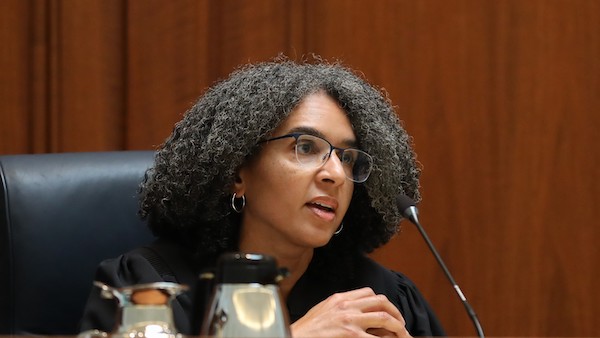
The state Supreme Court ruled Monday that killing two people -- a mother and her young child -- should not count as two strikes under the Three Strikes sentencing law, reversing a 3rd District Court of Appeal panel decision and disapproving a 2015 appellate court precedent.
The question in the case is whether a single criminal act - vehicular manslaughter while intoxicated that killed two people in 2002 - should count as two strikes. Justice Leondra R. Kruger, writing for a unanimous court, said no.
The case involves Troy Lee Shaw, whose conviction for driving under the influence in 2020 counted as a third strike, meaning he was sentenced to 25 years to life.
3rd District Court of Appeal Justice Stacy Boulware Eurie affirmed the sentence, citing a 2015 appellate ruling in affirming Shaw's sentence.
Kruger, an appointee of Gov. Jerry Brown, wrote that Shaw already faced a longer sentence for his 2002 manslaughter conviction.
"But it does not follow, as the Attorney General supposes, that the voters and legislators who enacted the Three Strikes law intended to authorize imposing an indeterminate life term on Shaw for his current offense -- even though his two prior strikes stemmed from just one criminal act -- while merely doubling the term of another defendant who had previously engaged in identical conduct," she wrote.
Kruger remanded the case to the 3rd District with instructions to tell a Placer County Superior Court judge to resentence Shaw. People v. Shaw, 2025 DJDAR 11355 (Cal. S. Ct., filed Aug. 16, 2024).
State courts have weighed how to handle criminal cases in which a defendant commits two crimes against one victim, or crimes in which a single act has two victims.
In 2015, the 4th District Court of Appeal ruled that a woman, Monica Rusconi, who struck and killed two cyclists with her vehicle in a drunk driving accident, should get two strikes when sentenced for a subsequent crime.
"For decades, our courts have consistently determined that where multiple victims have been injured by a single violent act, a defendant may be punished separately for each victim of his or her violence," wrote Justice Patricia D. Benke, an appointee of Gov. George Deukmejian.
"This principle has been so well accepted for such a lengthy period of time that we have no doubt that when the Legislature and then the People enacted our three strikes law in 1994, they were aware of it and fully expected it would be applied in three strikes cases," she added. People v. Rusconi, 2015 DJDAR 4679 (4th Dist. Court of Appeal, filed Feb. 20, 2014).
But Kruger, writing for the court, disapproved Rusconi, concluding that the state Supreme Court's decision in a 2014 case in which the defendant was convicted of two felonies - for robbery and carjacking - committed against the same victim should control in Shaw's case. People v. Vargas, 2014 DJDAR 9070 (Cal. S. Ct., filed July 6, 2012).
In a concurrence, Justice Joshua P. Groban complained that the case law surrounding what counts as a third strike is inconsistent, citing several examples that he wrote would yield very different sentencing outcomes depending on the facts of the case.
"We should interpret the Three Strikes law as it was presented to voters, as punishing defendants who committed a third violent felony after two prior failed attempts at reform," he wrote.
"We were right in Vargas when we explained that "the voting public would reasonably have understood the 'Three Strikes' baseball metaphor to mean that a person would have three chances -- three swings of the bat, if you will -- before the harshest penalty could be imposed," Groban added.
Neither David W. Beaudreau, who represents Shaw, nor the state attorney general's office returned emails and phone calls seeking comment.
Craig Anderson
craig_anderson@dailyjournal.com
For reprint rights or to order a copy of your photo:
Email
Jeremy_Ellis@dailyjournal.com
for prices.
Direct dial: 213-229-5424
Send a letter to the editor:
Email: letters@dailyjournal.com