


Education Law
Jan. 2, 2026
AB 1155: Ending the choice between pay and credit in law school


Joseph O'Hanlon
Attorney
Panish | Shea | Ravipudi LLP
Phone: (310) 883-7409
Email: johanlon@panish.law

Effective Aug. 1, 2026, Assembly Bill (AB) 1155 will require California law schools to give students academic credit for externships even when paid. Traditionally, schools exercised discretion to prohibit students from receiving both compensation and school credit for externships, often forcing students to choose between financial stability and academic progress.
The McGeorge School of Law Student Bar Association sponsored the bill, and Assemblymember Mike Fong (D-Alhambra) introduced it to the floor. AB 1155 enjoyed broad-based support as it moved through the legislature, registering zero "no" votes in the Assembly and Senate before passing on Oct. 3, 2025.
The parameters set forth in AB 1155 are clear. It only applies to J.D., LL.M. and S.J.D. students in good academic standing. "Externship" is field placement work at state agencies, nonprofits, NGOs or private firms that satisfy law school requirements. "Compensation" includes stipends, hourly wages, travel reimbursements and employer benefits.
Substantively, AB 1155 does not require externship sites to compensate students--that remains at the employer's discretion. Rather, it protects students when they do secure paid externships. It prevents law schools from denying academic credit simply because an externship is compensated, and from charging additional fees for placements. It also bars employers from requiring students to commit to future employment in exchange for pay, while protecting employers from workers' compensation liability.
The significance of AB 1155 lies in the socioeconomic equity gap in California legal education created, in part, by the intersection of steep tuition and high cost of living. The bill's Assembly Higher Education analysis by Kevin Powers reported striking statistics. J.D. program tuition at ABA-approved California schools averages nearly $175,000 and $75,000 at California-accredited schools. This burden weighs especially heavy on first-generation law students, who comprise one-third of statewide enrollment. These costs are then compounded by location. California law schools cluster in expensive metropolitan areas--Los Angeles, the Bay, San Diego and Sacramento--where living costs exceed the national average by 20%- to 70%. Consequently, many students must work during school to make ends meet.
Enter ABA and California accreditation standards mandating experiential learning credits during law school. Routinely, schools would withhold those credits when externships were paid. Consequently, externships intensified financial pressures despite their potential as income sources. Economically disadvantaged students, disproportionately those of color, would face an impossible choice: either bear a triple burden of unpaid externship work, paid employment and full-time coursework, or take out additional loans to focus on externships and school. Thirty-five percent of law students face anticipated debt exceeding $120,000.
AB 1155 is finally chipping away at these economic barriers, at least in most California law schools. It is notably not binding against the University of California. Instead, its requirements are "requests" upon the school's regents, who can decide to apply them through resolution. Still, it is progress. More students will receive credit for experiential learning opportunities that also help pay the bills. In time, its impact will proliferate, advancing socioeconomic diversity across the California legal profession at large.
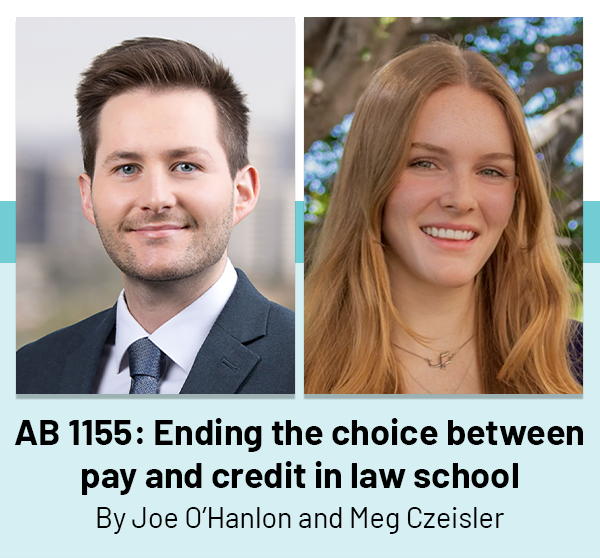
Joe O'Hanlon and Meg Czeisler are attorneys at Panish | Shea | Ravipudi LLP.
For reprint rights or to order a copy of your photo:
Email
Jeremy_Ellis@dailyjournal.com
for prices.
Direct dial: 213-229-5424
Send a letter to the editor:
Email: letters@dailyjournal.com