


Antitrust & Trade Reg.
Jan. 2, 2026
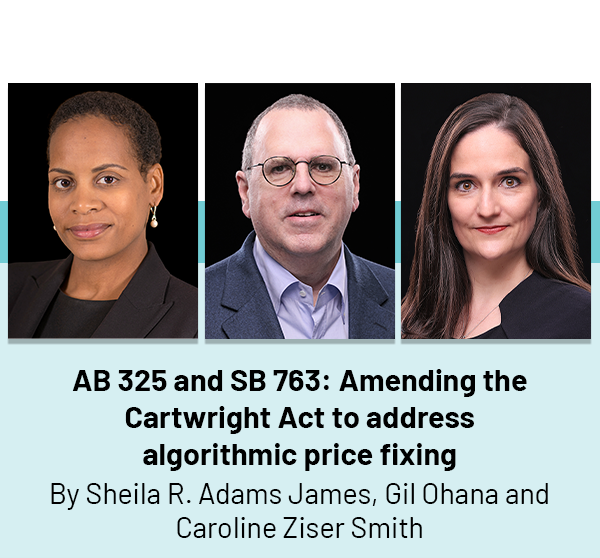
AB 325 and SB 763: Amending the Cartwright Act to address algorithmic price fixing





On Oct. 6, 2025, California amended its antitrust law, the Cartwright Act, to explicitly address the use of algorithms. While other states and cities have focused on the use of algorithmic pricing recommendations in residential real estate (e.g., New York's AB A1417B), California's amendments--AB 325 and SB 763--address the use of algorithms more generally.
AB 325: same prohibited conduct, new lower pleading standard
AB 325 amends the Cartwright Act in three ways. First, AB 325 prohibits agreements that use or distribute a common pricing algorithm "as part of a contract, combination in the form of a trust, or conspiracy to restrain trade or commerce." The bill defines a "common pricing algorithm" as any software or other technology used by two or more people to process a competitor's data to recommend, align, stabilize, set, or otherwise influence a price or commercial term. Before this amendment, the Cartwright Act already prohibited contracts, combinations, or conspiracies that restrain trade. With AB 325, the Cartwright Act now explicitly provides that the exchange of pricing information and recommendations derived from the use of common algorithms are illegal when they "restrain trade or commerce."
Second, the bill imposes liability if a user or distributor "coerces" another to accept a price or commercial term recommended by a common pricing algorithm for the same or similar products. Future litigation may test whether commercial inducements, like discounts exchanged for adherence to such pricing recommendations, constitute "coercion."
Third, AB 325 lowers the pleading standard for all collusion claims under the Cartwright Act, not only claims concerning algorithms. Per Assembly Committee notes, this change is a rejection of the more demanding standard established by the U.S. Supreme Court in Bell Atlantic v. Twombly, 550 U.S. 544 (2007). Under AB 325's new standard, complaints alleging a violation of the Cartwright Act can survive a motion to dismiss by pleading facts that merely make a conspiracy plausible, without needing to also plead facts that tend to exclude the possibility of independent, parallel conduct.
SB 763: greater potential exposure for defendants
SB 763 increases criminal and civil exposure for Cartwright Act violations. As with AB 325's reduced pleading standard, this change is not limited to cases involving algorithms. SB 763 raises the maximum criminal penalties per violation from $1 million to $6 million for corporations and from $250,000 to $1 million for individuals, as well as authorizes civil penalties of up to $1 million per violation. However, like the Sherman Act, the Cartwright Act permits the state to seek criminal fines that are double the loss or gain.
Both bills are effective Jan. 1, 2026.
Sheila R. Adams James is a partner, and Gil Ohana and Caroline Ziser Smith are counsel at Davis Polk & Wardwell LLP.
For reprint rights or to order a copy of your photo:
Email
Jeremy_Ellis@dailyjournal.com
for prices.
Direct dial: 213-229-5424
Send a letter to the editor:
Email: letters@dailyjournal.com