


Legal History / Judicial History,
Judges and Judiciary
Jan. 5, 2026
It happened
Retired but not retreating, I reflect on titles, time, and a judicial legacy that--like the law itself--sometimes loops back centuries with clarity and context.


Arthur Gilbert
Justice (ret.)
UC Berkeley School of Law, 1963
Arthur's previous columns are available on gilbertsubmits.blogspot.com.
This is my first column as a
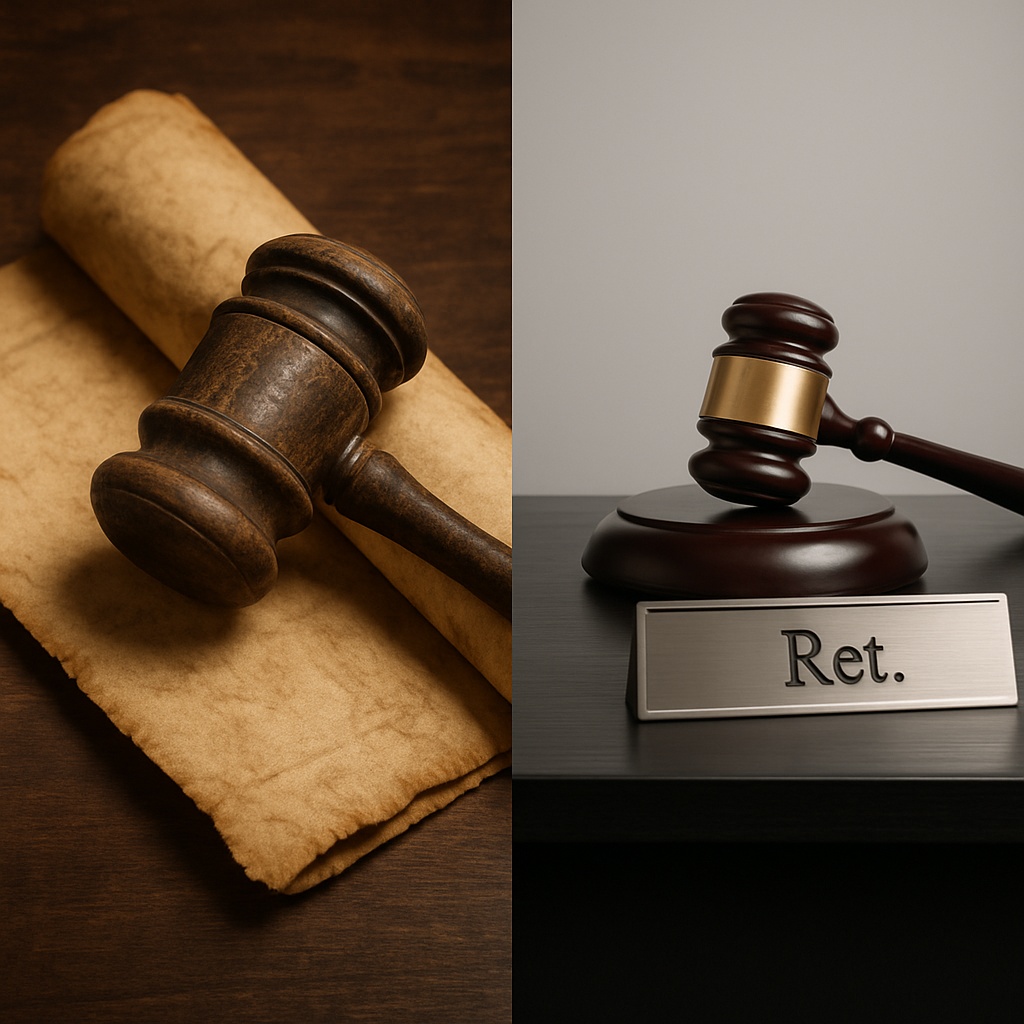
civilian. Feels odd, discomforting, that "Ret." after one's name. Notice the
period after "ret"? Look up "ret" in
any dictionary without the period and the definition is unsettling. For
example, The New Collegiate Dictionary defines "ret" as "to soak (something
such as flax of hemp) to loosen the fiber from the woody tissue." It kind of applies--I don't care to elaborate.
But put a period after ret, as in ret., and all
dictionaries state it means retired. And the definition of "retired" is
unnerving. For example, according to Oxford Languages, it means "withdrawn from
or no longer occupied with one's business or profession." Merrian Webster defines it as "secluded, a
retired village." And the insidious A.I. begins with "...someone has permanently
stopped working, usually due to period age, health..." I stopped reading.
Many retired judges simply
put Ret on their letterhead without the period. But is it not egotistical to
hang on to a title? It's like saying, "I
am still somebody even though deep down I know I am not. I need a title to
define myself." Maybe I should delete the "Ret." after my name as author of
this column. Naw, I just retired a few days ago and I am a bit insecure. On the
other hand, when one is an active sitting judge, is it not a little showy to
try to be of the guys, whoops, I mean a regular person by introducing yourself
at a bar function as Jim? Years ago, I
attended a local bar luncheon. A well-known federal judge sat down at the table
where I was sitting and said, "Hi, I am Jim."
Jim is a made-up name to protect someone, more likely myself. I said,
"Hi Jim, nice to meet you, I am Presiding Justice Gilbert."
You may be wondering why the
title "It Happened"? My first column,
370 columns ago, was titled "It Never Happened." Granted, the connection is
tenuous, but why not? The first column
in 1988 was supposed to be an article about the California Supreme Court's
insidious practice of "depublishing" heretofore published Court of Appeal
opinions. Those depublished cases could not be cited because they were
ostensibly right for the wrong reasons. To this day our high court has not told
us how it comes to that conclusion. Digression: as I write this column, I make
a mental note whether, on rereading it, I should delete certain words or
phrases. "Insidious" is such a word. If you just read "insidious," you know my
decision. The article back in 1988 was supposed to be ...you know an article--citations,
the usual. It didn't turn out that way. And so began the longest-appearing
column in the history of the Daily Journal.
Let's move on. This is the
first column of the year, and for the moment, I can only think of one New
Year's resolution that I cannot keep, not to criticize or express my bafflement
over Supreme and appellate court opinions. Notice I did not indicate the particular Supreme Court.
And finally, one never knows
what happens with the opinions that one has written in the past. Take, for
example, McDonald v. John P. Scripps Newspaper, 210 C.A.3d 100, (1989). In
1989, one of my research attorneys was noted present day appellate practitioner
Herb Fox. The McDonald case landed on Herb's desk. I credit him with
some of the initial research. It wound up on the front page of an edition of
the Los Angeles Times. San Francisco columnist Herb Caen devoted his column to
the case.
I learned it received
national attention. Herb recently gave me a book as a retirement present. It is
entitled "Corpus Juris Humorous: A Compilation of Outrageous, Unusual, Infamous
and Witty Judicial Opinions from 1256 A.D. to the Present," compiled and edited
by attorneys John B. McClay and Wendy L. Matthews (Barnes and Noble, 1994). The
McDonald case appears on page 156.
But what caught my eye on
page 192 was In Re Gilbert of Niddesdale, Assize Court of Northumberland County
Northumberland Assize Roll, 40 Henry III (1256). "Gilbert of Niddesdale, a
stranger struck up an acquaintance with a certain hermit whose name is Senannus
of Bottlesham, and as they were walking together in a certain moor, when this
same Gilbert laid hold of that hermit and beat him, wounded him and left him
for dead, and stole from him his cloths and one penny and fled."
Looks like opinion writing today has not
changed much since the 13th century. On second thought, in some ways, it might
be an improvement. Though the language is quaint, we do not have to puzzle over
what happened. To partially summarize more of the rest, as
Gilbert "was fleeing he ran into Randolph of Beleford, a sergeant of our lord
the King, who laid hold of him and charged him with being a criminal and took
him to Alnwick. The aforementioned said hermit came to
Alwick and said [not testified] that that other robbed and beat him. Gilbert
confessed and received his punishment. The victim got to cut his head off and
receive the property of the criminal in place of what was stolen from him. It
doesn't look like the criminal had much to give in the way of compensation. The
authors' notes to the case inform us that, under ancient English law, crimes
that were committed in "the realm had to be vindicated either by means of some
punishment "imposed upon the criminal or, if the criminal escaped, by means of
a fine payable directly to the Crown."
Darn good way to cut down on crime.
I feel quite at home being
cited in a book alongside cases from centuries ago. I mention the Gilbert case
for obvious reasons. My ancestors had nothing to do with the horrendous crime
committed against poor Bottlesham. And only for a penny. Wait, that didn't come
out right. Gilbert is a name conceived at Ellis Island or some other place. I
do not steal money, only an idea now and then.
Submit your own column for publication to Diana Bosetti
For reprint rights or to order a copy of your photo:
Email
Jeremy_Ellis@dailyjournal.com
for prices.
Direct dial: 213-229-5424
Send a letter to the editor:
Email: letters@dailyjournal.com