


Health Care, Pharmaceuticals, Biotech
Jan. 8, 2026
Trump administration's GenAI Medicare reviews raise legal concerns
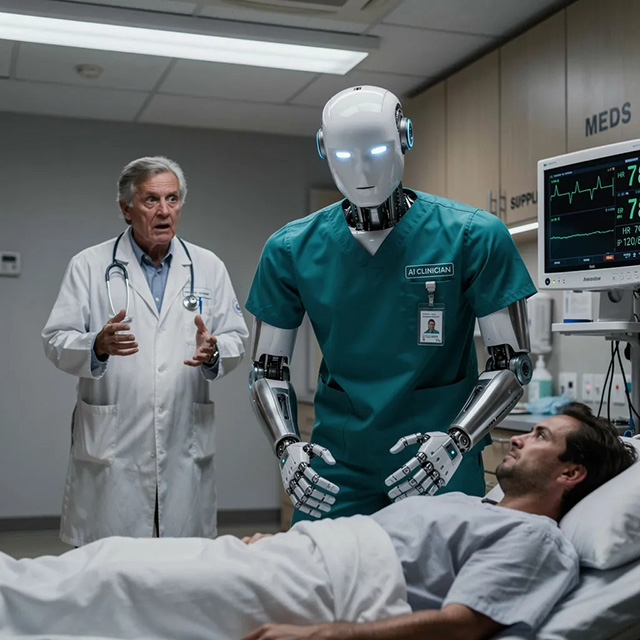
The Trump administration is already deploying GenAI to second‑guess physicians' determinations of medical necessity for seniors' treatments, shifting Medicare toward cost‑driven care over clinician judgment.


As we start the new year, I am compelled to share my
thoughts on some perplexing news that fits into the intersection of logical
reasoning located at the convergence of three columns I wrote for the Daily
Journal last year. It's news that will impact us all, sooner or later, in 2026
and beyond, as we age and need to access and utilize our Medicare benefits to
fund our medical expenses.
One of my columns focused on critiquing the expanding--and
almost ubiquitous, and therefore mandated--use of legal technology, especially
generative AI (GenAI), in the practice of law, now and going forward. I
explored why lawyers and courts must not only learn how to use these not-so-new
tools of our trade, but also how to command them. I also provided some lessons learned on how
we can--and must--competently navigate GenAI and cybersecurity in
order to avoid being sanctioned by our regulatory bodies for their
unethical or careless use. (See "How lawyers can navigate AI and cybersecurity,"
published Nov. 24, 2025, at https://www.dailyjournal.com/articles/388737-how-lawyers-can-navigate-ai-and-cybersecurity.)
Another column discussed the purpose and function of
insurance, which I wrote in the wake of the Eaton Fire, as we, as a society,
face the growing risk of financial uncertainty amid the ever-increasing
frequency of natural and man-made disasters, whether weather- and economically related.
One example is Congress's refusal to extend the tax subsidies of the Affordable
Care Act that expired at midnight on Dec. 31, 2025. A decision that I believe was foolish and
will end up driving millions of Americans and their families, along with some
health care providers and hospitals, into bankruptcy court. (See "Insurance
survival guide for modern disasters," published Jan. 24, 2025, at https://www.dailyjournal.com/articles/383013-insurance-survival-guide-for-modern-disasters.)
While the third column in this constellation of thought
discusses how the Heritage Foundation's 2024 manifesto, titled 2025 Mandate
for Leadership posits that "all federal executive power vest solely in the
person of the President and accordingly, 'it is the President's agenda that
should matter to the [executive branch] departments and agencies [i.e., the
Federal Reserve], not their own'."
Further, the 2025 Mandate suggested at the time "that the next
conservative Administration [now the current Trump administration] should
recognize the constitutional obligation of the executive branch to restrain the
excesses of both the legislative and judicial branches, emphasizing the
necessity of inter-branch pushback as a positive aspect." (See "The Project 2025 Mandate: Implications
for the Administrative State and the U.S. Constitution," published July 19,
2024, at https://www.dailyjournal.com/articles/379782-the-project-2025-mandate-implications-for-the-administrative-state-and-the-u-s-constitution.)
The point of convergence of my three columns manifests
itself today with the fact that the Trump administration has not only succeeded
in the outright emasculation of the federal legislative branch, but also in bypassing
the still-functioning trial and appellate federal courts to gain access to a
Supreme Court that uses its "shadow docket" to almost uniformly approve what
many legal scholars have determined to be the administration's questionable, if
not downright illegal, actions.
Additionally, Trump is using executive orders to lay the
groundwork for assuring that the "tech bros" who supported his reelection and
are now in charge of creating new and innovative GenAI systems that already
incorporate the unbridled subroutines Trump supports--and that are already
infected with the anti-woke, inherent racial and gender bias of their
developers and our society as a whole--to create the LLMs used to train them. (See
Trump's Executive Order 14319, dated July 23, 2025, at https://www.federalregister.gov/documents/2025/07/28/2025-14217/preventing-woke-ai-in-the-federal-government.) As such, these technology titans have also been
charged by the administration to only create systems that reinforce these
preexisting racial and gender biases.
Further, Trump has just signed another executive order that attempts to
hamstring the implementation of any state's regulation of GenAI that are
already being sold to our government. (See "Ensuring a National Policy
Framework for Artificial Intelligence," dated Dec. 11, 2025, at https://www.whitehouse.gov/presidential-actions/2025/12/eliminating-state-law-obstruction-of-national-artificial-intelligence-policy/.) As a result, these new anti-woke GenAIs have already begun to replace the scores of fired
and otherwise terminated federal employees and will be used to control the
tax-payer-financed, heretofore human-controlled processes that make--or will
make--decisions on just about every critical function of our government,
including who will receive their Social Security payments. (See Social
Security Administration 'In Turmoil' as New Reporting Details Damage Done by
Trump Cuts, dated Dec. 30, 2025, at https://www.commondreams.org/news/trump-social-security-administration-2674837440.) And starting on Jan. 1, 2026, some 6.4 million
Americans already enrolled in traditional Medicare and residing in Arizona, New
Jersey, Ohio, Oklahoma, Texas and Washington state will be drafted into and
become part of an already funded pilot program using GenAI, known as the
Wasteful and Inappropriate Service Reduction (WISeR)
model. Under this program, WISeR will be required to determine
if 17 different medical treatments prescribed by their physicians are really
needed by the senior patients--and will thus be paid for by Medicare from the
funds these seniors see taken out of their monthly Social Security checks and
used to underwrite the Medicare risk pool. (See WISeR
(Wasteful and Inappropriate Service Reduction) Model, at https://www.cms.gov/priorities/innovation/innovation-models/wiser.)
According to information posted on the U.S. Centers for
Medicare & Medicaid Services website (CMS.gov), which is managed and paid
for by CMS, the agency is currently led by Dr. Mehmet Oz, who reports to Health
and Human Services Secretary Robert Kennedy, Jr. CMS is the federal agency that
provides health coverage to more than 160 million Americans through Medicare,
Medicaid, the Children's Health Insurance Program and the Health Insurance
Marketplace.
So, I have a few questions: Who are the WISeR participants?
How were they selected? How will they protect our private personal medical and
financial information? How will they be monitored and controlled? What's inside
their models? How do the models work?
Who will be responsible for the models' misdiagnosis?
Here's some of what I was able to find out about WISeR:
WISeR model participants
|
Participant Name |
MAC Jurisdiction |
State |
|
JH Novitas |
Texas |
|
|
JL Novitas |
New Jersey |
|
|
JH Novitas |
Oklahoma |
|
|
J15 CGS |
Ohio |
|
|
JF Noridian |
Washington |
|
|
JF Noridian |
Arizona |
One final question: what's in it for these participants?
Again, as stated on the WISeR website, the model
participants will receive a percentage of the savings associated with averted
wasteful, inappropriate care as a result of their
reviews. That percentage will be adjusted based on the participant's
performance on measures related to the process, including provider experience.
One of my biggest concerns about the unfettered use of
GenAI in the public sphere is the same one I've had for nearly 30 years. I first
expressed it way back when I was appointed as a
public member to the National Association of Insurance Commissioners to
represent the interests of California insurance consumers, when the leading
property and casualty insurers sought the body's approval to introduce models
guided by propriety software to predict and price earthquake, windstorm,
firestorm and other catastrophic-based insurance policies. At that time, I stated:
"Insurance Regulators should not sanction the use of
proprietary earthquake catastrophe models in the regulatory process as long as these models are unverifiable "black boxes." If
regulators rely on such unverifiable models, they will be creating several
public policy risks (1) they will be abrogating their responsibility for
determining the fairness and equity of rate filings, (2) they will not be in
compliance with the principles of ratemaking developed by the Causality
Actuarial Society, (3) they will have illegally transferred their
responsibility to the hands of unregulated groups with financial interests
without appropriate checks and balances to protect the public interest, (4)
they will have developed unsound public policy. To mitigate these risks, this
paper offers a list of guidelines for the permissible use of earthquake
catastrophe models. To set the state for these guidelines, this paper
identifies the actuarial and social implications of injecting these
technologies into the regulatory landscape."
And it is still my informed opinion today. You can download and read the entirety of my
critique of non-publicly vetted and controlled computer algorithms used to make
public policy decisions that are shieled by "black boxes" in Risky Business:
Proprietary Modeling and Insurance Ratemaking, published as part of the
NAIC Symposium on Catastrophe Modeling in the Spring 1997 (March 1997) edition
of the Journal of Insurance Regulation, at https://naic.soutronglobal.net/Portal/Public/en-US/DownloadImageFile.ashx?objectId=9370&ownerType=0&ownerId=25826
As I shared with some of my fellow seasoned female lawyers
as we prepared for the new year, quoting the late great actor Betty Davis' immortal character Margo Channing in the classic
movie All About Eve, please "fasten your seatbelts, it's
going to be a bumpy ... [next 3 years]."
Submit your own column for publication to Diana Bosetti
For reprint rights or to order a copy of your photo:
Email
Jeremy_Ellis@dailyjournal.com
for prices.
Direct dial: 213-229-5424
Send a letter to the editor:
Email: letters@dailyjournal.com