


Family,
Bankruptcy
Jan. 21, 2026
Bankruptcy filings during divorce: What happens next?
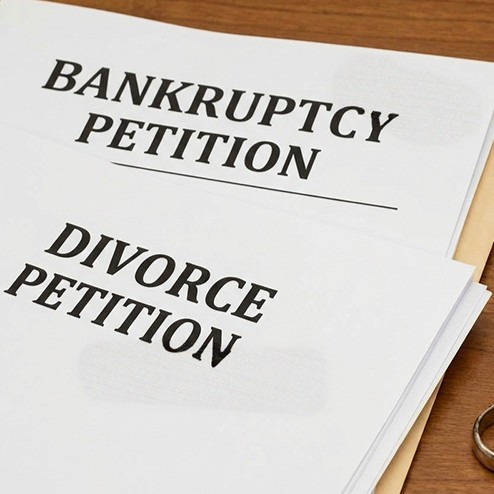
When a spouse files for bankruptcy amid divorce proceedings, family law attorneys face complex questions about automatic stays, property division and debt discharge.


James P. Menton Jr.
Partner
Robins Kaplan LLP
Corporate Restructuring and Bankruptcy Group
2121 Avenue of the Stars, Ste 2800
Los Angeles , CA 90067-3208
Phone: (310) 229-5813
Fax: (310) 229-5800
Email: JMenton@RobinsKaplan.com
UCLA Law School
Family law attorneys work tirelessly for their clients.
Despite these efforts, even the best of plans can be adversely impacted when
one spouse files for bankruptcy in the midst of
divorce proceedings. This article unpacks how a bankruptcy filing can impact
the divorce process and outlines when-and how-family law practitioners can move
forward.
Automatic stay
A bankruptcy filing results in the imposition of an automatic
stay under Bankruptcy Code Section 362. The automatic stay enjoins proceedings
affecting the debtor and property of the estate, including commencing or
continuing lawsuits that were or could have been started prior to the
bankruptcy, enforcing judgments or liens, taking or controlling estate
property, collecting on pre-bankruptcy debts and offsetting debts owed to the
debtor that arose before the bankruptcy case.
Certain domestic matters are excluded from the stay,
however, including paternity actions, domestic support orders, child custody or
visitation, dissolution of marriage (unless it involves diving estate property)
or domestic violence proceedings. 11 U.S.C. § 362(b). Other exceptions to aid
in enforcement of domestic support obligations include, among others,
collecting support not part of the estate and wage withholdings that are
property of the estate or property of the debtor. 11 U.S.C. § 362(b).
Relief from automatic stay
Relief from the automatic stay is necessary to divide
marital property that is estate property.
The bankruptcy court may grant relief "for cause" under Bankruptcy Code Section
362(d)(1). Cause is not defined and is decided on a case-by-case basis. Courts
consider factors like judicial economy, state court expertise and estate
interests. Bankruptcy courts generally defer to family courts in such matters. See,
e.g., MacDonald v. MacDonald (In re MacDonald), 755 F.2d 715, 717
(1985); In re Sandoval, 619 B.R. 417 (Bankr. C.D. Cal. 2020) (stay
modified by treating any property division by family court as a proposed
settlement subject to bankruptcy court approval); In re Badalamenti,
2025 WL 1012836 (Bankr. D. S.C. 2025) (stay modified to allow family court to
determine the equitable apportionment of marital assets and liabilities with
bankruptcy court retaining ability to review determination as it may relate to estate
property).
Property of the estate
The filing of a case creates an estate that includes "all
legal or equitable interest of the debtor" as of the commencement of the case,
with certain exemptions or exclusions. 11 U.S.C. § 541(a)(1).
The estate includes all interests of the debtor and the
debtor's spouse in community property as of the bankruptcy petition date that
is under the debtor's sole, equal or joint management and control, or liable
for certain claims. 11 U.S.C. § 541(a)(2); Damas v. Mantle (In re Mantle),
153 F.3d 1082, 1085 (9th Cir. 1988), cert denied, 526 U.S. 1068 (1999)("all community property not yet divided by a state
court at the time of the bankruptcy filing is property of the bankruptcy
estate.")
The estate also includes any interest in property that
would have been property of the estate as of the petition date and that the
debtor acquires, or becomes entitled to acquire, within 180 days of the
petition date, by inheritance, divorce or death benefits. 11 U.S.C. §
541(a)(5).
In individual Chapter 11 and Chapter 13 cases, the estate also
includes post-petition property and earnings from services performed before the
case is closed, dismissed or converted, whichever occurs first. 11 U.S.C. §§ 1115(a) and 1306(a).
Bankruptcy discharge
Individual debtor receives a discharge in bankruptcy upon
its completion. The discharge eliminates personal liability for most debts
existing as of the bankruptcy petition date. Among exceptions to discharge are
domestic support obligations and property division debts.
A domestic support obligation (DSO) is a debt (including
interest) for alimony, maintenance or support, owed to or recovered by a
spouse, former spouse, child of the debtor or governmental unit that is
established or subject to establishment before, on or after the bankruptcy
filing and based on a separation agreement, divorce decree or property
settlement agreement, court order or government determination. It can't be
assigned to a non-governmental entity, except for collection purposes. 11
U.S.C. § 101(14)(A). To determine whether an obligation is a DSO requires
focusing on the parties' intent and the debt's substance, not just the language
of the decree or agreement or the payee's identity. DSO debts are excepted from
discharge (i.e. non-dischargeable) under Bankruptcy Code Section 523(a)(5).
A property division debt to a spouse, former spouse or
child of the debtor-non-DSO debts-incurred by the debtor in
the course of a divorce or separation or in connection with a separation
agreement, divorce decree or other court order or government determination are
excepted from discharge under Bankruptcy Code Section 523(a)(15). They are
nondischargeable in Chapter 7 and 11 but dischargeable in Chapter 13 after the
plan is completed.
These two exceptions are automatic, and no adversary
complaint is required to be filed in the bankruptcy court but consider doing so
if concerned about these debts. In re Donnelly, 2025 WL 2025040 (Bankr.
S.D.N.Y. 2025)(attorney's fee awarded to former spouse
in matrimonial action, payable directly to her divorce lawyer, was ruled
non-dischargeable under sections 523(a)(5) and 523(a)(15)).
Preferences and fraudulent transfers
Preferences
Under Bankruptcy Code Section 547(b), a trustee may avoid
"preferential transfers." These are "transfers of an interest of the debtor in
property" made to or for the benefit of a creditor, on account of an antecedent
debt, while the debtor was insolvent, within 90 days prior to the bankruptcy
petition date (or within one year if to an insider), and the transfer enabled
the creditor to receive more than it would have received in a Chapter 7 case.
Section 547(c) lists affirmative defenses, including that transfers to satisfy
a DSO debt are not subject to avoidance under section 547(c)(7).
Fraudulent transfers
A bankruptcy trustee may avoid a transfer made or an
obligation incurred by the debtor within two years before the bankruptcy
petition for actual or constructive fraud under Bankruptcy Code Section 548.
Bankruptcy Code Section 544(b) provides the bankruptcy trustee with the same
rights that a creditor would have under state law. The California Uniform
Voidable Transactions Act (UVTA), Cal. Civ. Proc. Code § 3439, et seq.,
formerly known as the Uniform Fraudulent Transfer Act, provides that transfers
or obligations can be avoidable (invalid) because of actual or constructive
fraud. Thus, the bankruptcy trustee can scrutinize, for example, a marital
property agreement and potentially challenge the agreement under Bankruptcy
Code Section 548 as well under California fraudulent transfer law. Mejia v.
Reed, 31 Cal.4th 657 (2003)(confirmed that the
UFTA applies to marital property transfers).
Practical considerations
These considerations are intended to help family law
lawyers move forward in the event one spouse files for bankruptcy during
divorce proceedings. Upon the bankruptcy filing, assess the application of the
automatic stay and exceptions and take appropriate action. If filing for relief
from stay motion, use required forms, consider submitting optional separate
memorandum of points and authorities, and schedule hearing under applicable
local rules. Consider seeking a ruling that the stay does not apply, if applicable.
In addition, keep informed on the bankruptcy proceedings, including being
mindful of any DSO and property division claims and their treatment in
bankruptcy, and pursue rights as warranted. Further, consider preferential and
fraudulent transfer laws and potential claims and defenses for past conduct and
to inform future actions.
Submit your own column for publication to Diana Bosetti
For reprint rights or to order a copy of your photo:
Email
Jeremy_Ellis@dailyjournal.com
for prices.
Direct dial: 213-229-5424
Send a letter to the editor:
Email: letters@dailyjournal.com