


Ethics/Professional Responsibility,
Civil Procedure,
Civil Litigation
Jan. 21, 2026
Zoom depositions: The good, the bad and the unsettled
Remote depositions offer undeniable efficiencies in time and cost, but they also raise serious concerns about witness coaching and credibility assessment--challenges that require clearer guardrails as Zoom depositions become a permanent fixture of civil litigation.


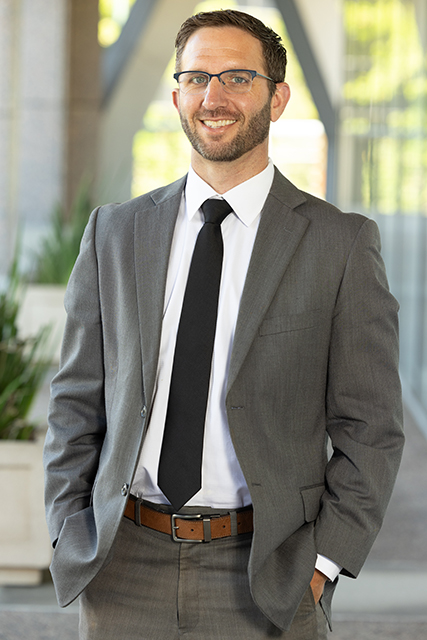
Adam M. Carlson
Managing Partner
Casper, Meadows, Schwartz & Cook
2121 N California Blvd
Walnut Creek , CA 94596
Phone: (925) 947-1147
Email: carlson@cmslaw.com
University of San Francisco SOL; San Francisco CA
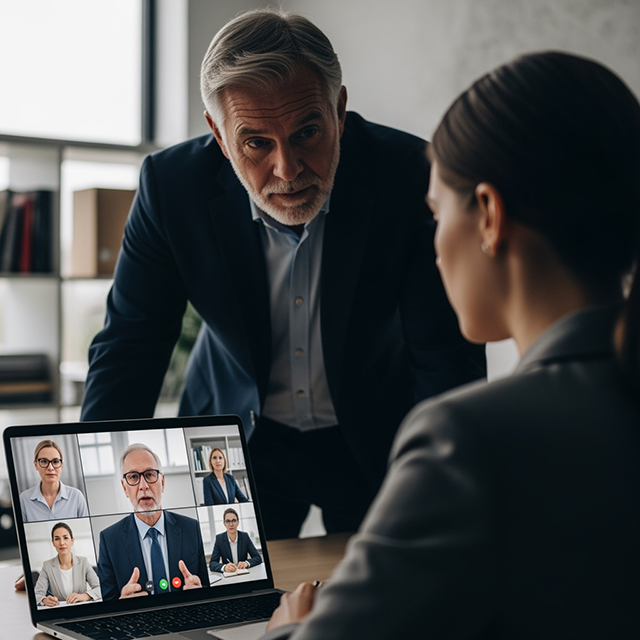
Remote depositions are no longer a pandemic workaround.
They are now a permanent feature of civil litigation
and their continued use has revealed a growing divide within the bar over
whether depositions are best conducted in person or by video conference. That
divide often appears generational: younger attorneys tend to prefer Zoom
depositions, while more seasoned litigators frequently favor in-person
proceedings. Neither camp is categorically right or wrong, but as Zoom
depositions become entrenched, courts and practitioners must grapple with both
their efficiencies and their vulnerabilities.
Why Zoom depositions can work better
The benefits of remote depositions are undeniable.
Eliminating travel saves time and expense, particularly when the deponent is
located out of state or in a distant part of California. Depositions that once
required a full day, or days, of logistics can now be conducted within a matter
of hours without leaving the office. Exhibits are often easier to manage as
well. Rather than arriving with multiple binders and stacks of paper, counsel
can share documents electronically, scroll through them efficiently, and
quickly pull up materials that were not anticipated in advance. This
flexibility allows examination to proceed while the topic remains fresh, rather
than breaking for copying or postponing follow-up questions.
Remote platforms can also make witnesses more comfortable.
Appearing from a familiar environment may reduce anxiety, which, for some
examining attorneys, is an advantage rather than a drawback because relaxed
witnesses may speak more freely. There is also the ability to take
contemporaneous, typed notes alongside the video feed that allows counsel to
track testimony with precision. While real-time court reporting exists for
in-person depositions, many attorneys find it easier in a remote setting to
review earlier testimony instantly without diverting attention away from the
witness.
The limits of remote depositions
Yet Zoom depositions present real downsides that cannot be
ignored. Chief among them is the difficulty of fully assessing how a witness
will present in person at either trial or a contested hearing. Subtle cues,
such as body language, posture and eye contact, can be flattened or obscured on
video. For key witnesses, particularly defendants or decision-makers whose
credibility will be central at trial, many attorneys believe that nothing
substitutes for evaluating them in person.
There is also a professional dimension that is harder to
replicate remotely. In-person depositions can foster collegiality and help
build working relationships between counsel. While professionalism is certainly
achievable on Zoom, for many practitioners, the connection is more attenuated.
Witness coaching and the need for clearer guardrails
A serious concern has arisen related to the increased risk
of improper witness coaching. In a remote deposition, it is far easier for a
defending attorney to be physically present with the witness off-camera,
allowing them to signal answers in ways that are difficult to detect. This risk
strikes at the core purpose of a deposition: obtaining the witness's
unvarnished testimony as it exists at that moment, not testimony shaped in real
time by counsel.
California courts have made clear that coaching a witness
during a deposition is improper and sanctionable. Coaching violates Code of
Civil Procedure section 2023.010(b), which defines misuse of the discovery
process to include failing to comply with deposition procedures. Courts have
repeatedly reaffirmed that "[c]oaching a deponent
is...a misuse of the discovery process" warranting sanctions. Tucker v.
Pacific Bell Mobile Services (2010) 186 Cal.App.4th 1548, 1561-1562.
More recently, in Agnone v. Agnone (2025) 111
Cal.App.5th 758, the Court of Appeal upheld sanctions where counsel refused to
turn on a camera during a Zoom deposition, concluding that the conduct "plainly
frustrated the deposition's truth-seeking function." The court reiterated that
trial courts possess broad authority to address discovery abuses, including
those not explicitly enumerated in the Discovery Act. (Id. at 765-767.)
Professional standards reinforce this principle. Los
Angeles Superior Court Guidelines for Civility in Litigation provide that
counsel should not "through objections or otherwise, coach the deponent or
suggest answers." (L.A. Sup. Ct. Appx. 3.A(e)(8).) Similar guidance appears in
local rules across the state. Federal courts have long recognized the same
concern, cautioning that a deposition is "a question-and-answer conversation
between the deposing lawyer and the witness," not an exchange filtered through counsel.
Hall v. Clifton Precision (E.D. Pa. 1993) 150 F.R.D. 525, 528.
Remote depositions magnify the difficulty of enforcing
these norms. Even when testimony is truthful, prompting a witness on how to
answer undermines the adversary's right to the witness's independent
recollection. The proper mechanism for ensuring accuracy is refreshing
recollection when appropriate, not real-time guidance. (Evid. Code, § 702.)
This issue can be addressed through local rules, the
California Rules of Court, or legislation requiring all attorneys representing
the witness to appear on camera or be in a separate room.
Conclusion: Choosing the right tool for the witness
Whether a deposition should be conducted remotely or in
person ultimately depends on context. Factors include the importance of the
witness, the attorney's preference for the chosen format, the need to evaluate
demeanor and practical considerations such as cost and geography. An
out-of-state expert may be well-suited to Zoom. A central party witness may not
be. Regardless, handled correctly, Zoom depositions
offer not a lesser form of discovery, but a different, and increasingly
integral and valuable, one.
Submit your own column for publication to Diana Bosetti
For reprint rights or to order a copy of your photo:
Email
Jeremy_Ellis@dailyjournal.com
for prices.
Direct dial: 213-229-5424
Send a letter to the editor:
Email: letters@dailyjournal.com