


Ethics/Professional Responsibility
Feb. 4, 2026
California tightens reins on attorney advertising
See more on California tightens reins on attorney advertising


Shahab Shawn Shaffie
Partner
Parker Shaffie LLP
Phone: (213) 622-4441
Email: shaffie@parkershaffiellp.com

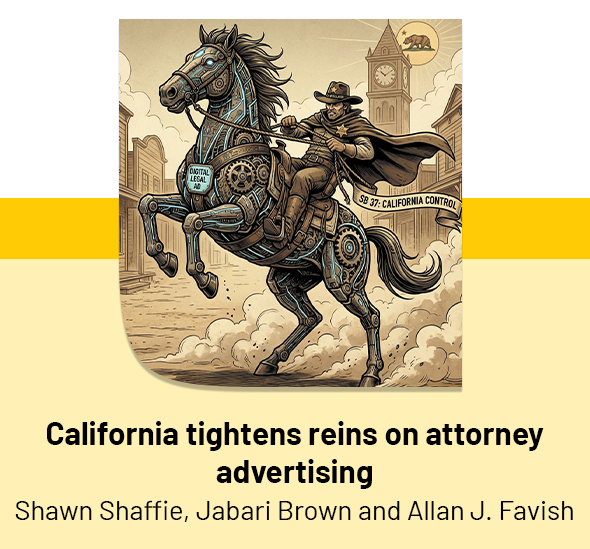
The landscape of legal marketing in California has undergone a seismic shift. With the enactment of Senate Bill 37, the state has modernized and sharpened the Business and Professions Code regarding attorney advertising.
For California firms, the update represents more than just a clerical change; it introduces aggressive new penalties and expands the definition of "advertisement" to meet the digital age. As the law took full effect on Jan. 1, 2026, the "business as usual" approach to digital marketing and lead generation now carries a much higher price tag for noncompliance.
To understand SB 37, practitioners must first look to Business and Professions Code Section 6155 and the case entitled Jackson v. LegalMatch.com, 42 Cal.App.5th 760 (2019). In that case, the court held that any entity operating for the purpose of referring a potential client to an attorney--even via an automated algorithm--is a Lawyer Referral Service (LRS). According to LegalMatch.com's formalistic holding, the simple act of sending a potential client's information to lawyers constitutes a "referral," regardless of whether the referring entity screens clients or a receiving attorney declines or takes the case.
In 2019, an entity operating a LRS without State Bar certification could face relatively minor civil penalties. Now the same entity without certification could be subject to a civil action, statutory damages and attorney's fees in the most lenient case.
At worst, its solicitations may be deemed as an illegal runner/capper operation under Section 6154, with any professional services contract secured through those solicitations deemed void as a matter of law, meaning a firm could be forced to disgorge every cent of fees earned from those clients.
With LegalMatch.com in mind, and in light of the new rules mandated by SB 37, here is a breakdown of the critical changes every practitioner must know.
The digital expansion on legal marketing rules
SB 37 officially brings the 21st century into Section 6157. Previously, "advertisement" was largely defined by traditional mediums like TV, radio and print. The new definition is intentionally broad and has expanded in scope to include: any written, recorded, or electronic communication available or directed generally to the public or specific groups to encourage the hiring of a lawyer.
The new rule also focuses on what we refer to as the "internet factor." It has expanded to include social media, websites and email marketing. So, if you send a digital communication to a "limited group of individuals" to secure business for your law practice, that communication is now officially an advertisement under the law.
Disclosure requirements: Transparency is mandatory
Transparency is no longer a suggestion; it is a statutory requirement. Every advertisement must now conspicuously display the following information:
Accountability: The name of at least one California licensed attorney, firm, or LRS responsible for the ad.
Geography: The city, town, or county of at least one bona fide office location (or the address of record with the State Bar).
Joint advertisements: For firms using joint advertisements with character-limited platforms (like X/Twitter, Instagram, or Google Search Ads), a "clear and prominent link" to a landing page containing all required disclosures is now mandatory.
The "teeth" of the law: Up to $100,000 penalties
Perhaps the most alarming change for law firm owners is the new private right of action. Section 6157.2 now empowers misled consumers to bring civil actions against firms. Remedies include the greater of statutory damages between $5,000 and $100,000 per violation or three times the amount of actual damages, attorney's fees, injunctive or declaratory relief and any other relief the court deems proper. Similarly, now, Section 6158.4 allows any person to initiate a State Bar complaint for these violations, and Section 6158.7 confirms that violations are formal grounds for professional discipline. But Section 6157.2 does come with a critical procedural hurdle in that before a consumer can file a civil suit for advertising violations, they must first "exhaust" administrative remedies by filing a complaint with the State Bar under Section 6158.4. The process generally follows this timeline:
The nine-day window: Once a complaint is served, the advertiser has nine days to voluntarily withdraw the ad. If they do, no further action can be taken by the complainant.
72-hour safe harbor: If the advertiser doesn't blink and the State Bar finds "substantial evidence" of a violation, the firm has one final 72-hour window [30 days for non-electronic media] to withdraw the ad before a civil enforcement action can be commenced.
The determination: If the firm fails to withdraw the ad after the Bar's determination, the consumer is then authorized to proceed with a civil action.
Section 6155: Navigating the "safe harbors"
Attorneys looking to grow their practice safely must adhere to Section 6155. Only two forms of paid solicitation are now protected.
First, certified referral services, so long as the entity has a California State Bar LRS Certification (e.g., LegalMatch eventually obtained #0140).
Second, Joint Advertising: Under the new version of Section 6155(g), participating attorneys must expressly take liability for the content of the advertising, identify specific lawyers the consumer can choose in the ad, and provide a "clear and prominent link" to all required disclosures.
The bottom line: Protecting your practice in the post SB 37 wild west
The State Bar is no longer the only entity watching your intake. Under Section 6158.4, any person can initiate a complaint, and professional discipline is now a mandatory consideration under Section 6158.7.
To avoid becoming the next "test case," California firms must:
• Verify certifications: Demand proof of State Bar LRS certification from every digital lead provider.
• Audit contracts: Review intake and retainer agreements for any mention of third-party "investigators" or "field reps" that could be classified as unauthorized referral sources.
• Digital transparency: Ensure all web-based ads conspicuously display the name of the responsible California attorney and their office location.
In 2025, the cost of one "bad lead" could be the forfeiture of your fees and up to a $100,000 judgment. Now is the time to audit.
Shawn Shaffie is a partner, and Jabari Brown and Allan J. Favish are attorneys at Parker Shaffie LLP.