


Torts/Personal Injury,
Constitutional Law
Feb. 6, 2026
Defamation by chatbot: Why Section 230 doesn't protect the new tech
For 30 years, Section 230 insulated platforms from liability, but generative AI is forcing courts to ask a new question: When AI speaks, is it third-party content, or the provider's own?


Krista L. Baughman
Partner
Baughman Law
1255 Treat Blvd., Suite 300
Walnut Creek , CA
Phone: (925) 310-6033
Email: krista@baughmanlaw.com
Brooklyn Law School; Brooklyn NY
Krista's practice focuses on First Amendment and anti-SLAPP law and litigation.
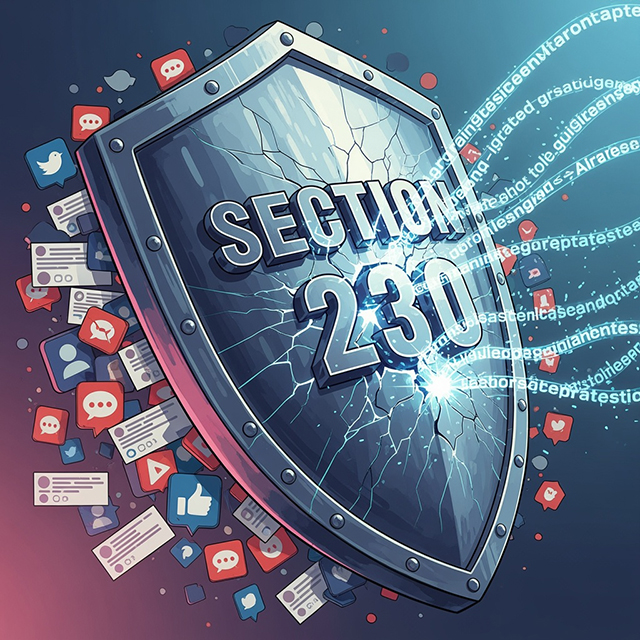
For 30 years, technology companies have operated with
assurance that Section 230 of the Communications Decency Act broadly shielded
them from liability tied to third-party content. But with the advent of novel
artificial intelligence technology, Section 230's protections are now being
tested by plaintiffs who allege harm at the hands of generative AI. One example
is the pending case of Wolf River Electric v. Google LLC, in which a
Minnesota solar company alleges that Google's AI Overview falsely told its potential
customers that it had been sued by the state attorney general for deceptive
practices.
As courts begin to confront the application of Section 230
to this new frontier, they will need to determine whether generative AI
responses to user queries constitute third-party content--or instead, whether AI
providers are themselves responsible for what their systems generate.
Section 230's text and limitations
Congress enacted Section 230 in 1996 to promote free
expression on the then-burgeoning internet while protecting platforms from the
burdens of policing vast amounts of third-party content. The first policy
objective--promotion of free expression--is reflected in subsection (c)(1)'s
immunity for a platform that passively hosts "information provided by another
information content provider." This codifies Congress's choice to protect
companies that "serve as intermediaries for other parties' potentially injurious
messages," as recognized by the 9th Circuit in Zeran v. AOL. The second
objective--encouraging ISPs to voluntarily block or filter offensive material
without fear of liability--is reflected in subsection (c)(2)'s protection of
"good faith" efforts to moderate content.
These are the primary protections Section 230 provides.
But when evaluating the statute's scope, it is equally important to consider
what the statute does not do--including protect ISPs for their own
unlawful speech.
This was established in the seminal case of Fair
Housing Council v. Roommates.com, which held that platforms lose protection
when they "materially contribute" to content creation. The 9th
Circuit held that by requiring users to disclose protected characteristics in a
drop-down menu as a condition of accessing its services, Roommates.com took an
active role in creating discriminatory content, thus stripping immunity.
Since 1996, courts have dramatically expanded the scope of
Section 230, immunizing platforms from all manner of legal claims, including
those involving user posts, terrorist recruitment materials, false dating
profiles and use of algorithms to present third-party content. But notably, in
each of these examples, the underlying speech at issue was generated by third
parties. This presents a legally significant difference from cases alleging
defamation by generative AI.
Defamation-by-chatbot falls outside Section 230
As of today, no court has explicitly extended Section 230
immunity to generative-AI outputs. And there are compelling textual, legal and
policy reasons why this should remain the status quo.
Based on its text, Section 230 addresses liability for
information generated by third parties--not for new outputs generated by AI
companies. In Wolf River, for example, Google's AI Overview is alleged
to have generated novel assertions about plaintiff company that existed nowhere
on the internet, and to have cited to "sources" that did not contain the
defamatory assertion the AI had published. Factually, this is a marked
departure from the functioning of traditional search features, which display
links and excerpts from the websites that first published the content.
Indeed, the creative capacity of artificial intelligence
is why we call it "generative" AI: Its value lies in creating fresh content,
not regurgitating existing text. If ChatGPT simply copied and pasted existing
speech from other websites, the output would be redundant of search browser
functionality and unhelpful to users.
While AI companies cannot deny that their products do more
than copy and paste from other parts of the internet, they may argue that
chatbots "remix" information found in the training data, thereby justifying
Section 230 immunity. This argument should fail in cases where a plaintiff can
prove that the false information never existed in any form prior to
being published by a chatbot. Moreover, as Professor Eugene Volokh observes in Large
Libel Models? Liability for AI Output, all human speech is a product of
rearranging encountered words and patterns, yet that reality does not immunize
humans from assembling defamatory statements. AI's generative nature places AI
companies squarely in the role of content creator, not neutral platform for
third-party speech. For these reasons, subsection (c)(1) cannot protect
generative-AI outputs.
Section 230(c)(2) is equally unlikely to provide
protection, as the text assumes platforms moderate someone else's content
and thus would not immunize outputs that are created by a platform's own
generative systems. Moreover, (c)(2) immunity is contingent on the provider
acting in "good faith," so allegations of bad faith--such as libel--would
undermine its applicability.
Finally, from a legal and policy perspective, granting
blanket immunity for AI platforms should give considerable pause, as it would
create an accountability vacuum that has never before
existed in defamation law. In traditional cases of online libel, while the
victim may be prevented by Section 230 from suing the platform directly, she
can (at least, in theory) pursue a claim against the original, human publisher
of the speech. However, no third-party human speaker exists in AI defamation
cases, thus precluding a victim from seeking relief. This outcome is
particularly worrisome given the significant institutional credibility carried
by AI outputs: When the imprimatur of Google, OpenAI or Meta appears above
fabricated accusations, readers are likely to trust them. Depriving individuals
of redress for the destruction of their good names and reputations would be an
unprecedented result that should be given serious consideration.
A different technology demands a different approach
Recently, calls for AI regulation have intensified, yet no
federal legislation has emerged. In this vacuum, litigants will continue to
assert defamation liability against AI companies for generative outputs, and
courts must contend with whether a law designed for passive intermediaries can
govern generative AI. Fortunately for the courts, Section 230 need not be
rewritten in this process--because the statute never promised immunity for
original content in the first place.
Submit your own column for publication to Diana Bosetti
For reprint rights or to order a copy of your photo:
Email
Jeremy_Ellis@dailyjournal.com
for prices.
Direct dial: 213-229-5424
Send a letter to the editor:
Email: letters@dailyjournal.com