


U.S. Supreme Court,
Government,
Antitrust & Trade Reg.
Feb. 24, 2026
After Supreme Court tariff ruling Trump signals further executive action
The fat lady has not sung: At a Feb. 20 press conference responding to the Court's ruling, President Trump--after launching a series of ad hominem and salacious attacks on the justices, telling them and their families they should be ashamed for ruling against him--vowed to invoke other authorities to press forward with what critics describe as an expansive view of executive power.


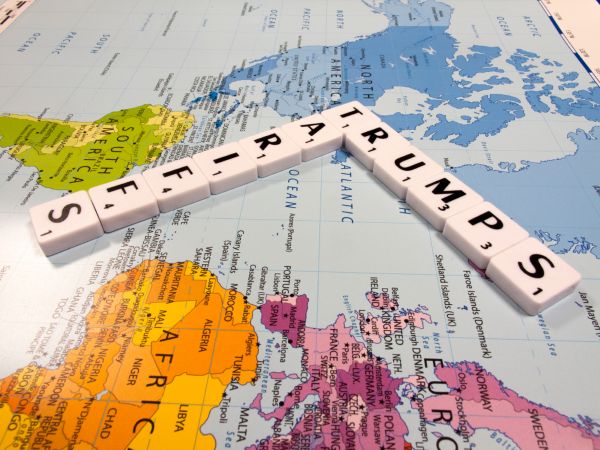
SCOTUS says Trump's IEEPA tariffs are an illegal
usurpation of Congressional taxation power and cannot stand
The Supreme Court's decision issued on Feb. 20, 2026,
declaring President Trump's International Emergency Economic Powers Act (IEEPA)
tariffs an illegal usurpation of Congressional taxation power marks a pivotal
moment in the ongoing struggle over the scope of executive authority in
American trade policy.
As I detailed in my earlier Daily Journal columns on this
topic (see "Trump's
tariff strategy tests the limits of presidential power and legal authority,"
May 6, 2025, and, "Trump
tariffs fact a judicial reality check," June 6, 2025), at the heart of this
legal battle lies the fundamental question: Does the (IEEPA) grant the
President the sweeping power to impose tariffs, or are such decisions
exclusively reserved for Congress by the Constitution? The Court's ruling
against the administration not only rebukes an aggressive assertion of
presidential power but underscores the enduring principle of separation of
powers that underpins the nation's legal framework. As businesses, states, and
policymakers absorb the ramifications, the broader debate over emergency
powers, statutory limits and the rule of law remains far from settled.
Case overview and procedural posture
• The Court decided consolidated
cases, Learning Resources, Inc. v. Trump, Case No.: 24-1287and Trump
v. V.O.S. Selections, Inc., Case No.: 25-250 challenging tariffs imposed
under the IEEPA.
• The question presented was
whether IEEPA authorizes the President to impose tariffs.
• The District of D.C. (D.D.C)
issued a preliminary injunction against the tariffs in favor of the two small
business plaintiffs in Learning Resources, Inc., the Court of
International Trade (CIT) granted summary judgment to the five small business
and 12 State plaintiffs in V.O.S. Selections, and the Federal Circuit
affirmed in relevant part.
• The Supreme Court granted the
administration's certiorari (including before judgment) and consolidated the
cases.
• The Court held that IEEPA does
not authorize the President to impose tariffs, vacated and remanded
No. 24-1287 to dismiss for lack of jurisdiction, and affirmed the Federal
Circuit's judgment in Case No.: 25-250.
Procedural/Jurisdictional notes
• The Supreme Court confirmed CIT's exclusive
jurisdiction over the V.O.S. Selections challenge and found the D.D.C.
lacked jurisdiction in Learning Resources.
Factual background
• President Trump declared
national emergencies for drug influx from Canada, Mexico, and China, and for
"large and persistent" trade deficits, invoking IEEPA.
• He imposed a 25% duty on most
Canadian and Mexican imports and a 10% duty on most Chinese imports to address
drug trafficking.
• He also imposed at least a 10%
duty on all imports from all trading partners, with higher rates for dozens of
nations, to address trade deficits.
• He later issued several
increases, reductions and other modifications to the tariffs.
Constitutional and statutory framework
• Article I, Section 8 of the
United States Constitution assigns Congress the sole power to lay and collect
taxes and duties, which clearly includes tariffs, and the Framers did not vest
taxing power in the Executive.
• The Government conceded no
inherent presidential peacetime authority to impose tariffs and relied solely
on IEEPA's "regulate ... importation" language.
Major Questions Doctrine and Separation of Powers
• The Chief Justice, joined by
Justices Gorsuch and Barrett in Part II-A-2, invoked the major questions
doctrine, requiring clear authorization for highly consequential power.
• The Court found no historical
precedent for using IEEPA to impose tariffs and deemed the asserted authority
economically and politically significant, triggering hesitation absent clear
authorization.
• The Court rejected any exception
to the doctrine for emergency statutes or foreign affairs, emphasizing Congress
alone holds peacetime tariff power.
Statutory interpretation of IEEPA
• IEEPA allows the President to
"investigate, block ... regulate, direct and compel, nullify, void, prevent or
prohibit ... importation or exportation," but omits any mention of tariffs or
duties.
• The Court held "regulate" does
not include taxation, noting no statute where a grant to "regulate" subsumes
the taxing power, and Congress treats regulation and taxation separately.
• Reading "regulate" to include
tariffs would partly render IEEPA unconstitutional because the Constitution
forbids taxes on exports.
• The neighboring verbs in
§1702(a)(1)(B) concern sanctions and controls, not revenue-raising, and
presidential practice confirms no tariff power under IEEPA.
• The Court rejected arguments
that commerce-related discussions of tariffs answer the statutory question,
stressing Congress speaks clearly and with constraints when delegating tariff
powers.
• It rejected the spectrum
argument placing tariffs between "compel" and "prohibit," holding tariffs are
taxation, different in kind from IEEPA authorities.
• Reliance on the IEEPA'
predecessor, the Trading with the Enemy Act (TWEA)
and Court of Customs and Patent Appeals' decision
in United States v. Yoshida Int'/, Inc., 526 F. 2d 560 was unpersuasive, as a single limited specialized decision
did not establish a settled meaning incorporated into IEEPA.
• Wartime precedents were
inapposite because the President lacks inherent peacetime tariff authority, and
the inferential chain to IEEPA failed.
• Federal
Energy Administration v. Algonquin SNG, Inc.,
426 U. S. 548, under Section 232 and Dames & Moore v. Regan, 453 U. S. 654,
did not support reading IEEPA to authorize tariffs, given Section 232's
explicit duty references and the narrowness of Dames & Moore.
Opinions and concurrences/Dissents
lineup
• The Chief Justice delivered the
Court's opinion for Parts I, II-A-1, II-B, joined by Sotomayor, Kagan, Gorsuch,
Barrett, and Jackson; Parts II-A-2 and III were joined by Gorsuch and Barrett.
• Justice Kagan, joined by
Sotomayor and Jackson, concurred that IEEPA does not authorize tariffs and
found the major questions doctrine unnecessary because ordinary statutory
interpretation sufficed.
• Justice Barrett concurred,
agreeing the best reading of IEEPA excludes tariff authority and addressing the
major questions doctrine's framing.
• Justice Gorsuch concurred,
endorsing application of the major questions doctrine and detailing its
constitutional grounding.
• Justice Jackson concurred that IEEPA
does not authorize tariffs, relying on legislative history showing Congress
intended "regulate ... importation" to mean freezing or controlling foreign
property transactions, not taxation.
• Justice Thomas dissented, and
Justice Kavanaugh dissented joined by Thomas and Alito, but the majority's
holding on IEEPA's lack of tariff authority stands.
Dissenting views (limits and potential implications)
• Justice Thomas, joined fully
with Justice Kavanaugh's dissent, argued "regulate ... importation" historically
includes duties and that delegating tariff power in foreign commerce is
constitutionally permissible.
• Justice Kavanaugh's principal
dissent maintained that text, history, and precedent (including Nixon's 1971
tariffs under TWEA and Algonquin's reading of "adjust the imports") show
IEEPA authorizes tariffs, and that applying the major‑questions doctrine here is novel
in foreign affairs.
• The dissent noted other statutes
likely still permit most similar tariffs and raised potential consequences such
as refunding billions collected under the IEEPA tariffs and uncertainty for
trade deals.
Conclusion
While the Supreme Court's majority found no statutory or
constitutional basis for presidentially imposed tariffs under IEEPA, the
dissent warned of continued executive attempts to push the boundaries of
foreign commerce authority. The litigation's outcome has immediate implications
for billions of dollars in tariffs, market uncertainty, and ongoing legal
challenges--yet, as the aftermath shows, the "fat lady" has not sung. President
Trump's vow to explore alternative legal avenues promises further contention,
leaving the nation and world markets watching to see whether Congress, the
courts, or the executive branch will ultimately define America's future trade
and constitutional order.
Submit your own column for publication to Diana Bosetti
For reprint rights or to order a copy of your photo:
Email
Jeremy_Ellis@dailyjournal.com
for prices.
Direct dial: 213-229-5424
Send a letter to the editor:
Email: letters@dailyjournal.com