


Feb. 24, 2026
California Supreme Court weighs whether an unreadable arbitration agreement can bind workers
In a 6-1 decision, the California Supreme Court considered whether an arbitration agreement that was nearly impossible to read can be enforced--and clarified how illegibility factors into contract formation and unconscionability analysis.




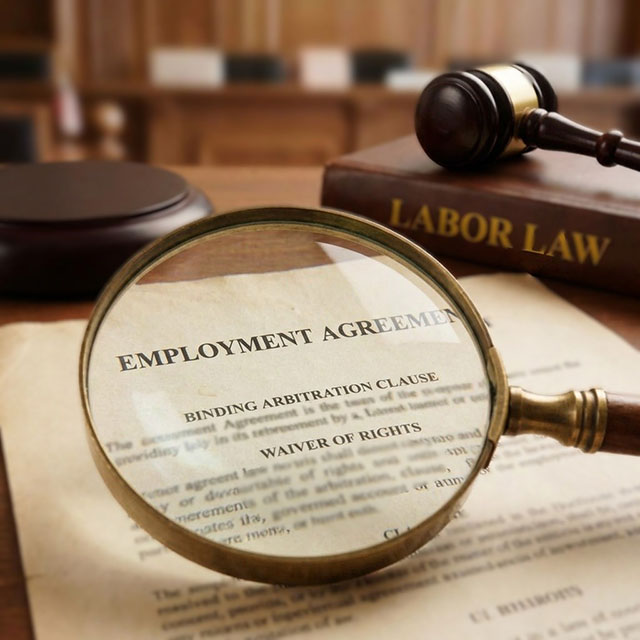
In a 6-1 decision, the California Supreme Court addressed a simple but
significant question: Can an arbitration agreement be enforced when its
operative terms are nearly impossible to read?
More broadly, how should courts treat illegibility when determining
whether a contract is unconscionable, or whether a contract was formed at all?
Ultimately, the Supreme Court's decision reinforces a foundational
contract principle: meaningful assent requires meaningful opportunity to
understand the agreement.
The issue stems from Evangelina Yanez Fuentes v. Empire Nissan, Inc.,
No. S280256 (Cal. Sup. Ct. Feb. 2, 2026). There the court clarified how
illegibility of an agreement fits within California's unconscionability
framework and emphasized that arbitration agreements are subject to the same
contract principles as any other agreement.
How the case came before the Supreme Court
Evangelina Yanez Fuentes, an auto sales agent, filed suit against her
former employer alleging discrimination, wrongful termination and related
statutory violations.
The former employer, Empire Nissan, moved to compel arbitration based on
a one-page "Applicant Statement and Agreement" signed during the hiring
process. The document contained an arbitration provision in extremely small,
blurred print due to repeated photocopying. The California Supreme Court
entertained oral argument and issued its decision, which clarified the
standards of unconscionability when considering agreements, including
arbitration agreements.
The trial court
By way of background, at the trial court level, Fuentes argued that the
arbitration agreement was unenforceable because it was unconscionable and,
alternatively, that no valid agreement to arbitrate exists because the
agreement was virtually illegible thereby precluding her assent to its terms.
The trial court denied the motion to compel arbitration, finding the
agreement unconscionable due to its microscopic and barely legible text.
Relying on Davis v. TWC Dealer Group, Inc. (2019) 41Cal.App.5th 662,
674, the court found that small, difficult-to-read print contributed to a high
degree of procedural unconscionability, and the format also supported at least
a low to moderate degree of substantive unconscionability. However, the trial
court did not reach Fuentes's argument--that Empire Nissan failed to prove that
the arbitration agreement was valid.
The Court of Appeal
Disagreeing with Davis, the Court of Appeal reversed and held that
"tiny and unreadable print" is a problem of procedural unconscionability only
and should not be "double counted" as a problem of substantive
unconscionability. Applying California's two-part unconscionability test, which
provides that both procedural and substantive elements must be present to
conclude a term or agreement is unconscionable, the court held that procedural
unconscionability alone was insufficient to invalidate the arbitration
agreement.
The Supreme Court review
The California Supreme Court granted review to resolve the conflict
between the two approaches and clarified how procedural defects such as
illegibility should be analyzed under the unconscionability sliding-scale
framework.
During oral argument, several justices expressed skepticism that an
illegible agreement can meaningfully bind an employee, raising questions
whether the appellate court's analysis unduly minimized the practical impact of
an unreadable contract.
In its February 2, 2026 opinion, the court
reversed the Court of Appeal decision, clarified the proper framework for
review of the enforceability of the agreement, and found that the agreement in question was imposed
with a high degree of procedural unconscionability. Furthermore, the court
stated that with such a high degree of procedural unconscionability, even a low
degree of substantive unconscionability could render the agreement
unenforceable.
The following facts were significant
in the court's analysis:
• Fuentes was given only
five minutes to review an entire application packet.
• She was told to hurry
because the drug testing facility was closing.
• She was not informed
that the packet contained an arbitration agreement.
• She was not given an
opportunity to ask questions.
• She was not provided a
copy of the agreement after signing.
• And the arbitration
provision itself appeared in a tiny, blurry font, compressed into a dense,
jargon-heavy paragraph nearly impossible to decipher.
"Indeed, it is hard to
understand why an employer would present an important legal agreement to its
employees in such a form," the majority wrote. Taken together, the court
found significant "oppression" and "surprise." The court did, however, reaffirm
California's sliding-scale nature of unconscionability.
Where procedural unconscionability is
substantial, only a low degree of substantive unfairness is needed to render an
agreement unenforceable. That principle, the court emphasized, requires careful
judicial examination of the agreement's actual terms when the formation process
is suspect.
Importantly, the court clarified that illegibility, standing alone,
generally relates to procedural unconscionability, not substantive unfairness. However,
when the formation process is highly suspect, courts must carefully
scrutinize the agreement's terms for even minor substantive imbalances.
Arbitration agreements are not alone
Notably, the court was clear that the
arbitration agreement must be treated like any other contract and carefully
examined. As such, ambiguities in the contract must be construed against the
drafter. Likewise, courts must carefully evaluate both the formation issues and
the substance of arbitration agreements.
Ultimately, the Supreme Court
reversed the appellate judgment and remanded the case, with directions that the
trial court must address Fuentes' separate argument that the illegible document
may not have formed a valid contract at all.
Although it is not yet clear how the
trial court will decide the issue, the Supreme Court's ruling leaves employers
with important lessons: if a purported agreement is illegible, mutual assent
itself may be automatically lacking, regardless of unconscionability.
Implications for employers
The court's ruling offers employers a cautionary roadmap: arbitration
agreements presented during the hiring process, under time pressure, without
explanation and in difficult-to-read format, will face heightened judicial
scrutiny.
Employers and counsel should adopt clear protocol under which employees
review arbitration as well as other employment agreements. Moreover, agreements
that are poorly reproduced, excessively dense or difficult to read may be
vulnerable to challenge even if their substantive terms are otherwise lawful,
particularly when combined with formation circumstances, such as those
identified in Fuentes.
As a best practice, employers should ensure that arbitration agreements
and other employment-related documents are:
• Clearly legible
• Written in understandable language and in readable font size and format
• Presented in a manner that allows employees a meaningful opportunity to
review them
This opinion underscores the importance of maintaining clear, accessible,
and well-drafted employment agreements to minimize litigation risk and makes
clear that courts will not overlook procedural defects simply because
arbitration agreements are favored under the law.
Submit your own column for publication to Diana Bosetti
For reprint rights or to order a copy of your photo:
Email
Jeremy_Ellis@dailyjournal.com
for prices.
Direct dial: 213-229-5424
Send a letter to the editor:
Email: letters@dailyjournal.com