


Feb. 24, 2026
Wiener bill to ease PG&E breakup sets stage for constitutional fight
SB 875 would streamline San Francisco's path to public power, but critics warn it could trigger legal challenges, higher rural rates and broader market consequences.


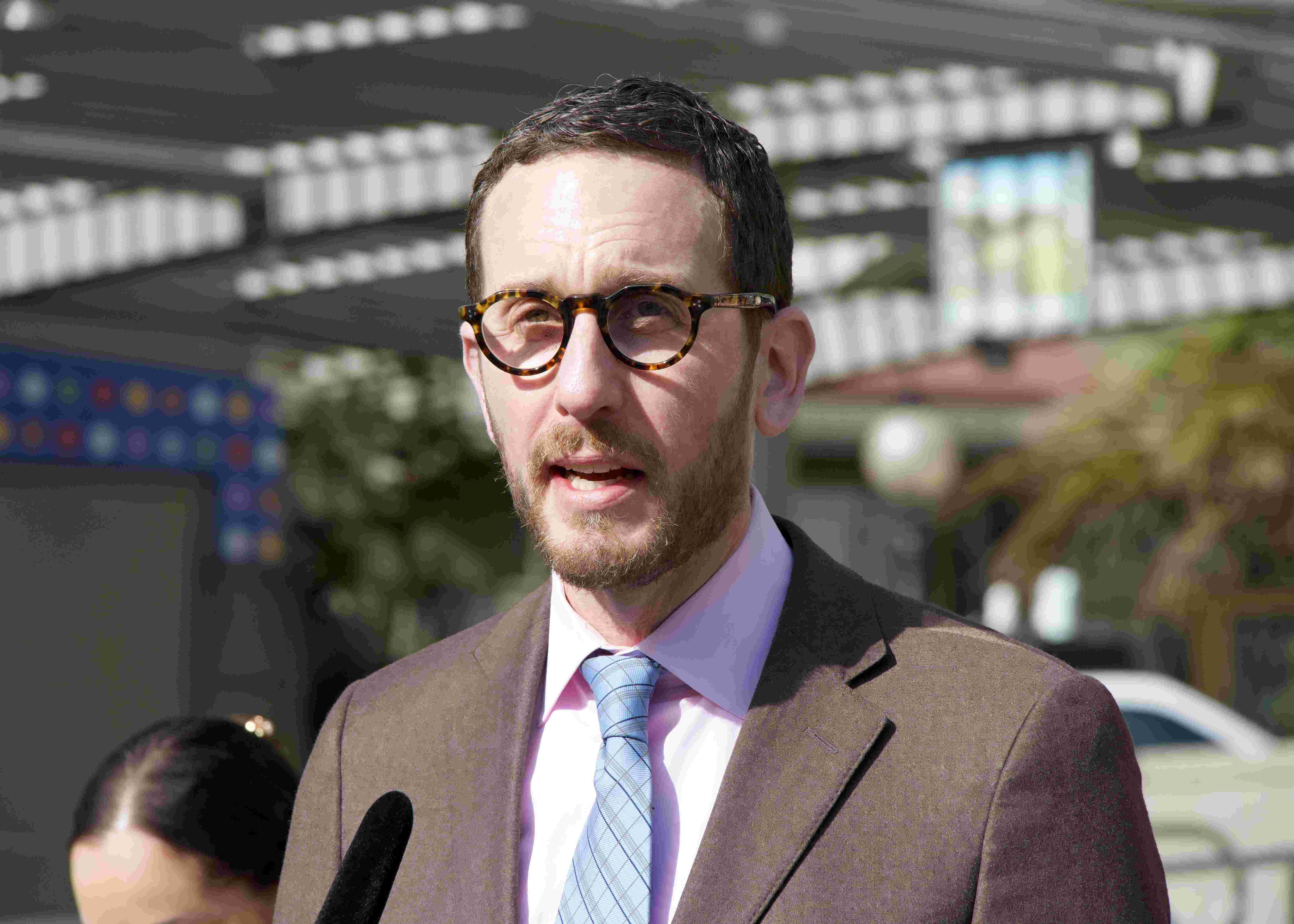
SAN FRANCISCO -- Breaking up is hard to do, but Sen. Scott Wiener keeps trying to cut ties with Pacific Gas & Electric.
The San Francisco Democrat stood on the steps of City Hall on Monday morning to announce his latest -- and likely final -- attempt to help San Francisco part ways with the utility.
If SB 875 becomes law, PG&E will almost certainly challenge it on both constitutional and regulatory grounds. A successful divorce bid could also spur similar efforts by wealthy cities, potentially creating a cost spiral that raises rural energy costs and even undermines the insurance market in fire-prone areas.
"We are done," Wiener said. "It is time for San Francisco to break up with PG&E. We are fed up with paying double what our neighbors in Sacramento and Palo Alto pay for electricity with their publicly owned utilities. We're fed up with the blackouts and the poor maintenance that have left hundreds of thousands of people without power for days."
"We have and continue to make very significant investments in the energy system in San Francisco, including more than $3 billion in the last 20 years ... Government takeovers of parts of our grid would not make customer energy bills less expensive," PG&E responded in an official statement shared by PG&E representative Lynsey Paulo.
Wiener's stated issues with the utility are well-known: high rates, blackouts, poor maintenance and sparking the deadliest blaze in state history. While his language at the news conference might sound like he is talking about a celebrity divorce, his bill takes aim at an obscure regulatory issue he says has tied San Francisco to the utility against its will.
The changes scheduled to go into print by Tuesday morning target the valuation process before the California Public Utilities Commission.
The new language would reverse regulatory changes passed in 1992 that made it harder to create public power utilities. It would also limit the commission's role "to determining whether the transaction is fair and reasonable to affected public utility employees" and make it easier to enforce time limits on the process.
The transition would demand that San Francisco buy off power lines, substations and other expensive equipment, likely invoking eminent domain. The sides remain far apart about what they believe the true value of this property is.
Wiener cited years of "deferred maintenance" and "neglected infrastructure" the new owners would need to address. He also claimed the utility has stretched out what was supposed to be an 18-month process for nearly five years.
"San Francisco has dramatically underpriced the value of PG&E's electric system, suggesting that the assets in San Francisco are worth only about $2-$3 billion," the company said in its statement. "Not only is that a lowball amount, but the California Public Utilities Commission (CPUC) has been clear that the City and County of San Francisco (CCSF) would have to pay far more than the value of the assets, which means a takeover will drive customers' rates up, not lower them."
In a rare case of San Francisco envying Sacramento, the capital illustrates both the promise and the perils of the change. The effort that created the Sacramento Municipal Utility District lasted from 1923 to 1946. The fledgling utility then faced years of difficulties but is now the sixth largest publicly owned utility in the country. It has scored far higher than PG&E on recent customer satisfaction surveys conducted by J.D. Power and by the American Customer Satisfaction Index.
A successful divorce would also have far-ranging ripple effects. Haas School of Business professor Severin Borenstein, the faculty director of UC Berkeley's Energy Institute, has spoken frequently to news outlets about how a wealthy area like San Francisco opting out of the larger system could raise costs for remaining PG&E customers -- particularly those in rural and fire-prone areas.
"The fact is that urban PG&E customers are subsidizing rural PG&E customers because the cost, not just the wildfire cost but historically just the hardware cost per kilowatt hour is just drastically higher in rural areas," Borenstein said on Monday.
He added that it makes the bill difficult to pass politically. Not only do more urban areas splitting away not help rural voters, it also isn't in the interest of people in urban areas that already have public power. If too many customers leave, Borenstein said, the Legislature might have to pass a direct subsidy that would hit those urban ratepayers too.
Virginia Tech history professor Richard F. Hirsh has followed these battles for years. He compared Wiener's bill to a battle that played out in Maine in 2023. Voters were asked to fund a state takeover of two utilities.
"The utilities contended that public ownership wouldn't guarantee lower rates or better service," he said by email. "Voters rejected the referendum, allowing the utilities to remain, although critics argued that the utilities spent heavily on advertising to win."
Wiener has frequently cited the role of PG&E lines in sparking the deadly 2018 Camp Fire that devastated the town of Paradise. But if SB 875 set off an exodus of affluent urban areas out of the utility, it could raise utility rates in Paradise and make it more difficult to offset liability for future fires. That, in turn, could have implications for the California FAIR Plan, the state's insurer of last resort.
According to a 2025 UCLA School of Law article shared by one of its authors, National Resources Defense Council senior analyst Mohit Chhabra, this offloading of high-risk service areas is a key factor why publicly owned urban utilities can offer low rates.
"As public entities accountable to local constituencies, POUs [publicly owned utilities] can be more responsive to local needs, but are typically smaller and relatively more resource-constrained. ... While POUs typically outperform IOUs [investor-owned utilities] on affordability, IOUs face high costs driven by wildfire mitigation in their larger, more rural service territories," he wrote with Ruthie Lazenby and Sylvie Ashford in "Power Struggle: California's Electric Utility Ownership Dilemma."
Malcolm Maclachlan
malcolm_maclachlan@dailyjournal.com
For reprint rights or to order a copy of your photo:
Email
Jeremy_Ellis@dailyjournal.com
for prices.
Direct dial: 213-229-5424
Send a letter to the editor:
Email: letters@dailyjournal.com