


Space Law
Feb. 25, 2026
Space race 2.0 - It's about the law
If the 1969 space race was about who could get there first, Space Race 2.0 is about who gets to define what "there" means.



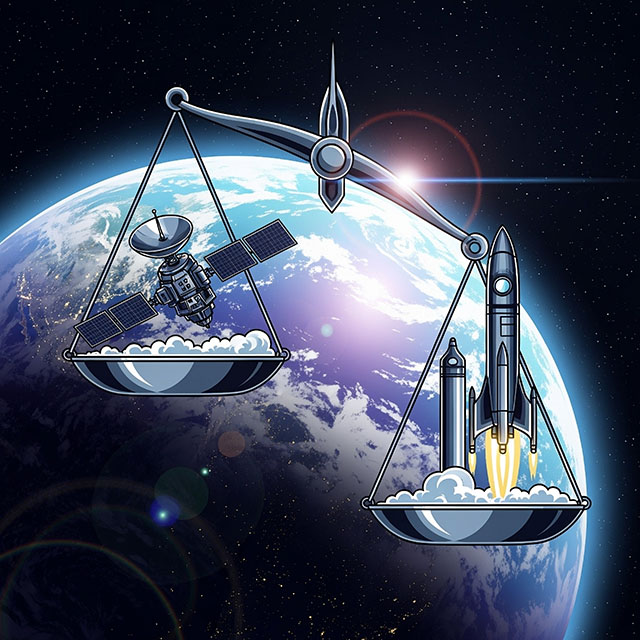
You don't need a rocket to see that we're in a race again.
But Space Race 2.0 does not look like 1969. There are no
superpower speeches about planting flags. No televised countdowns framed as
existential contests between political systems. This time, the competition is
quieter, more layered and far more legally sophisticated.
Militarization in space is not new. Satellites have long
supported terrestrial military operations. What is new is the strategic use of
law itself as an instrument of competition. If the original space race was
about who could get there first, Space Race 2.0 is about who gets to define
what "there" means.
That is lawfare.
Lawfare in the space context is not simply litigation or
regulatory maneuvering. It is the deliberate use of legal interpretations,
institutions and normative processes to secure strategic advantage. It is about
shaping the rules before infrastructure hardens and practice crystallizes into
custom. It is about deciding how key treaty terms are understood in operational
contexts the drafters of the regime put in place in 1967 could not fully
anticipate.
At the center of this contest is the Outer Space Treaty.
The Treaty remains elegant and spare. Article I declares that the exploration and use of outer space are the
"province of all [hu]mankind." Article II prohibits national appropriation.
Article VI places responsibility for national activities, including those of
private actors, squarely on States. Article IX requires due regard and
consultation in cases of potentially harmful interference.
Those phrases are not self-executing. They are
interpretive battlegrounds.
What does "province of all humankind" mean in a world of
commercial lunar extraction? What constitutes "appropriation" when resources
are removed and sold? What is "due regard" when multiple landers operate within
kilometers of one another on the lunar south pole? And what rises to the level
of "harmful interference" in a domain where plume effects are cumulative and
shared?
These questions are not academic. They are being answered
right now through national legislation, bilateral arrangements and operational
practice.
The Artemis Accords, for example, are framed as political
commitments grounded in the Outer Space Treaty. They emphasize
interoperability, transparency and the creation of "safety zones" to implement
Article IX's due regard obligation. To some, they are pragmatic coordination
tools among like-minded States. To others, they are efforts to solidify an
interpretation of the Treaty that privileges particular
operational models and partnerships.
Meanwhile, China and Russia have advanced the concept of
an International Lunar Research Station and pursued parallel norm-building
efforts in multilateral forums. They are not rejecting international law. They
are contesting its meaning.
That is the hallmark of lawfare. No one is abandoning the
legal framework. Everyone is working to shape it.
This matters because law, once embedded in practice,
becomes difficult to dislodge. If a particular approach to resource
utilization, safety perimeters or data sharing becomes normalized through
repeated conduct and acquiescence, it can begin to resemble customary
international law. At that point, the race is no longer about who lands first.
It is about whose interpretation governs everyone else.
For those of us working to protect human history in space,
this dynamic is not abstract.
Historic lunar sites, like Tranquility Base, are fixed.
They are fragile. They are already present. And they are among the few lunar
assets in which all States share an interest. They are also a test case for
whether due regard has operational meaning.
If a State authorizes a private company to land near
Tranquility Base, what conditions attach to that license? How are plume effects
assessed? Is consultation triggered? Are mitigation measures required? These
are not sentimental questions. They are governance questions.
Heritage is the easiest place to agree. No State benefits
from erasing the first human landing site or damaging early robotic missions.
Because heritage is inert and non-operational, it provides a neutral reference
point for working through proximity, cumulative effects and coordination before
traffic becomes dense and commercial pressure makes restraint inconvenient.
In that sense, protecting human history and heritage is
not peripheral to Space Race 2.0. It is foundational. It forces States to
confront how they interpret due regard and harmful interference in concrete
terms. It reveals whether "province of all humankind" still carries operational
weight once infrastructure and competition arrive in force.
The legal contest extends well beyond the lunar surface.
In orbit, mega-constellations raise questions about
spectrum allocation, debris mitigation and equitable access. In cislunar space,
traffic management remains largely aspirational. On Earth, domestic licensing
regimes are increasingly shaping what responsible behavior looks like in space.
Article VI's requirement of authorization and continuing supervision is being
operationalized through national law. The State that sets rigorous, transparent
and enforceable standards may influence global expectations.
There is also a compliance dimension. Lawfare can exploit
asymmetries. A State that faithfully implements transparency and consultation
obligations may constrain its own actors, while a competitor adopts narrower
interpretations or delays disclosure. The result is not open violation but
differential leverage.
And this is where every attorney, not just those who label
themselves "space lawyers," has a role.
Space is not remote. It is embedded in daily life. GPS
guides ambulances and Uber drivers. Satellites synchronize financial
transactions. Weather forecasting, precision agriculture, disaster response and
global communications all depend on orbital infrastructure. When you tap your
phone, swipe your card or stream a hearing, you are relying on space.
That makes space law infrastructure law.
Commercial lawyers negotiate launch contracts and
insurance provisions. Environmental lawyers advise on debris mitigation and
planetary protection. National security lawyers assess dual-use technologies
and export controls. Administrative lawyers shape licensing frameworks.
Litigators will eventually test liability theories when something goes wrong on
orbit or on the Moon. Even trusts and estates lawyers will grapple with assets
that operate beyond territorial borders.
The interpretive choices being made today will cascade
into all of those domains.
If "due regard" becomes a thin procedural formality,
congestion and conflict risks increase. If "appropriation" is defined so
narrowly that coordination erodes, markets may fragment. If heritage and other
shared interests are treated as expendable, we lose not only history but a
neutral platform for building trust.
Conversely, if lawyers insist on clarity, transparency and
accountability in licensing, contracting and dispute resolution, they help
anchor competition within a rules-based framework.
Space Race 2.0 is not about planting flags. It is about
planting interpretations.
The power to define what counts as appropriation, what
triggers consultation and what satisfies due regard is the power to structure
markets, alliances and access. It is the power to determine whether space
becomes a platform for shared progress or a patchwork of legally fortified
enclaves.
The engineers will build the landers. The entrepreneurs
will raise the capital. The diplomats will negotiate communiqués. But it is
lawyers who translate broad principles into operational constraints, who draft
the licenses, interpret the treaty language and allocate risk.
If we get the law wrong now, we will not simply have
misread a treaty. We will have shaped a domain that may define humanity's next
century on terms we did not fully examine.
If we get it right, competition can remain bounded by
shared rules, heritage can anchor expansion and the "province of all humankind"
can retain real operational meaning.
The rockets will capture headlines. The real contest is
unfolding in footnotes, licensing conditions and the interpretation of a
handful of deceptively simple treaty provisions.
That is the race we are running.
Submit your own column for publication to Diana Bosetti
For reprint rights or to order a copy of your photo:
Email
Jeremy_Ellis@dailyjournal.com
for prices.
Direct dial: 213-229-5424
Send a letter to the editor:
Email: letters@dailyjournal.com