


Judges and Judiciary,
Evidence,
Criminal
Mar. 4, 2026
Dead data walking
California courts keep citing the "roughly 1 in 200" armed-robbery-death statistic, originally from a single 1980 Supreme Court footnote, showing how judges can turn a shaky number into enduring legal lore.


4th Appellate District, Division 2
Michael J. Raphael
Associate Justice
4th District Court of Appeal
Yale Law School
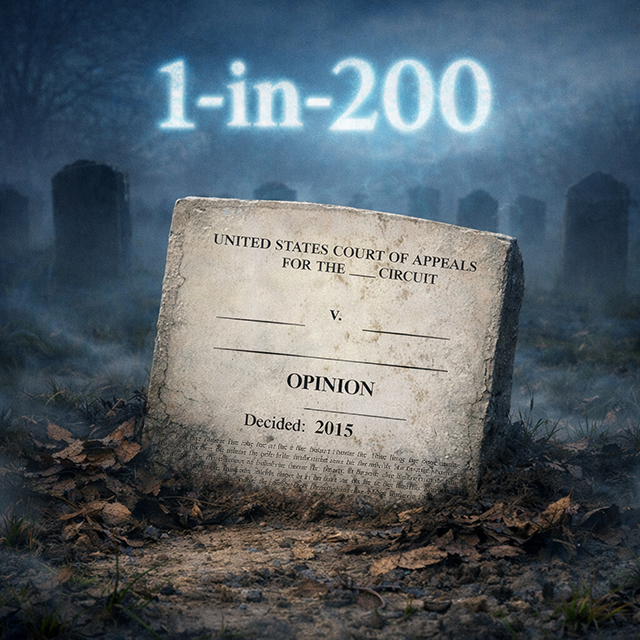
This article is about a statistic.
It is this: "only roughly 1 in 200" armed robberies result
in death. People v. Banks, 61 Cal.4th 788, 811 (2015).
That statistic can be found in dozens of California
opinions. Our Supreme Court cited it in 2015, 2020 and 2025. See Banks,
61 Cal.4th at 811; People v. Scoggins, 9 Cal.5th 667, 682 (2020); People
v. Emanuel, 17 Cal.5th 867, 884 (2025).
Court of Appeal citations to it in 2025 included People
v. Granberry, 116 Cal.App.5th 934, 950; People v. Bridges, 2025 WL
2218128; People v. Mungia, 2025 WL 2016676; People v. Mooney,
2025 WL 1501987; and People v. McDermott, 2025 WL 353847. I have joined
at least one opinion citing the statistic, People v. Fowlkes, 2023 WL
2801951.
As I will explain, I question the statistic's provenance
and would like to offer a thought about the judicial use of statistics.
I do not, however, question the conclusion the statistic
supports. It illustrates that a participant in an armed robbery can anticipate
that lethal violence might occur, yet--absent more information--reasonably
not expect a death. This supports California law's conclusion that mere
participation in an armed robbery does not make a person recklessly indifferent
to human life.
That conclusion matters for the "special circumstance"
triggering the death penalty or life imprisonment without parole under Penal
Code § 190.2(d). See Scoggins, 9 Cal.5th at 682. It also
matters for a murder conviction under a felony murder theory per Penal Code §
189(e)(3). See Emanuel, 17 Cal.5th at 884. That is, to find
"reckless indifference" to human life, a court must look beyond mere
participation to the way guns were used, what the participant knew about an
accomplice's likelihood of killing, and the opportunities the participant had
to minimize violence or aid the victim. See People v. Clark, 63
Cal.4th 522, 618-624 (2016).
That approach does not depend on whether the statistic is
1-in-200 or somewhat different. My concern is the statistic, not the approach.
So what about the 1-in-200 ratio?
That roughly 1-in-200 armed robberies result in death is an empirical snapshot,
not a scientific fact. A scientific fact can be cited indefinitely. See, e.g.,
People v. Howington, 233 Cal.App.3d 1052, 1057 n.3 (1991) (chemical
difference between cocaine hydrochloride and cocaine base).
In contrast, empirical crime data are not timeless. Could
the ratio change over the years, based on how robberies occur? Where does the statistic come from?
The statistic originated in a 44-year-old United States
Supreme Court opinion, Enmund v. Florida,
458 U.S. 782 (1982). See Banks, 61 Cal.4th at p. 811. Enmund's footnote 24 contains the statistic, though
in percentage form, and the Court explained how it was derived. The Court
determined from the FBI's Uniform Crime Reports that the nation suffered
548,809 robberies in 1980. The same report showed 2,361 persons were murdered
in connection with robberies the same year. That meant "about 0.43% of
robberies in the United States in 1980 resulted in homicide." Enmund, 458 U.S. at 800 n.24. (The footnote also
cited a 1980 article with a similar statistic.)
This footnote is the source of the 1-in-200 statistic. The
numerator (2,361) is the number of murders in connection with robberies in 1980.
The denominator (548,809) is the number of robberies. That comes to 1 in 232. On
those figures, the "roughly 1-in-200" expression, if anything, understates the
rarity of a murder in connection with a robbery.
There are, though, three problems with adapting this
statistic into California law.
First, the denominator Enmund
used was robberies. Its 1-in-200 statistic reflected the percentage of
those robberies that involved a murder.
But when our Supreme Court relied on it, the denominator
became armed robberies: "thousands of armed robberies occur each year;
per Enmund, only roughly 1 in 200 results in
death." Banks, 61 Cal.4th at 811; see also Emanuel, 17
Cal.5th at 884 ("only about 1 in 200 armed robberies result in death").
The 1980 crime
report is available on the federal Office of Justice Programs website. The
report (page 17) says that 38% of the robberies involved no weapon. Forty
percent involved firearms, 13% knives or blades, and 9% other weapons--meaning
62% involved some weapon. Counting only armed robberies reduces the denominator
from 548,809 to 340,262. Assuming all the murders occurred in those armed
robberies, that would reduce the frequency statistic to 1 in 144. (Considering
only robberies with firearms would reduce that denominator to 219,534.)
If the question is how likely a murder is in an armed robbery,
the Enmund data better supports "roughly 1 in
150" than "roughly 1 in 200."
A second problem is the numerator. The 2,361 killings
connected to robberies are reported in the section of the 1980 crime report
about murders. See pages 7 & 13; Enmund,
458 U.S. at 800 n.24 ("2,361 persons were murdered...in connection with
robberies"). That figure included only deaths that, based on police reports,
were classified as murder or intentional manslaughter. Negligent deaths,
accidents and justifiable homicides were not included.
But when our Supreme Court relied on it, the numerator
became crimes where an armed robbery "results in death." Banks, 61
Cal.4th at 811. This maps onto the reason why the statistic matters in
California. Per Penal Code section 190.2(d), a special circumstance applies
where a felony "results in death," not only where a death is intentional. And
under the felony murder doctrine, a participant in a robbery can be convicted
of murder for a "killing committed by a cofelon,
whether intentional, negligent, or accidental."
People v. Cavitt, 33 Cal.4th 187, 197 (2004). Courts would
therefore want to know how often robberies result in death not just in murder.
With a higher numerator, the statistic would show deaths
more frequently in armed robberies. The 1980 crime report provides no way to
tell how many additional deaths would appear in the numerator if
non-intentional killings were added to the total. Most deaths during robberies
surely are intentional, but some are not. See, e.g., People v.
Anderson, 51 Cal.4th 989 (2011) (conviction on a felony murder theory where
the defendant accidentally ran over a victim while stealing her car).
Third, the statistic comes from a single year, 1980. I
looked at the
same statistics from 2019, the last year that the federal government
reported the data in the same format as in 1980. That year, there were 267,988
robberies nationally and 509 murders during a robbery (table 1; expanded
homicide table 10.)
That means that the same calculation yields 1 in 232 for
1980 but 1 in 527 for 2019. But 44.4% of robberies in 2019 were unarmed
(robbery table 3), which would make the frequency of murders during armed
robberies (again, not deaths) 1 in 298 rather than the 1 in 144 in 1980. A
ratio "about 1 in 300" would be a good fit. That is better support for
California law's conclusion than the oft-quoted ratio.
More recent data is available on the FBI's Crime Data Explorer, allowing analysis of
California or national figures across one- to ten-year periods. Because the
homicide rate has declined, recent calculations yield a much lower percentage
of homicides connected to robberies than in 1980.
My concern is not with the statistic's import; it does not
mislead as to the conclusion California law draws from it. Rather, the use of
this statistic can provoke thoughts about reliance upon empirical data in
appellate cases.
When an appellate court cites a statistic in a published
opinion, that statistic becomes fair game for lawyers and judges to repeat
indefinitely. Challenging such a statistic takes work and requires extra-record
analysis, which may be impermissible or methodologically unreliable.
Law professor Allison Orr Larsen has written on the
general subject. In Factual Precedents, 162 U.Penn.L.Rev.
59 (2013), she discussed situations where the United States Supreme Court has
cited facts, including statistics, that lower courts then relied on without
further analysis. See, e.g., id. at 62 (statistic that a quarter
of carpal tunnel cases resolve within a month without intervention). She has
explored how factual assertions in Supreme Court opinions could be mistaken or
one-sided. Larsen, Confronting Supreme Court Fact Finding, 98 Va.L.Rev. 1255 (2012).
The "roughly 1 in 200" statistic seems an interesting
example of judicial repetition of a statistic. That figure is no more reliable
than alternatives derived from other years' data, with or without the
numerator/denominator corrections noted above. The only distinction is that "1
in 200" appeared in opinions and has then been widely replicated. While lower
courts are bound by legal holdings of higher courts, perhaps factual
propositions can warrant more skeptical treatment. Empirical data may be
contestable or fluctuating.
An aphorism of uncertain origin is "the plural of anecdote
is not data." In law, a plenitude of
citations is not data, either.
Submit your own column for publication to Diana Bosetti
For reprint rights or to order a copy of your photo:
Email
Jeremy_Ellis@dailyjournal.com
for prices.
Direct dial: 213-229-5424
Send a letter to the editor:
Email: letters@dailyjournal.com