


Space Law/Aviation/Aerospace
Apr. 3, 2026
Advanced Air Mobility's potential for litigation - Part 5
AAM takes flight, and so does litigation--from IP skirmishes to vertiport battles, the next aviation revolution comes with legal turbulence.



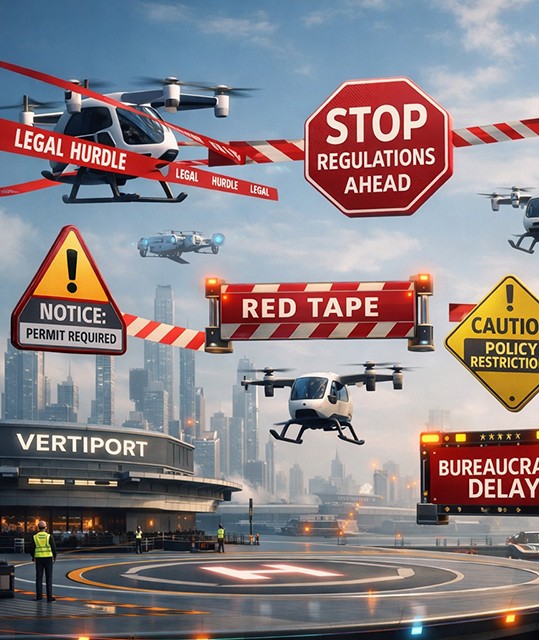
Most litigation is driven by facts and circumstances, which makes it somewhat unpredictable. However, Advanced Air Mobility (AAM) has already experienced litigation common to emerging industries. Moreover, as AAM evolves into another form of commercial aviation, it will likely feature similar lawsuits.
Finally, the currently developing structure of the AAM industry suggests certain litigation scenarios. We can't stare too hard at the crystal ball, but some educated guesswork may be in order.
Past and current AAM litigation: We can very briefly summarize AAM lawsuits as follows.
Wisk (now owned by Boeing) sued Archer for IP violations. They settled, and Archer supposedly issued warrants to Boeing. Joby has also sued Archer for other IP violations, including poaching trade secrets, employees and/or real estate opportunities. That case is pending; Archer has countersued. A German OEM, Lilium, went bankrupt, but Archer acquired its IP. Archer recently sued Vertical, a British OEM, for patent infringement.
That's a thumbnail sketch of AAM lawsuits so far.
Some studies suggest that emerging industries show a greater incidence of litigation than mature ones. This has been seen in previous waves of new technology: e.g., semiconductors, biotech, the Internet, smartphones, crypto and now AI. If you've practiced law for any decade of the 21st century, you've seen this before. We can reasonably expect similar litigation to continue, especially as new OEMs enter the fray.
Traditional aviation litigation: Aviation litigation practice may be broken down into governmental practice (for example, compliance and adversarial proceedings) and civil proceedings (for example, products liability and personal injury).
Governmental practice/Compliance: A lot of compliance practice before the FAA or DOT for established operating regimes (for example, Part 135) is done between operators and their Flight Standards District Office (FSDO, pron. "fizzdough"). Attorney involvement can be limited in FSDO matters because disputes are more often technical than legal.
AAM may be different. Part 194 is brand new, and the only near-term operations will be under the eVTOL Interim Pilot Program (eIPP) and Other Transaction Agreements (OTAs) negotiated with FAA/DOT. Establishing and then transitioning away from these arrangements may require more direct legal involvement, at least until Part 194 evolves into something driven by FSDO practice.
Adversarial proceedings: As AAM evolves towards passenger operations, there will be investigations, license revocations, fines, etc., just like traditional aviation. Part 194/SFAR 120 made no changes to FAA rules of practice--for example, at 14 CFR Part 13, Investigative and Enforcement Procedures. Violations of Part 194 will be subject to the same adversarial proceedings as any other form of aviation.
That being said, let's mention the elephant in the room: the first AAM mishap will literally be a test case. Given the novelty of AAM, that first "case or controversy" might be pretty colorful. It'll blow up a few phones, and that will probably make the NTSB and FAA lean in. So, aviation law practitioners might want to do a little due diligence on AAM worst case scenarios (for example, battery fires or water landings) before passenger operations begin.
Civil practice/accidents and insurance: Suing anyone that's even vaguely connected to an event isn't the most coherent litigation strategy, but it's fairly common. For aviation mishaps, typical litigation targets are OEMs, maintainers, operators (both carriers and aviators), airports and air traffic control. Pretty much everyone who might have discoverable information or insurance coverage may be joined to a lawsuit, especially if the incident involves injuries.
At this stage, the OEMs seem to be involved at every level of AAM operations: they are not only delivering airframes and parts, but training pilots and maintainers. Some OEMs have secured Part 135 certificates, apparently to operate their own branded fleets. They are not only investing in dispatch/hailing and ATC features; they are also pursuing joint ventures to develop and operate vertiports.
This is all very ambitious, and such a vertically integrated business model may be the best way to launch AAM operations, improve products/services and create buzz. However, any company that's embedded at every link in the chain of commerce makes for a pretty big litigation target, if not the only target.
Who else will be sued? We won't know for sure, until AAM evolves past the eIPP/OTA pilot programs and the test cases start.
AAM structural issues/antitrust and trade regulation: Both Joby and Archer have obtained Part 135 certificates, indicating an intent to both build aircraft and operate them as air carriers. The last time OEMs and air carriers shared common ownership, Congress banned the practice via the Air Mail Act of 1934. For example, Boeing was forced to divest United Airlines. Since then, OEMs have generally not owned or operated air carriers, with some exceptions: for example, Bombardier's partial ownership of the Flexjet fractional ownership program.
Note also that aviation is often considered interstate commerce per se, so aviation law contains echoes of antitrust and trade regulation. For example, DOT has its own separate authority to directly investigate unfair practices and competition in air transportation; see 49 USC 41712(a). Economic discrimination at Federally funded airports is prohibited by Grant Assurance #22.
Fledgling or nascent industries are not immune from public antitrust/trade practices enforcement, much less private complaints. This is not to say that the currently proposed vertically integrated AAM business models will be antitrust targets. However, as they evolve, they might benefit from focused antitrust compliance review.
Franchising: Alternatively, if the OEMs effectively control the launch business model--providing equipment, spare parts, software, other IP, pilots, mechanics, vertiports and ride hailing--any resulting licensed, third party AAM business operation might look a little like a franchise, especially if OEMs insist on pushing their branding with everything else they provide.
This is sometimes referred to as an "accidental" or "unintentional" franchise. To loosely paraphrase the FTC Franchise Rule, a franchise involves identification with a licensor's trademark(s), payment of a franchise fee, and consistent control or assistance by the licensor/franchisor.
Applicable state franchise laws are substantially similar, but not identical. For example, some states hold to a "community of interest" approach to control or assistance. Others hold to a "common marketing plan or system" approach.
It looks like AAM business models are going to tick a lot of those boxes, unless they evolve away from vertical integration. As post-eIPP business models emerge, a review for accidental franchise issues might be prudent. For example, although both FTC and state franchise rules have exemptions for large franchise investments and large, financially sophisticated franchisees, these must be carefully reviewed, case by case.
Oddly, franchising may not be a bad model for rapid adoption of AAM. The first generation of eVTOLs will be best suited to short range, local operations--city by city, region by region. If you wanted to flood such markets, you could do worse than emulate McDonald's or Starbucks.
Vertiport issues: As mentioned in Part 2, the biggest unknown factor facing AAM may be building out new vertiports. Aviation may be interstate commerce per se, but land use is a local affair, determined at the municipal level. As AAM moves away from existing airports and heliports, we can expect to see local compliance, lobbying, siting and zoning practice, including litigation.
For example, AAM noise regulation is still a work in progress. eVTOLs are widely considered to be less noisy than turbine-powered aircraft, but that only relates to their single event noise/exposure level (SENEL or SEL). While their SEL may be modest, their frequency, number and timing of operations will also figure in municipal noise compliance. Moreover, apart from total volume, eVTOL rotor speed, location, airframe shape and angles of approach will all form the subjective quality of AAM noise. eVTOLs may sound more like bumblebees than jets, but these bumblebees weigh over 2-3 tons. Some may find a swarm of them disconcerting.
As new vertiports are developed outside traditional airports and flight paths, and closer to housing and roads, we should probably anticipate occasional NIMBY-style pushback and litigation.
Vertiport construction will likely also result in related litigation--e.g., defective design and construction or delay damages--if only because nobody's built a clean sheet design yet. Before any practice is mastered, there will be delays and mistakes, and that alone makes for lawsuits.
Conclusion: Litigation is generally unpredictable. However, new laws reliably lead to test cases and as industries mature, litigation patterns emerge.
This survey of AAM legal practice is a series of educated guesses. Please take them with a grain of salt. Until AAM evolves past pilot programs and OTAs, we really won't understand the legal tasks posed by commercial flight operations. Please consider this series in the spirit intended: as the start of an exceptionally long discussion. Before this next transportation revolution arrives, let's take a walk around and size it up from all sides.
The FAA's I28 "crawl-walk-run methodology (using]) existing services and infrastructure with minimal changes" is sound and on track. Part 194 seems well poised to integrate initial AAM operations with the National Airspace System. The amendments it makes provide a short list of AAM operational structures--e.g., Parts 135, 91 and 91K--which in turn gives us a rough sense of transactional requirements.
Cutting the paperwork for AAM operations won't be like reinventing the wheel. AAM purchase agreements, operating and finance leases will probably be different than they are for airliners (hopefully, they'll be shorter), but they're not going to be unprecedented.
Similarly, the types of compliance and litigation practice seen in traditional aviation or emerging industries are not unknown. For good or ill, many working lawyers have seen several new industries and practice areas launched in their lifetimes. The truth is, AI will make more changes to the practice of law than AAM will.
Law and lawyers have executed previous transportation revolutions. It's demanding work, but that's what billable hours are made from.
Welcome to the next transportation revolution. We hope you've enjoyed your flight.
Submit your own column for publication to Diana Bosetti
For reprint rights or to order a copy of your photo:
Email
Jeremy_Ellis@dailyjournal.com
for prices.
Direct dial: 213-229-5424
Send a letter to the editor:
Email: letters@dailyjournal.com