


Alternative Dispute Resolution
Apr. 15, 2026
How mediators should handle the 'irrational' client
See more on How mediators should handle the 'irrational' clientWhen an 'irrational' client walks into mediation, the instinct is to push back--but experienced mediators know that managing the emotion, not the argument, is what moves the needle.


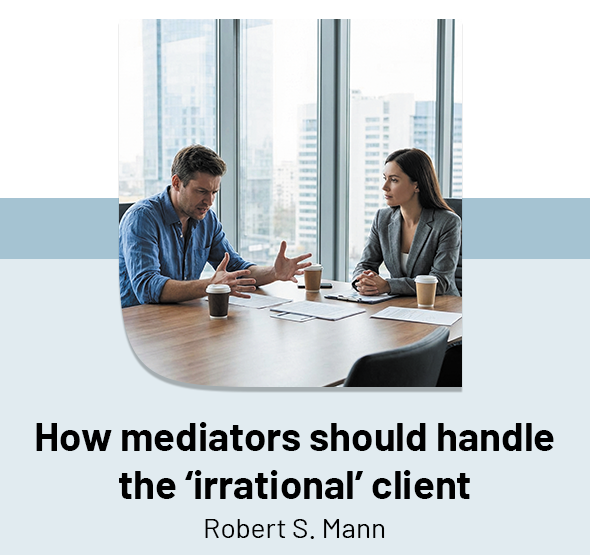
Every seasoned mediator has faced it: the party who rejects objective risk, clings to improbable narratives, interrupts relentlessly or demands outcomes untethered from legal or economic reality. Lawyers often label such participants "irrational," or in more blunt terms, "these people are crazy." Yet in mediation, that label--however tempting--rarely helps. The mediator's task is not to diagnose, dismiss or defeat perceived irrationality. It is to manage it, reframe it and, where possible, transform it into movement.
In a litigation culture increasingly defined by polarization, social media echo chambers and eroding institutional trust, the mediator's skill in dealing with difficult or "irrational" parties has become central to case resolution. This article examines practical strategies for addressing these dynamics while preserving neutrality and advancing settlement.
Rethinking "irrational"
The first step is conceptual. What appears irrational to counsel may be rational within the party's emotional, informational or experiential framework.
A plaintiff who rejects a substantial offer may be responding not to dollars but to perceived disrespect. A defendant who insists on trial despite adverse facts may be defending reputation, not balance sheet. A litigant who clings to conspiracy-like theories may be reacting to trauma or distrust.
Rather than asking, "Why are they being irrational?" mediators should ask, "What need or fear is driving this behavior?" This shift--from judgment to curiosity--changes everything. It is another way of differentiating between "positions," which are largely unimportant and unhelpful to resolution, and "interests," which are key to resolution.
Common forms of "irrational" conduct
Although each case is unique, certain patterns recur:
1. Overconfidence bias: A party believes their case is
airtight despite legal vulnerabilities.
2. Anchoring extremes: Initial demands or offers are so far outside market
norms that they derail negotiation.
3. Emotional flooding: Anger, grief or humiliation overwhelms rational
discussion.
4. Distrust of process: Suspicion that the mediator or opposing counsel is
manipulating information.
5. Identity entrenchment: The dispute becomes inseparable from personal dignity
or moral righteousness.
Each requires a tailored approach.
Establishing psychological safety
Before confronting unrealistic expectations, the mediator must create an environment where the party feels heard. Research in cognitive psychology shows that individuals are more receptive to disconfirming information once they perceive that their perspective has been acknowledged.
Active listening is not theatrical. It is strategic. Reflecting back a party's concerns--without endorsing their conclusions--can reduce defensiveness. Validation of emotion is not validation of fact. But without it, reality testing will likely fail.
Separating emotion from evaluation
Attempting early case analysis with a highly emotional participant is usually counterproductive. When someone is angry or distressed, cognitive processing narrows. The mediator's priority should be emotional regulation.
It's tempting to equate the need to be heard with mere "venting." But allowing the party to be heard, even if that means listening patiently to issues that might be remote from the merits of the case, while still maintaining some boundaries, often diffuses volatility. After expression comes reframing. Emotions can be translated into interests: anger into accountability, fear into security, pride into protection of reputation. Once interests are identified, they can be addressed through creative settlement structures.
Reality testing without alienation
The most delicate task in mediation is challenging unrealistic expectations without damaging rapport. Direct confrontation rarely works. Resistance or "pushback" rarely works. Instead of declaring outcomes, mediators should use incremental questioning that preserves autonomy and allows parties to discover risk rather than be told about it and mediators can often succeed by expressing an understanding of the emotional interest behind the position.
For example, a plaintiff starts a mediation by demanding $500,000 in a case where the damages aren't even close to that number. The plaintiff feels that they acted unfairly and forced him to file a lawsuit and has mistreated him during the litigation process. He says: "I want to be paid for my suffering," even though the facts and law don't support the claim. It's tempting for the mediator to say: "I'm sorry, but your case just isn't worth that kind of money," or "The law doesn't provide that you can recover those damages." That kind of statement is rarely helpful. What may be more helpful is to simply acknowledge the point: "You've been through a lot. I can understand that you feel you are entitled to a lot of money." A discussion about why it might difficult, or impossible, to actually recover those damages in settlement or at trial can occur later.
Working with counsel strategically
When a party appears unyielding, the mediator must assess counsel's role. Effective mediators build alliances with lawyers without appearing aligned. The mediator can serve as a neutral reality filter when counsel cannot deliver hard truths without jeopardizing the attorney-client relationship. However, mediators must avoid becoming the "bad cop." If the mediator is perceived as pressuring one side, trust evaporates.
Addressing distrust directly
Transparency reduces suspicion. Explaining process mechanics--how offers are conveyed, how confidentiality works, what is and is not disclosed--builds credibility. Inviting accountability paradoxically strengthens authority.
Managing extreme anchors
When a party makes an extreme opening demand, mediators should explore its components rather than dismiss it. Breaking down damages categories often reveals areas for adjustment and shifts the conversation from positional to substantive. Often, asking the question: "How do you think a jury might react to this kind of request?" can be helpful to normalize the discussion.
When cognitive distortion is severe
In some cases, shorter sessions, breaks, cautious use of joint sessions or a mediator's proposal may provide structure and facilitate movement. Proposals work best after thorough exploration and when both sides fear appearing weak.
Recognizing trauma and identity injury
In employment, personal injury and partnership disputes, the monetary claim may mask deeper injury--loss of identity, betrayal, humiliation. Non-monetary terms such as neutral references, policy changes, apologies where appropriate or confidentiality provisions can unlock impasse.
Maintaining neutrality under pressure
Neutrality does not mean passivity. It means applying the same rigor to each side's assumptions while preserving trust and credibility.
Self-management: The mediator's discipline
Mediators must monitor their own cognitive biases. A mediator who labels someone irrational risks disengaging from them. Disengagement usually results in the mediator, and then the parties, giving up on the settlement process. Instead, mediators must remind themselves of the need to look behind the positions to the interests. Curiosity can displace irritation.
When settlement is not possible
Even without resolution, mediation can clarify valuation, expose weaknesses, reduce hostility and create a framework for future negotiation. Success should not be measured solely by same-day signatures.
Practical takeaways
1. Replace the label "irrational" with inquiry into underlying needs.
2. Validate emotions before testing assumptions.
3. Use questions, not pronouncements, for reality testing.
4. Leverage counsel strategically but maintain neutrality.
5. Break extreme positions into analyzable components.
6. Consider non-monetary solutions for identity-based disputes.
7. Guard your own objectivity.
Mediation is not simply a numbers exercise. It is a psychological process. The paradox is this: people become more rational when they feel respected.
The difficult party is not an aberration. They are the reason mediation exists.
Robert S. Mann mediates and arbitrates real estate, business and construction disputes at ADR Services, Inc. He can be reached at rmann@adrservices.com.