


Apr. 22, 2026
From bold start to billion-dollar verdicts, Mary Alexander marks 25 years
The pandemic and AI made plaintiffs' law more demanding. Mary Alexander says the work of standing up for injured people makes every challenge worth it.


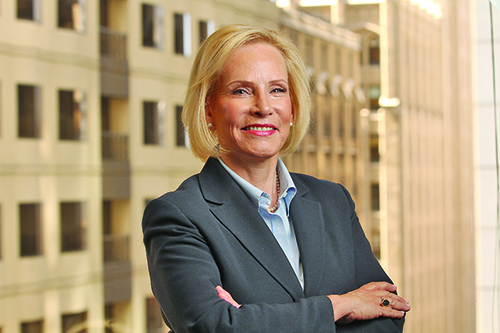
In a 2001 Daily Journal article about her newly launched firm, Mary Alexander made a bold prediction: "I'm going to bring people in and get bigger, and it's going to be great."
Twenty-five years later, Mary Alexander & Associates has secured more than $1 billion in verdicts and settlements, taken on some of California's most consequential civil cases, and established Alexander as one of the state's most recognized plaintiffs' attorneys. Not bad for a toxicologist who didn't go to law school until her husband was dying of leukemia.
"I wanted to make a bigger difference in the health of American workers and consumers through the law than through research," Alexander said. "That's what led me to law school."
While earning a master's degree in public health at UC Berkeley, she came home one evening and mentioned to her husband that she'd attended a lecture on benzene -- a chemical known to cause leukemia. He went pale. Years earlier, working his way through college at a civil engineering firm, he had routinely used pure benzene to test asphalt samples, often over an open burner flame. Two months after that conversation, he was diagnosed with leukemia. He died during her first year of law school.
The experience clarified everything for Alexander and charted the course for her legal career. When she graduated and interviewed at what she described as the top defense law firm in San Francisco at the time, the hiring partner walked her through a new case: a widow and two children suing an oil company because the husband had been exposed to benzene and died of leukemia.
"It wasn't me," she said, "but it could have been me."
She didn't wait for an offer. She turned it down and went to work for plaintiffs.
Alexander founded her firm in 2000 after stints at a couple of plaintiffs' practices, including Sal Liccardo's firm in San Jose. From the start, she said, her goal was straightforward: to get justice for people who'd been hurt, and to do it with compassion.
"I wanted to have a firm that really reflected my goals in representing people," she said, "to hold people accountable that had injured them."
The case that would define the firm's first two decades arrived almost simultaneously with its founding. Alexander was brought into the lead paint poisoning litigation around 2001, joining a team pursuing California counties' claims against paint manufacturers whose products had exposed generations of children to toxic lead in their homes. The case ran nearly 20 years, surviving four appeals before ultimately yielding a $1.15 billion verdict and contributing to a $305 million settlement for 10 counties.
For Alexander, the case was also unusually personal. In her first job out of college as a toxicologist she had worked with lead, in a laboratory, with animals.
"I really loved that case because it combined my science, my toxicology background, my ability to read scientific articles and deal with experts that were scientists and also my practice of law," she said.
That background surfaced memorably at trial when she asked a pediatric researcher what lead paint chips taste like to a child.
"He said, 'It tastes sweet,'" Alexander recalled. "The look on the judge's face!"
The Ghost Ship warehouse fire litigation became another major case for the firm. As liaison counsel for plaintiffs following the December 2016 fire that killed 36 people at an Oakland artist collective, Alexander helped secure a $32.7 million settlement with the City of Oakland and a confidential settlement with PG&E -- while navigating complex governmental immunity questions that required defeating six motions.
"It was such a tragic and preventable way" to die, she said of the victims, many of them young adults whose parents she represented. "That made it so hard."
A decade later, she said, the firm is still working to recover remaining funds from the building's owners.
The firm has also handled clergy abuse litigation, participating in cases against the Roman Catholic Archdiocese of Los Angeles that produced total settlements exceeding $1.5 billion, including an $880 million settlement covering more than 1,300 victims. Child sexual abuse cases -- in schools, at organizations like Big Brothers Big Sisters -- have become a significant part of the practice.
"Those cases are sad," Alexander said, "but it's so satisfying to help people who have struggled for many, many years."
She has drawn on her own experience of loss in that work. Her second husband, she noted, died of cancer caused by Agent Orange exposure in Vietnam.
"Since I know what loss is, and I know what suffering is, I feel like that helps me understand people and help them," she said.
Beyond the courtroom, Alexander served as president of Consumer Attorneys of California during the bruising 2000s tort reform initiative battles and as president of the American Association for Justice -- notably during her first year running the new firm. She has been inducted into the Trial Lawyer Hall of Fame and named trial lawyer of the year by both CAOC and the San Francisco Trial Lawyers Association.
Asked what she would tell the lawyer who made that confident prediction in 2001, Alexander doesn't hesitate.
"Hold on to your seat," she said. "The world has really changed. We went through COVID. Now we've got AI. The practice of law has gotten harder, believe it or not. But I love it. I love representing people and helping them."
The firm's 25th anniversary, she said, is less a moment for looking back than a reaffirmation of what it set out to do.
"For 25 years, we have had the privilege of standing beside our clients and fighting for the justice they deserve," she said. "We are proud of the work we have done on their behalf."
David Houston
david_houston@dailyjournal.com
For reprint rights or to order a copy of your photo:
Email
Jeremy_Ellis@dailyjournal.com
for prices.
Direct dial: 213-229-5424
Send a letter to the editor:
Email: letters@dailyjournal.com