


Civil Procedure
Apr. 23, 2026
Death by rejection: The clerk's office as an unwitting adversary
California's e-filing system can turn minor clerical or formatting errors into dispositive rejections that retroactively jeopardize filings, deadlines and substantive rights.



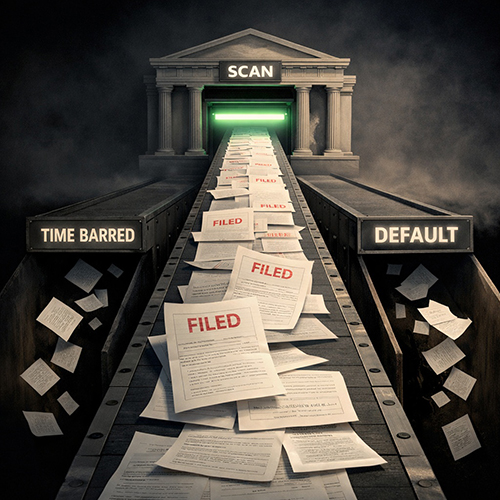
In the modern e-filing system, a document is no longer truly 'filed' when it is submitted--it is only provisionally lodged, subject to later clerical validation that can retroactively determine whether a litigants' rights were ever preserved at all. The following scenarios illustrate the point:
A personal injury complaint is filed days before the two-year statute of limitations runs. Three weeks later, the clerk rejects the filing because the attorney selected the wrong fee category. By the time the rejection notice arrives, the statute has run. The complaint is refiled, but the defendant now has a defense. Cf. Mito v. Temple Recycling Ctr. Corp. (2010) 187 Cal.App.4th 276.
A father timely delivered a notice of appeal from a custody order, but the clerk refused to file it due to a pending fee waiver request and instead file-stamped days later; those days rendered the notice untimely. The mother files a motion to dismiss. Cf. Lezama-Carino v. Miller (2007) 149 Cal.App.4th 55.
An attorney files a cross-complaint. The clerk rejects the cross-complaint because a party name field in the e-filing portal contained a minor error. The attorney corrects the field and resubmits. The clerk now rejects the cross-complaint a second time, this time because it was not filed concurrently with the answer and no leave of court has been obtained. Cf. Bean v. City of Thousand Oaks (2025) 114 Cal.App.5th 775.
The transition from the physical filing window to the digital portal was intended to increase efficiency and accessibility. Electronic filing promised to reduce the burden on court staff and lower costs for litigants. However, this shift has brought with it a significant unintended consequence: the rise of the clerical rejection as a dispositive event in litigation. While court clerks perform an essential service in maintaining the judicial record (and writing from experience, as a former clerk), the practice of rejecting filings for technical or formatting errors has begun to encroach upon the substantive rights of litigants.
The issue is compounded by mandatory Electronic Filing Service Providers. These platforms create a time gap between submission and notification of a rejection. In the paper-filing world, an attorney stood at the window in real time; if there was a problem, it was corrected on the spot. Today, when an attorney hits "submit," a confirmation provides a false sense of security. The document sits in a digital queue, sometimes at length, before a clerk reviews it. If it is rejected, the notification often arrives after a critical deadline has passed.
The fundamental legal principle at issue is that the role of a court clerk is ministerial, not judicial. As the Court of Appeal observed, "It is difficult enough to practice law without having the clerk's office as an adversary." Rojas v. Cutsforth (1998) 67 Cal.App.4th 774, 777. "The functions of the clerk are purely ministerial... The clerk has no discretion to reject a complaint that substantially conforms to the local rules." Id. Yet "proper form" has become increasingly difficult to achieve on the first attempt due to hyper-technical local rules. A missing electronic bookmark to exhibits, a typo in an attorney's address causing a minor discrepancy in their bar profile, or even the wrong "filing category" selected in the e-filing system is often treated as a rejection-worthy defect. When a clerk rejects a document for these reasons, the clerk is determining that the filing is null --a power that historically belongs to the judge. If a document complies with the rules of court, the clerk has a ministerial duty to file it. See Carlson v. Department of Fish & Game (1998) 68 Cal.App.4th 1268, 1276.
Our legal system is adversarial. If a complaint is legally insufficient, opposing counsel has remedies, whether it be a demurrer, motion to strike or another tool. If a motion is procedurally flawed, opposing counsel can object. When a clerk preemptively rejects a filing, the clerk bypasses this mechanism and resolves a dispute before it reaches the bench, performing preemptive strikes on behalf of the opposition. Courts have recognized this very issue, agreeing with the Carlson court that "the local superior court may not condition the filing of a complaint on local rule requirements. Instead, so long as a complaint complies with state requirements, the clerk has a ministerial duty to file." Mito v. Temple Recycling Ctr. Corp. (2010) 187 Cal.App.4th 276, 280.
The urgency of this problem is most apparent in matters involving narrow timing windows. If a clerk rejects an ex parte application because a declaration was not separated into a distinct PDF or a fee was coded incorrectly, the emergency hearing is effectively canceled. The emergency does not wait for the clerk's queue to clear. The same peril applies to the filing of trial documents, summary judgment motions or even case management conference statements. A clerical rejection of an Answer on a Friday afternoon can leave a party exposed to a default on Monday morning.
A significant impact is felt at the intersection of the statute of limitations and court backlogs. A complaint filed close to the limitations deadline may wait in a queue for days or weeks. If the clerk rejects it, the notification often arrives after the limitations period has expired. Because the rejection treats the original submission as if it never occurred, the plaintiff's claim may be barred. The courts have recognized that a paper is deemed filed when it is deposited with the clerk with directions to file it. Rojas, supra, 67 Cal.App.4th at p. 778. Courts may issue nunc pro tunc orders when a clerk improperly rejects a filing (Id. at pp. 776-778), but this forces the litigant into secondary motion practice to recover a right that should never have been taken.
We must also consider public trust. When the system prioritizes administrative perfection over the merits of a grievance, faith in the judiciary erodes, especially for self-represented litigants who lack the expertise to navigate modern e-filing portals.
At the same time, it would be incomplete to view this issue without acknowledging the operational realities facing clerk's offices. Obviously, not all rejections are improper; certain filings must still be refused to preserve the integrity of the court's processes.
Court staff are contending with historically high case inventories, reduced staffing and significant filing backlogs, all while adapting to relatively new e-filing infrastructures that shift (not eliminate) the administrative burden. In that environment, clerical review often becomes a form of triage, with staff under pressure to enforce compliance quickly and consistently across thousands of submissions. The rise in technical rejections is not simply the product of overreach, but also a predictable byproduct of systemic strain. Recognizing this context does not excuse the outcomes that impair substantive rights, but it underscores that the problem is structural: a system that demands near-perfect technical compliance at scale, while operating under resource constraints, will inevitably produce results that disadvantage litigants.
The solution is a shift in how we view the act of filing. If a document contains the essential elements of a legal filing, it must be accepted. If it contains defects, the clerk's office should still file it and notify the party such that the defect may be addressed. The adversarial system can handle defective filings through existing remedies like motions or amended pleadings. The ministerial duty of the clerk is to serve the court and the public by maintaining the record. By prioritizing substance over form, we can ensure that the transition to digital courts remains a step forward for justice. It is time to return the power of determining the validity of a filing to the bench, and to the adversarial process where it belongs.
Submit your own column for publication to Diana Bosetti
For reprint rights or to order a copy of your photo:
Email
Jeremy_Ellis@dailyjournal.com
for prices.
Direct dial: 213-229-5424
Send a letter to the editor:
Email: letters@dailyjournal.com