


Antitrust & Trade Reg.
May 4, 2026
Cleared in Washington, blocked in London: Paramount-Warner Bros. and the long arm of the CMA
The U.K.'s upcoming Competition and Markets Authority evaluation of the proposed Paramount-Warner Bros. transaction illustrates a growing reality in global merger review: Approval from U.S. regulators is no longer sufficient to ensure a deal's completion.



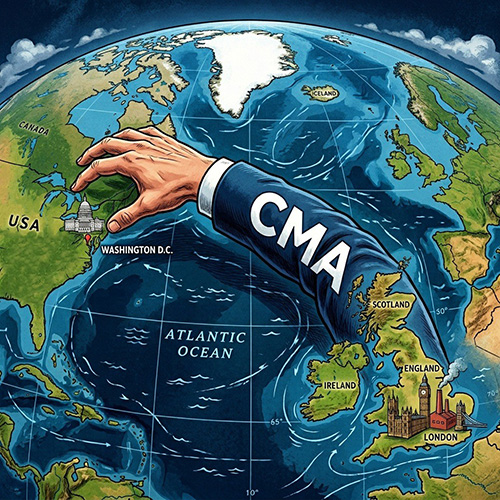
The upcoming Competition and Markets Authority (CMA) evaluation of the proposed Paramount-Warner Bros. transaction illustrates a growing reality in global merger review: approval from U.S. regulators is no longer sufficient to ensure a deal's completion. As the CMA undertakes its own assessment, U.K. clearance is now an imperative checkpoint for transactions negotiated and centered in the United States. That dynamic reflects not only the CMA's expanding jurisdictional reach but also meaningful differences between U.S. and U.K. antitrust analysis--particularly in how markets are defined and competitive effects are evaluated. For U.S.-based companies, the implication is clear: foreign regulatory exposure must be incorporated into deal strategy from the outset rather than treated as a secondary consideration.
I. An evolving framework: U.S. and U.K. approaches to merger review
In the U.S., merger review remains grounded in the statutory framework of the Clayton Act Section 7 and is reflected in the 2023 Merger Guidelines issued by federal enforcers. At its core, the inquiry is whether a transaction may substantially lessen competition, but the way that question is answered has evolved. Agencies continue to begin with market definition and competitive overlap yet increasingly place weight on how firms interact across related markets, the role of vertical and horizontal integration, and the broader structure of the industry in which the deal occurs. This evolution is particularly evident in industries characterized by high fixed costs, a limited number of significant competitors, and repeated interaction among those firms. In such settings, regulators are looking beyond traditional concentration metrics to assess whether a transaction alters incentives in ways that could facilitate coordination or reduce competitive intensity over time. The analysis is therefore more forward-looking, focusing not only on present competitive conditions but also on how the combined firm may reshape future behavior.
At the same time, U.S. enforcement remains shaped by institutional and procedural constraints. The United States Department of Justice Antitrust Division or Federal Trade Commission must ultimately defend its theories in court, which reinforces a relatively structured analytical approach grounded in defined markets, evidentiary review and analysis, and demonstrable competitive effects. As a result, while U.S. merger review has incorporated more structural and dynamic considerations, it continues to operate within a framework that is disciplined by judicial review and established legal standards.
Under the U.K.'s merger control regime, the CMA generally has jurisdiction where either (i) the target's U.K. turnover exceeds £100 million, or (ii) the parties' activities give rise to a "share of supply" of at least 25% in the U.K. (or a substantial part of it) and the transaction results in an incremental increase--subject to a safe harbor where each party's U.K. turnover does not exceed £10 million. If the CMA opens an investigation, it can impose interim measures (including hold-separate/anti-integration obligations) to prevent pre-emptive action, and it may ultimately prohibit the merger or require remedies, including divestitures, to address any substantial lessening of competition.
On paper, those remedies are local. In practice, they are global. A merged content company cannot run one set of licensing, distribution and technology arrangements in the United States and a separate set in the United Kingdom, so a U.K.-only divestiture typically forces the parties to restructure the entire transaction. The DOJ, by comparison, must sue in federal court to stop a deal and has lost several recent challenges, while the CMA acts administratively, moves faster and imposes binding remedies without the equivalent litigation risk.
II. Market definition divergence
The CMA and DOJ start from different premises. The CMA applies a "substantial lessening of competition" standard that is fact-driven and flexible, drawing market boundaries from internal business documents, consumer survey data, and the realities of how U.K. audiences consume content. The DOJ, under its 2023 Merger Guidelines, leans more heavily on the hypothetical monopolist test and structural presumptions triggered by HHI thresholds that were deliberately lowered to catch more deals. The practical consequence for Paramount-Warner Bros. is that the same transaction can face narrow U.K. markets showing acute concentration while the U.S. analysis frames broader markets where the deal looks defensible.
III. Microsoft/Activision and GE/Honeywell -- The precedents to cite
Two cases bracket the risk. GE/Honeywell (2001) was the first transaction cleared by U.S. authorities and blocked by a foreign regulator, the European Commission, and it permanently reshaped how American boards think about extraterritorial antitrust. Microsoft/Activision updated the lesson for the CMA era: the FTC lost in federal court, the European Commission cleared with behavioral remedies, and the CMA initially prohibited the transaction, forcing Microsoft to divest cloud streaming rights to Ubisoft specifically to satisfy British concerns. That structural divestiture then applied globally.
Together, these cases establish a durable rule: the toughest regulator dictates the remedy package for the entire deal. Since 2023, that regulator has increasingly been the CMA rather than Brussels or Washington.
IV. From U.S. clearance to global constraint
For U.S. dealmakers, the key shift is that merger outcomes are no longer determined primarily in Washington. Clearance from the United States Department of Justice Antitrust Division or the FTC was once seen as the central hurdle; today, transactions must withstand scrutiny from multiple regulators, including the CMA, the European Commission, and authorities in jurisdictions such as China, Brazil and others with merger control regimes. Even individual U.S. states have increasingly challenged mergers with effects in their boundaries. Although the CMA cannot formally block a U.S. merger, it can prevent the combined firm from operating in the United Kingdom. For global businesses, that constraint can be outcome-determinative. As a result, companies increasingly must evaluate whether a deal can satisfy the most demanding regulator in the review process rather than focusing solely on U.S. approval.
This dynamic is reinforced by the CMA's use of conditional approvals. Rather than a simple yes-or-no decision, clearance often depends on implementing remedies--such as divestitures or behavioral commitments--that may affect the firm's operations beyond the U.K. In practice, the most interventionist regulator can shape the structure of the deal itself. Following Brexit, the CMA's independence from the European Union has further elevated its role, making foreign regulatory strategy a principal component of deal planning.
Indeed, post-Brexit, the CMA is positioning itself as an independent global competition authority rather than a Brussels echo. The Digital Markets, Competition and Consumers Act 2024 expanded its toolkit with strategic market status designations and stronger investigative powers over digital platforms. The U.K. government has publicly pressed the CMA toward a more pro-growth posture, yet the agency's media and digital-markets staff remain interventionist, particularly where U.K. public service broadcasters, content plurality and premium sports rights are at stake.
For U.S.-based companies, this creates a commercial and diplomatic paradox: The CMA's willingness to shape the contours of transatlantic deals now factors into U.S.-UK trade relations, and American boards would be well-advised to account for CMA review at the deal-structuring stage rather than treat it as a downstream formality.
Submit your own column for publication to Diana Bosetti
For reprint rights or to order a copy of your photo:
Email
Jeremy_Ellis@dailyjournal.com
for prices.
Direct dial: 213-229-5424
Send a letter to the editor:
Email: letters@dailyjournal.com