


Constitutional Law
May 5, 2026
The deterioration of the Voting Rights Act: From preclearance to Louisiana v. Callais
The Supreme Court's 6-3 ruling in Louisiana v. Callais fundamentally undermined the Voting Rights Act by requiring proof of intentional discrimination under Section 2, making majority-communities of color districts far harder to create and defend.


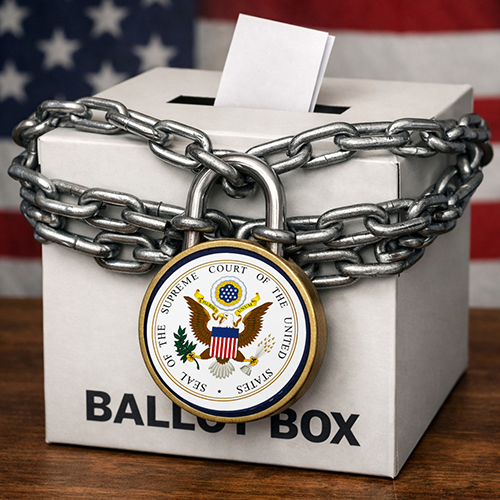
The Voting Rights Act of 1965 (VRA) was enacted to enforce constitutional guarantees of equal voting rights and to eradicate entrenched racial disenfranchisement that persisted nearly a century after ratification of the Fifteenth Amendment. Congress designed the Act in response to post-reconstruction Jim Crow-era practices, such as poll taxes, literacy tests and violence that suppressed Black political participation. A core feature was the preclearance regime, which required jurisdictions with documented histories of discrimination--among them Alabama, Georgia, Louisiana, Mississippi, South Carolina, and Virginia, plus parts of North Carolina--to obtain federal approval before changing election laws. The Department of Justice has described the VRA as among the most successful civil rights statutes ever enacted, producing dramatic gains in voter registration and representation for Black Americans.
The erosion of preclearance and the path to today
The Supreme Court's modern doctrine has progressively weakened the VRA's prophylactic protections. In 2013, the Court's decision in Shelby County v. Holder 570 U.S. 529 (2013) eliminated the effective operation of preclearance by allowing covered states to change election laws without federal pre-approval, which contributed to a wave of restrictions in Republican-led states. This loss of front-end federal review shifted the burden to after-the-fact litigation, heightening the importance of Section 2--the VRA's nationwide ban on voting practices that leave voters in majority of color communities with less opportunity to participate and elect their candidates of choice.
Louisiana v. Callais: The majority's reinterpretation of Section 2
The Court's decision in Louisiana v. Callais, Et Al. No.24-109 (see, Affirmed and remanded) marks a decisive turn in Section 2 jurisprudence. The case arose after a federal court found Louisiana's 2022 map likely violated Section 2 for failing to include a second majority-Black district despite Black residents constituting roughly one-third of the state's population. When the state enacted a new map (SB8) [see, SB8 Act 2] adding a second majority-Black district, a three-judge court struck it down as an unconstitutional racial gerrymander, and the Supreme Court affirmed in its April 29, 2026, 6-3 decision.
In doing so, the majority reframed the operative standard under Section 2. Justice Alito's opinion characterizes Section 2's "less opportunity" language as guaranteeing only the opportunity that results from a state's permissible, race-neutral districting criteria, and it grounds Section 2's enforceability in evidence supporting a "strong inference" of intentional discrimination rather than disparate impact. The Court asserts that this reading both "updates" the Gingles framework and aligns Section 2 with the Fifteenth Amendment's focus on intentional discrimination, stating that Section 2 imposes liability only when the state intentionally affords voters of color less opportunity because of race. Applying that approach, the majority held Louisiana's SB8 unconstitutional because the VRA did not compel creation of an additional majority-minority district, and the state lacked a compelling interest to use race in districting as it did.
Practical effects on majority-persons of color districts and litigation
The decision's immediate and downstream consequences are substantial. By striking down Louisiana's second majority-Black district as a racial gerrymander, the Court set a precedent likely to make it harder for lawmakers to create and defend majority-persons of color districts crafted to comply with the VRA. The ruling limits court-ordered redistricting that intentionally uses race as a factor, weakening a central tool that civil-rights groups have long used under Section 2 to prompt maps that boost persons of color voting power. States across the South and beyond that drew majority-persons of color districts to comply with the VRA may now face a new wave of challenges seeking to dismantle those districts. Political actors are already moving to redraw maps under the new rules, with several states advancing or considering maps expected to increase Republican representation.
Impact on Black Americans' voting power
Civil-rights leaders and affected representatives forecast material diminishment of Black electoral influence. Representative Cleo Fields, whose district was central to the case, stated the ruling will make it far harder for communities of color to challenge maps that dilute their political voice. Advocates at the NAACP Legal Defense Fund and ACLU warned that, without an enforceable Section 2 capable of sustaining race-conscious remedies, legislatures will face far fewer constraints on maps that undercut the voting strength of communities of color. The Court's majority, for its part, cited "vast social change" and the narrowing racial gap in registration and turnout to justify reducing reliance on race in districting.
Conflict with the VRA's original purposes
The VRA's animating purpose was to secure equal access and effective electoral opportunity for Black voters in jurisdictions with persistent discrimination, employing robust federal oversight and, when necessary, race-conscious line-drawing to prevent dilution. By discarding preclearance in Shelby County and now elevating Section 2's threshold toward proof of intentional discrimination while disfavoring race-conscious remedies, the Court has curtailed the very mechanisms that historically enabled voters in historically intentionally excluded communities of color to translate the force of their population and turnout into representation. The dissent characterized Louisiana v. Callais as a now-completed demolition of the VRA's protections, warning it will set back the foundational right to racial equality in electoral opportunity. On the ground, the ruling is expected to spur rapid redistricting that reduces majority-communities of color districts and to complicate challenges to vote dilution, outcomes in palpable tension with the Act's original role as the "crown jewel" of the civil-rights era.
Conclusion
From the dismantling of preclearance to the redefinition of Section 2 in Louisiana v. Callais, the Supreme Court's recent path has transformed the VRA from a proactive shield into a reactive, intent-focused tool that is harder to wield. States are already mobilizing to redraw maps under the new standards, and civil-rights groups anticipate intensified litigation with diminished prospects for establishing and preserving majority-persons of color districts. In both doctrine and effect, these shifts conflict with the VRA's original purposes of ensuring equal electoral opportunity and preventing the dilution of Black political power.
Submit your own column for publication to Diana Bosetti
For reprint rights or to order a copy of your photo:
Email
Jeremy_Ellis@dailyjournal.com
for prices.
Direct dial: 213-229-5424
Send a letter to the editor:
Email: letters@dailyjournal.com