


Intellectual Property
Jun. 16, 2026
Jury rejects UGG patent claim against Quince over boot design
After hearing competing arguments over copying and patent validity, an Oakland jury found that Quince did not infringe Deckers Outdoor Corp.'s design patent covering the UGG Classic Ultra Mini boot.


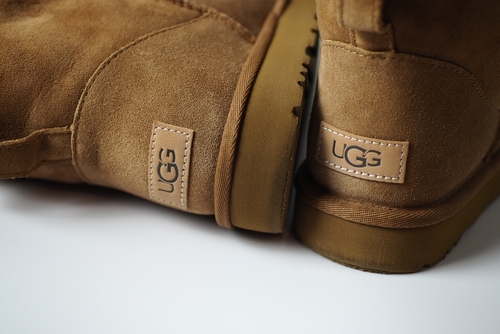
After less than a day of deliberations following closing arguments Monday, an Oakland jury sided with online retailer Quince in a patent lawsuit brought by UGG parent Deckers Outdoor Corp. over a low-cut sheepskin boot design.
Deckers sued Quince -- incorporated as Last Brand Inc. -- seeking an injunction against alleged infringement of U.S. Design Patent No. D927,161, which covers the design of the UGG Classic Ultra Mini boot.
Quince, which offers lower-cost versions of products sold by higher-end brands, argued that the two boots are substantially different and that, regardless, the patent is invalid. The jury ultimately declined to find Quince liable. The jury found that Quince's product infringes on the patent, it decided that the patent was invalid, Morrow said.
"We're thrilled to have vindicated Quince's mission," Quince attorney Xinlin L. Morrow of Morrow Ni LLP said. "This is a win for consumer rights. We believe the patent was invalid because they covered a basic design that shouldn't be owned by a single corporation and we're happy that a federal jury agreed with us."
Thorpe North & Western partner Jed H. Hansen represented Deckers at closing arguments Monday, urging jurors to focus on the overall appearance of the boots rather than the technical details of the patent drawings.
"You heard a great deal about lines," Hansen said in his closing argument Monday. "You heard about solid lines. You heard about dashed lines." Deckers Outdoor Corporation v. Last Brand, Inc., 4:23-cv-04850 (N.D. Cal., filed Sept. 21, 2023).
At its core, Hansen said, the case was simple.
"Quince got caught copying and now they want you to let them keep doing it," Hansen said.
The plaintiff initially made trade dress infringement claims as well, but U.S. District Judge Araceli Martinez-Olguin struck them at the summary judgment phase.
Hansen told the jury not to focus on the intricacies of the two boots and instead to consider their general designs.
"This isn't someone looking at boots under a microscope... If the two designs are substantially the same, that is infringement," Hansen said.
Quince countered that UGG's patent was too vague and broad to be valid.
"A single corporation cannot own a basic design like this," Morrow told the jury.
Morrow argued that the lines do, in fact, matter. The UGG boot has curved lines, giving the design a distinct look, while the lines on Quince's model are straight. The two boots have different ankle shapes as well, she said.
Deckers' expert, disputing an example Quince presented of a prior design that would render the patent invalid, said the two boots had distinct ankle shapes. But the company turns around and says the Quince boot infringes on its patent despite having a distinct ankle, Morrow said.
"Deckers can't have it both ways," Morrow said.
Morrow also argued that the patent is invalid because its drawings fail to adequately distinguish between different design features. The drawings, she said, contain both yellow and green lines across the shoe. One color must represent seams while the other represents contours, but it never says in the patent which color represents which feature. That means the patent doesn't sufficiently describe how to recreate the design, a requirement for a valid patent.
Morrow also argued that the design, a simple low-cut sheepskin boot, is obvious and simply combines widespread elements from different existing boot styles.
"That's not inventive. That's not what patent law is designed to protect," Morrow said.
Hansen countered that Morrow's argument required starting with the UGG design and assuming it is a "template" for all low-cut sheepskin boots.
"That's not how obviousness works," Hansen said.
Hansen argued that Quince's decision to copy the design undermined its contention that the patent was obvious.
He repeatedly pointed to Quince's internal development document for the boot, which instructed the manufacturer on how to produce it. The document includes a reference for the manufacturer: a link to the UGG Classic Ultra Mini. Beyond showing infringement, Hansen said, the document refutes the obviousness argument because Quince would not have instructed the manufacturer to directly copy a generic, widely available design.
"Well they didn't copy those other boots... because they wanted to ride off of Deckers. They copied the Ultra Mini," Hansen said.
Quince also didn't employ a shoe designer at the time the boot was developed, he said.
"It wanted in on it but it didn't want to pay," Hansen said.
Hansen acknowledged the examples of prior art but said the jury had to ask itself whether the UGG boot was closer to those designs than the Quince boot is to the UGG boot.
Even if the jury sided with Deckers on those questions, Morrow said, the patent is invalid because the design is largely functional. Morrow asked the jury to imagine a brick wall. If someone tried to patent the look of brick, it would prevent anyone else from building as strong a wall. The supposedly distinct elements of UGG's design -- its seams, shape, pull tab and top line -- all serve functional purposes, she said, and therefore cannot be protected by a patent.
But Hansen said the analogy doesn't work because the design as a whole is not functional, even if certain minor elements are.
Hansen ended his rebuttal with a nod to the two companies' different business models and the practice of producing low-cost alternatives to brand-name designs, commonly called "dupes."
"Remember Exhibit 149, remember that they specifically matched the Ultra Mini," Hansen said. "Don't be duped. Make them stop."
Morrow agreed that Quince's business model was at the center of the case, but offered a different perspective.
"Will the American consumers continue to have options in the marketplace?" Morrow said.
Daniel Schrager
daniel_schrager@dailyjournal.com
For reprint rights or to order a copy of your photo:
Email
Jeremy_Ellis@dailyjournal.com
for prices.
Direct dial: 213-229-5424
Send a letter to the editor:
Email: letters@dailyjournal.com