


Wills, Estates & Trusts
Sep. 9, 2026
Beyond grantmaking: Why estate planners should prepare clients for the next generation of philanthropy
See more on Beyond grantmaking: Why estate planners should prepare clients for the next generation of philanthropy



Elizabeth A. Bawden
Partner
Withers
Email: elizabeth.bawden@withersworldwide.com
Elizabeth is a partner in the firm's trusts, estates, and charitable planning group at Withers, where she sits in firm's Los Angeles office.
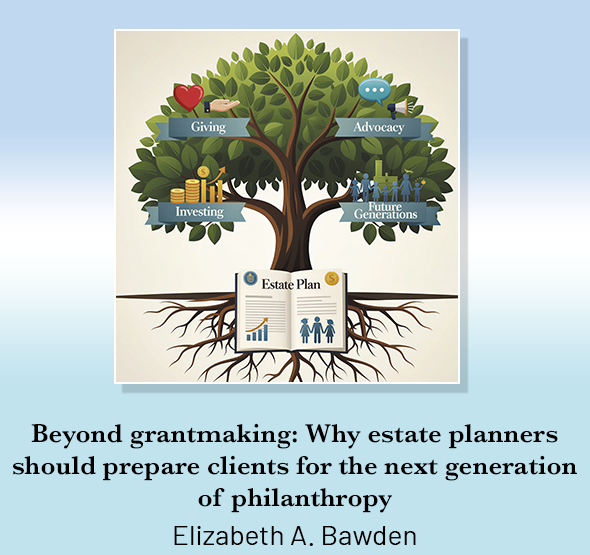
The traditional estate planning conversation about philanthropy centers on charitable giving: What causes does a client want to support at death and how? The plan may include an outright gift to a charity or an enduring gift through an endowment, charitable trust, fund or foundation. Those gifts may be exactly right. But a lawyer who focuses only on conventional charitable giving may miss other ways to support the client's philanthropic goals.
The Philanthropic Initiative's 2026 study of professional advisors, including trust and estate attorneys, and high-net-worth clients confirmed an important disconnect: clients want their advisors to initiate philanthropic conversations, are far less focused on tax reduction than advisors assume, and place greater emphasis on achieving impact than many advisors recognize. For estate planners who want to add value as trusted advisors, understanding philanthropy beyond charitable giving is increasingly important.
Beyond traditional charitable giving
Traditional charitable giving is only one part of philanthropy. Melinda French Gates says, "Philanthropy is not about the money. It's about using whatever resources you have at your fingertips and applying them to improving the world." An estate planner who focuses only on tax-deductible gifts may therefore see only part of what a client wants to accomplish.
Clients also have philanthropic tools beyond traditional grants. They may participate in giving circles or donor networks; make mission-aligned or impact investments intended to generate social or environmental impact alongside financial return; provide philanthropic capital through loans, guarantees and recoverable grants (tools that help charities attract additional capital and pursue impact that traditional grantmaking alone may not achieve); engage in advocacy, influencing or crowdfunding; or support tax-exempt non-charities. Business owners such as Patagonia founder Yvon Chouinard have also used non-charitable structures to combine business ownership and advocacy in ways that would be difficult through a traditional charity.
The new philanthropy conversation
Estate planners may hesitate to discuss broader philanthropic tools because they are not investment advisors or philanthropy experts, or because they assume those options are too complex or inappropriate for the client's wealth level. But clients cannot choose among possibilities they do not know exist. Our role is to understand their goals, make relevant choices visible and design legal structures that support the impact they want to achieve.
Estate plans must also anticipate future generations whose approach to philanthropy may differ significantly from that of today's clients. The Indiana University Lilly Family School of Philanthropy's 2025 Next Generation of Philanthropy Study found that Gen Z and Millennial donors increasingly seek "long-term, hands-on involvement with the issues that are important to them."
This does not mean estate planners should become investment advisors, philanthropic consultants or experts in every emerging strategy. Our role is different: to understand enough to recognize when a client's goals extend beyond a conventional charitable gift, ask the questions that reveal those goals and design documents that preserve appropriate flexibility. Other advisors can help evaluate particular investments, organizations or strategies. The estate planner's contribution is to ensure the legal structure can support the client's objectives over time.
5 ways to get started:
Ask. Ask every client whether philanthropy matters to them, and if it does, ask with curiosity what they want their wealth to accomplish.
Expand the options. Make clients aware of both traditional charitable tools and broader philanthropic possibilities. You need not master every option, but should know enough to identify possibilities, explore further when a client is interested and provide resources or referrals when appropriate.
Identify easy wins. Help clients choose the right assets for philanthropic gifts, such as considering taxable retirement assets before assets that may pass to family with a basis adjustment. Carefully identify charitable recipients and coordinate beneficiary designations needed to accomplish the plan. For clients with developed philanthropic goals, suggest a letter of wishes explaining those goals to future fiduciaries or family members.
Draft for participation and flexibility. For clients who currently make charitable gifts, discuss whether their agent or trustee may continue gifts upon their incapacity and draft trusts and powers of attorney accordingly. When creating trusts for future generations, consider drafting distribution, investment and delegation provisions to allow for broader philanthropic activity. Do the trust's investment provisions permit mission aligned or impact investments? Can a beneficiary receive a distribution to pursue hands-on philanthropy work? Does the trust permit tax-deductible charitable giving (flexibility can be granted by giving a beneficiary a power to appoint income annually to charity)?
Educate yourself. An estate planner does not need to become a philanthropy expert to have better conversations with clients. Small changes like intentionally taking notice of philanthropy stories in the news and seeking out conversations with colleagues and other advisors about philanthropic strategy broaden an estate planner's ability to support clients who want to achieve impact.
The most valuable philanthropic conversations are no longer about tax deductions or charitable vehicles alone. They are about purpose, impact, and aligning wealth with a client's values across generations using a broader approach and range of tools. Estate planners are uniquely positioned to help clients define what they want their wealth to accomplish and ensure that the legal structures governing that wealth support those aspirations. Estate planners who ask better questions, introduce clients to a broader range of options and draft with flexibility can build stronger plans while deepening their role as trusted advisors.
Elizabeth A. Bawden is a partner in the private client and tax team at Withers.
For reprint rights or to order a copy of your photo:
Email
Jeremy_Ellis@dailyjournal.com
for prices.
Direct dial: 213-229-5424
Send a letter to the editor:
Email: letters@dailyjournal.com