


Environmental & Energy
Oct. 7, 2026
Regulating the market for pore space: California's attempt to map out a new frontier
California's proposed framework for carbon sequestration projects seeks to prevent landowner holdouts through unitization but may require significant revisions to address constitutional takings concerns and other legal and regulatory obstacles.



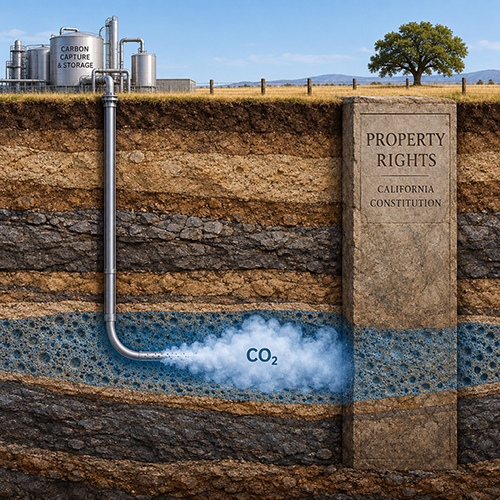
In 2022, the California Legislature enacted Senate Bill (SB) 905, directing the California Natural Resources Agency (CNRA) to publish a framework for developing government sanctioned agreements to manage multiple tracts of land overlying a geologic storage reservoir for purposes of operating a carbon dioxide sequestration (storage) site. This process, known as unitization, ensures that holdout property interests cannot derail a carbon capture and sequestration (CCS) project or leverage a minority interest to extort windfall compensation and thereby undermine the State's strong interest in promoting such projects. California has long recognized that overlying landowners have co-equal (or correlative) rights to the reasonable and beneficial use of migratory resources in a shared aquifer or reservoir and used unitization to resolve conflicting interests in such resources. (See City of Barstow v. Mojave Water Agency, 23 Cal. 4th 1224, 1240 (2000); Katz v. Walkinshaw, 74 P. 766, 770-72 (Cal. 1903)). The application of this concept to allocate rights to use pore space - a fixed, stationary physical attribute of the subsurface estate - is not entirely straightforward, however, and the Draft Framework for Governing Agreements Pertaining to Carbon Sequestration (Draft Framework) that CNRA published on July 3, 2026 to satisfy SB 905's requirements should give this reality, and constitutional takings protections, more serious consideration to avoid legal challenges and programmatic delays that have plagued other states' unitization plans.
Problem to be Addressed: The Impact of Holdouts
California has a well-documented public interest in creating conditions that will allow large-scale deployment of CCS technology throughout the state. California's 2022 Climate Change Scoping Plan identifies CCS as a key technology to support achievement of the state's greenhouse gas reduction goals, including carbon neutrality by 2045. In addition, Governor Newsom has directed the California Air Resources Board (CARB) to establish a carbon capture and removal target of 20 million metric tons (MMT) in 2030 and 100MMT in 2045 as key elements of the state's strategy to combat climate change. Site control of storage facilities, among other things, is a critical component of achieving the state's targets, and this is where the nature of the operations presents a potentially intractable problem.
CCS projects involve pressurizing carbon dioxide (CO2) captured from emitting sources (e.g. natural gas power plants) or directly from the air, and injecting the CO2 in a supercritical liquid state deep into porous rock formations (reservoirs) that will safely and permanently contain the CO2 beneath an impermeable layer of cap rock, in perpetuity. The large reservoirs needed to support ongoing capture operations often exist below multiple tracts of land with multiple surface and mineral rights owners, any one of which, or a handful whom, might refuse to authorize the use, whether in an attempt to negotiate for more compensation or just on principled opposition to carbon capture. Typically, the use of another's pore space will not interfere with their use and enjoyment of other property rights, but that consideration is not particularly relevant in cases of permanent physical occupation, which raises questions about how landowners should be compensated if they are forced to participate in a sequestration project.
CNRA's Proposed Response to Address Holdouts
To address these challenges, Public Resources Code section 71461(a) directs CNRA to develop recommendations addressing (1) the appropriate state agency for reviewing and approving unitization agreements; (2) a consent threshold requiring proponents to hold at least three-fourths of the total interests; (3) standards for fair and reasonable compensation; (4) good-faith-offer requirements; (5) surface-access standards for post-injection monitoring; (6) liability-allocation standards; (7) financial-responsibility standards; (8) royalty-payment allocation standards; and (9) any other requirements to comply with state or federal legal or constitutional standards. The aforementioned Draft Framework dutifully provides nine categories of recommendations corresponding with the directions in Section 71461. These include the following:
Recommendations 1a-1b (Agency Review and Hearings): The Department of Conservation would be designated as the "Reviewing Agency" and would draw on the experience of its Geological Energy Management Division (CalGEM) to assess the adequacy of the pore space procured. Publicly noticed hearings would be required when nonconsenting owners are involved (implying that the State would still require, and review for approval, unitization agreements where the proponent independently secures 100% of the pore space - just without a public hearing). The proponent would be responsible for providing the hearing notice to a variety of affected and interested parties. The Reviewing Agency would retain jurisdiction to add additional landowners to the unit and the agreement if the CO2 migrates beyond the original storage site, with compensation retroactive to when migration occurred.
Recommendation 2 (75% Consent Threshold): Proponents would be required to produce written, recordable consent from holders of 75% of the interests to be unitized, calculated by modeled storage volume or, in the alternative, surface-acreage.
Recommendation 3 (Fair Compensation Standards): The Reviewing Agency would determine just compensation based on comparable arm's-length agreements negotiated in good faith and any opposition evidence from property owners. The Reviewing Agency would additionally collect and publish values determined to be fair compensation to increase transparency. The published data might consist of anonymized ranges of values to avoid undermining competition for pore space, but the decision on what to publish and how would be left to the discretion of the Reviewing Agency.
Recommendation 4 (Good-Faith-Offer Verification): Proponents must make good-faith offers to all holders of property interests relevant to the CCS project; documentation of the same shall be submitted to the state review and release to the public.
Recommendation 5 (Surface Access for Post-Injection Monitoring): Unitization agreements should clearly articulate surface-site access, allow for "third-party" monitoring, and provide for amendment to satisfy future regulatory requirements. These requirements would apply to all parcels, even though only a handful of wells are needed to inject and monitor sites consisting of several thousand acres.
Recommendation 6 (Liability Allocation and Recording): Unitization agreements should clearly allocate liability for a defined set of damages "caused by the operation" to the proponent and require that any financial instruments name surface owners as third-party beneficiaries and be recorded against the appropriate legal estate.
Recommendation 7 (Financial Assurances): Unitization agreements should incorporate applicable regulatory financial-responsibility requirements, including at least 100 years of post-injection monitoring coverage.
Recommendation 8 (Parity Compensation): Nonconsenting owners must receive the same type and amount of compensation accepted by at least 75% of consenting owners.
Recommendation 9 (Other Considerations): Warns that (i) grants of rights to use pore space for CO2 storage are not expressly exempt from the Subdivision Map Act; (ii) subsurface trespass based on Civil Code section 3334 may be actionable (although unclear if this is still the case if the Reviewing Agency expands coverage of the unitization agreements in response to migration); and (iii) securing Reviewing Agency approval of unitization agreements is subject to the California Environmental Quality Act (CEQA) and its potentially lengthy review timelines.
Although the Recommendations represent a positive development and evince California's continued commitment to advancing carbon capture as part of the state's efforts to arrest and combat climate change, there are several issues that must be addressed in the Draft Framework, some big and some small, to ensure that it does not impede progress.
Potential Constitutional Issues with State Sanctioned Use of Pore Space
First and foremost, the Draft Framework raises constitutionality concerns that need to be resolved. Article I, Section 19 of the California Constitution provides that "Private property may be taken or damaged for a public use and only when just compensation, ascertained by a jury unless waived, has first been paid to, or into court for, the owner." This provision is broader than the Takings Clause of the U.S. Constitution, as it protects against property being "damaged" for public use, it guarantees a jury determination of just compensation, and it requires pre-payment of compensation. Like the federal Constitution, however, it additionally requires just compensation for the permanent physical occupation, a per se taking, of property. As demonstrated by recent trial court decisions in North Dakota that assessed the constitutionality of a pore space pooling statute against a similar constitutional clause (discussed in more detail below), the recommendations in the Draft Framework are potentially at odds with several aspects of the California Takings Clause.
Justifying Unitization as an Exercise of the Police Power
Preliminarily, this potential conflict could be a moot point if unitization for CCS is viewed not as an act of eminent domain, but instead as an exercise of the state's police power. Courts have upheld oil and gas pooling and unitization statutes against constitutional takings challenges, reasoning that a forced pooling order is "a proper exercise of the police power in furtherance of conservation of natural resources." (Anderson v. Corp. Comm'n of Ok., 327 P.2d 699 (Ok. 1957); Bandini Petroleum Co. v. Superior Ct., 110 Cal. App. 123, 128-29 (1930).) Unlike with eminent domain, where the government takes private property and therefore must compensate the owner, exercising police power only restricts how property is used and is further justified as a means to prevent public harm or protect public assets from waste, depletion, or environmental damage. In the latter context, involving reliance on the aforementioned correlative rights doctrine, the government has more latitude to intervene when private markets fail.
Binding authority has not yet resolved the debate regarding whether the injection and permanent storage of supercritical CO2 in a nonconsenting owner's pore space is a physical occupation of that owner's subsurface property or instead a reasonable limitation on use to prevent waste of pore space resources. As noted above, two North Dakota district courts (Swenson Living Trust v. N.D. Indus. Comm'n (NDIC), No. 08-2025-CV-00095 and Nw. Landowners Ass'n v. State, No. 05-2023-CV-00065) have rejected the characterization of pore space amalgamation provisions as an exercise of the state's police power. The same courts further rejected the argument that subsurface property rights are less than absolute and require interference with the owner's intended use before finding a taking. (See United States v. Causby, 328 U.S. 256 (1946).) In light of the questions raised by these cases, the Draft Framework at a minimum should add a more robust discussion that clearly grounds the unitization authority in the state's power to prevent waste, protect correlative rights, and promote efficient resource use.
Justifying Unitization Through Eminent Domain
If the overarching goal of the Framework is to facilitate development of CCS projects in the near term, however, incorporating proper eminent domain procedures would also be prudent to backstop the police power justification. Accordingly, accepting for argument's sake that the Draft Framework facilitates the per se physical taking of nonconsenting owners' pore space, it must provide for a jury determination of just compensation and pre-payment. As proposed, the provisions of the Draft Framework do neither, at least not in every instance. The California Constitution requires a jury, not the Reviewing Agency (DOC), to determine just compensation (see Recommendation 3). It further requires just compensation to be paid before possession, whereas the Draft Framework permits post-hoc additions of new properties to the unit after the CO2 migrates (if supported by certain findings made by the Reviewing Agency). Although the compensation would be retroactive back to the time of migration (see Recommendations 1b and 6), the California Constitution does not allow for such corrective action.
To address the first issue, the Framework should clearly state that compulsory inclusion constitutes eminent domain for a public use (carbon sequestration for climate neutrality) and identify the condemning authority (whether the DOC, the proponent, or the state). Recommendations 3 and 4 should additionally be revised to replace the administrative proceedings described therein with the constitutionally mandated judicial compensation proceedings. These recommendations should further recognize, however, that California's quick-take (or "immediate possession") eminent domain statute, Code of Civil Procedure §§ 1255.010-1255.480, allows the government or its delegee to take possession of property upon making a preliminary deposit, set initially by a qualified expert rather than a jury, which will later verify the initial amount. The recommendations should allow project proponents to request that the Reviewing Agency follow these procedures in the alternative when time is of the essence for site control.
As for the concern that compensation is improperly retroactive, this will come up if and when the Reviewing Agency seeks to add additional landowners to a unit due to the migration of the stored carbon to a space not previously included in the unitization agreements. Here, storage project proponents and the state would likely be best served by sincere efforts to avoid subsurface trespass altogether. The Framework should accordingly keep the unitization amendment process for emergencies, but allow operators to trigger amendment proceedings based on monitoring data that identifies unanticipated movement and a need to acquire different or additional space before it is occupied. The Framework should additionally allow "the location of the pore space that the injected carbon dioxide could occupy" to include a contingency or buffer zone beyond the modeled CO2 plume boundary to control for any modeling uncertainty from the start. If these efforts fail, the quick take provisions could be used to expedite compensation for the pore space owner, however owners might still seek other remedies that could halt or reduce injection activities until eminent domain proceedings are complete.
Although proper eminent domain proceedings are the safer option for guarding against holdouts that could interfere with the development of carbon sequestration sites, California does not have to give up on use of the police power and the correlative rights doctrine entirely. It still may prove to be viable. To ensure a smooth transition from one solution to another in case of a successful challenge, however, some states, including Louisiana, have adopted a system that relies on government sanctioned unitization that will revert to securing pore space through eminent domain if a court rules the unitization statute unconstitutional. Although the transition would not be seamless and the project selected as the test case would face significant delays only to find that it needs to start again with an eminent domain proceeding, having alternative arrangements in place to backstop reliance on the correlative rights doctrine would at least eliminate the need to first draft new guidance, regulations, or even statutes.
Other Critiques of the Draft Framework
In addition to the significant constitutional questions raised by Draft Framework, smaller concerns also deserve further consideration and could warrant revisions. These issues include:
Scope of the Framework's Application. Public Resources Code section 71461 directs CNRA to develop a unitization framework that governs "agreements regarding two or more tracts of land overlying the same geologic storage reservoir or reservoirs for purposes of managing, developing, and operating a carbon dioxide capture, removal, or sequestration project." By specifying that noticed public hearings must be conducted on agreements "when there is less than 100% agreement of consenting owners", and not limiting any of the other requirements to these specific circumstances, the Draft Framework implies that it applies to all instances where two or more entities own the targeted pore space, even where the entire reservoir has been secured through private transactions. This would unnecessarily insert the State into voluntary private commercial arrangements that do not require any intervention. Although section 71641 may be open to this interpretation, it is not required and is not consistent with the point of a unitization system: to address the problem of holdouts. The Draft Framework should clarify that it only applies when 75% or more, but less than 100%, of the pore space owners have elected to participate.
Surface right requirements. The Draft Framework also appears to needlessly require surface rights on every parcel/in every agreement that makes up the unit. Sequestration sites may consist of thousands of overlying acres, only a handful of which are needed for injection wells and monitoring wells. The Reviewing Agency should evaluate whether the unit as a whole has the surface access necessary for the aboveground infrastructure and not require that every parcel be capable of supporting that infrastructure. In particular, to avoid complicating any eminent domain proceedings, the Reviewing Agency should not require surface rights in agreements with non-consenting owners in order to reduce costs and conflicts.
Third-party monitoring. CRNA should clarify that the requirement to reserve rights for "third-party monitoring" refers to monitoring by any party other than the landowner, to the extent the landowner is not the proponent. The Class VI permitting scheme for CO2 injection wells administered by the U.S. Environmental Protection Agency does not place restrictions on operators monitoring their own facilities.
Appropriate Reviewing Agency. Selecting DOC as the Reviewing Agency makes sense for all the reasons stated in the Draft Framework. But giving DOC a limited, up-front, discretionary role in the project approvals could complicate efforts to secure site control, often a critical precursor to permit applications and investment decisions, without first having to undergo environmental review under the California Environmental Quality Act (CEQA). Because there are no other, subsequent project approvals by DOC that would give it the right to impose necessary mitigation measures at a subsequent stage, the narrow exception recognized in Save Tara v. City of W. Hollywood, 45 Cal. 4th 116 (2008) likely will not apply. Storage sites specifically created as part of a new or existing carbon capture system associated with a thermal power plant could rely on Public Resources Code section 21080(b)(6), which exempts actions relating to a thermal powerplant from CEQA preliminarily, provided the plant will be the subject of an EIR, negative declaration, or other document prepared pursuant to a regulatory program certified under Section 21080.5. But at least some consideration should be given to whether other agencies might be more suited for the Reviewing Agency role if a reasonable solution to the CEQA problem cannot otherwise be resolved on a broader scale.
Resolve Subdivision Map Act Questions. The Draft Framework cautions property owners to consider that the Subdivision Map Act (Government Code §§ 66410 et seq.) restricts "the division, by any subdivider, of any unit or units of improved or unimproved land, or any portion thereof, shown on the latest equalized county assessment roll as a unit or as contiguous units, for the purpose of sale, lease, or financing, whether immediate or future." Leases and easements for energy projects including solar power, energy storage, biogas, and wind generation, along with mineral, oil, and gas leases, are exempt from these restrictions, but pore space for carbon capture has no comparable express carve-out.
Public Resources Code section 71462(b) provides that pore space rights may be "conveyed in the manner provided by law for the transfer of mineral interests in real property." One might interpret this broadly to not require compliance with subdivision procedures, which are often a precursor to or part of a conveyance transaction, and not narrowly to mean pore space can be conveyed by deed, lease, easement, or other recorded instrument. Like mineral rights, pore space is a separate bundle of transferrable rights, not an independently taxed and financed parcel. In this way, pore space is not like condominiums, which explicitly require compliance with the Act (see, e.g., Government Code § 66426). But the need to monitor and guarantee carbon storage in pore space to comply with regulations and government incentives requires more certainty than time limited leases of mineral resources. This cuts in favor of a more regulated process for establishing separate estates.
The fact that the Legislature has explicitly stated when the Subdivision Map Act does and does not apply makes its silence on pore space hard to interpret. Until the Legislature decides one way or another, however, interpreting section 71462(b) to exempt pore space seems to be the most reasonable way for the Framework to fill the void as the indications thus far are that pore space should be viewed as similar to minerals.
Next Steps
The CNRA hosted the last public meeting on the Draft Framework on September 8, 2026 and comments on the framework are due by November 13, 2026. Companies anticipating having to rely on the framework to amalgamate storage facilities should consider the issues raised here and advocate for solutions that will contribute to a more defensible, reliable and expedited process for unitizing pore space, as may be needed if, and only if, there are hold outs.
Submit your own column for publication to Diana Bosetti
For reprint rights or to order a copy of your photo:
Email
Jeremy_Ellis@dailyjournal.com
for prices.
Direct dial: 213-229-5424
Send a letter to the editor:
Email: letters@dailyjournal.com