


Technology
Oct. 14, 2026
AI gives boutique law firms a bigger bench
See more on AI gives boutique law firms a bigger benchArtificial intelligence could give boutique law firms the leverage to handle sophisticated legal work once requiring much larger teams, allowing specialized expertise to compete more effectively with Big Law-scale staffing.



Arnold P. Peter
Founding and Managing Partner
Peter Law Group
Phone: (310) 432-0500
Email: apeter@peterlawgroup.com
Loyola Law School; Los Angeles CA
Arnold P. Peter advises studios, production companies, talent and executives on high-profile deals and the workplace disputes that arise on and off the set. He previously served as Director of Labor Relations and Vice President of Legal and Business Affairs at Universal Studios and as chair of the California State Bar Labor and Employment Law section. He is a leading voice on how emerging technologies, including artificial intelligence, are reshaping how smaller firms deliver value.
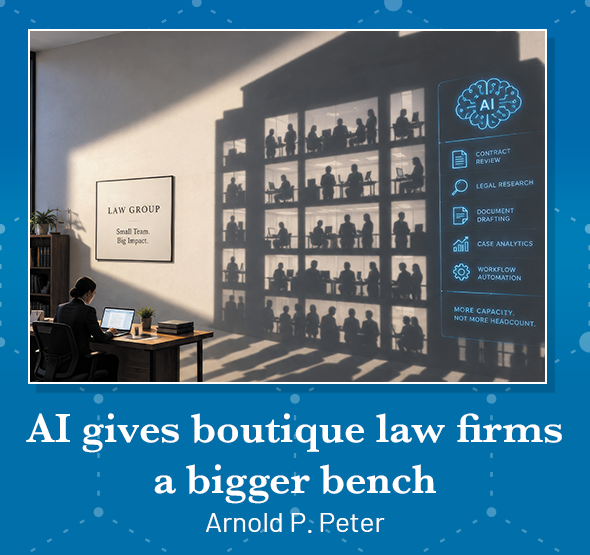
For decades, one competitive advantage of the large law firm was almost impossible for a smaller firm to overcome: people. A 1,000-lawyer firm could put a partner, four associates, three paralegals and an entire litigation-support operation on a major matter. If necessary, it could add another dozen lawyers. A 10-lawyer firm could not.
The boutique's lawyers might be just as experienced, with partners more closely involved in the client's matter. The firm could also be faster, more entrepreneurial and less encumbered by institutional conflicts and management layers. But when a major case or transaction required 50 additional lawyers, it could not create that capacity.
Artificial intelligence may be changing that equation. Boutique law firms could be among the greatest beneficiaries of the AI revolution--not because AI will replace lawyers, but because it can dramatically increase the leverage of experienced ones.
What exactly is a "boutique" law firm?
The word "boutique" has become overused in the legal profession. It is frequently but erroneously employed as a more elegant synonym for "small firm."
That is not what defines a boutique. A true boutique is defined less by its number of attorneys than by specialization, expertise and the nature of the services it provides. An entertainment boutique, intellectual-property boutique, employment boutique, securities boutique or complex-litigation boutique may handle matters every bit as sophisticated as those handled by corresponding departments at the country's largest firms. Its principal product is specialized professional judgment. The term also generally implies a steady stream of work generated by the reputation and standing of its attorneys rather than through mass marketing or paid online advertising.
That business model should also be distinguished from many high-volume specialty practices. Personal-injury, workers' compensation, consumer bankruptcy, immigration and mass-tort firms can be highly specialized, sophisticated and extraordinarily successful. But many operate on an economic model heavily influenced by volume: developing efficient systems for processing relatively large numbers of matters involving recurring legal and factual issues.
The classic boutique has a different economic model. Its inventory is not necessarily hundreds or thousands of substantially similar files. Its primary asset is the specialized judgment of a relatively small number of professionals. Matters frequently require individualized strategy, senior-level attention and specialized industry knowledge.
This distinction is especially important in discussions of artificial intelligence. In a volume practice, AI may primarily automate work, allowing the firm to handle more matters at a lower cost per matter. For a boutique, however, AI offers something more significant: leverage. It can enable a small group of experienced lawyers to perform work that once required a much larger legal team.
Big Law's historical advantage wasn't necessarily better lawyers
A difficult truth underlies the traditional economics of sophisticated legal practice: large firms did not always win engagements because their lawyers were better. They sometimes prevailed because clients believed they needed an army--and, at times, they did.
Imagine a complex litigation matter producing 50,000 documents. A major firm could assign associates, paralegals and litigation-support professionals to review them. A five-lawyer boutique simply could not reproduce that staffing structure.
The same problem existed in transactional work. A senior lawyer might possess extraordinary negotiating experience, but there are only so many hours in a day; expanding the practice required associates to prepare first drafts, compare versions, review contracts, research issues and maintain precedent libraries.
The conventional solution was straightforward: more work required more people. AI begins to separate capacity from headcount. That could prove enormously disruptive.
Think of AI as leverage, not replacement
Much of the public debate about artificial intelligence asks whether AI will "replace lawyers." For sophisticated legal work, that question largely misses the immediate point. The more interesting question is whether lawyers using AI can perform work that traditionally requires much larger teams of lawyers who do not.
Consider legal research. AI-assisted tools can help an experienced attorney quickly map an unfamiliar issue, identify relevant authorities and assess competing arguments. The attorney must still verify the authorities and reach the ultimate legal conclusion, but there is an enormous productivity difference between beginning with a blank screen and beginning with an intelligently organized research roadmap.
The same principle applies to document-intensive litigation. AI tools can analyze substantial document collections, locate communications involving particular individuals, identify recurring themes and develop chronologies. That does not mean a machine should decide whether an email proves discriminatory intent, whether a document is privileged or whether a witness is credible--those remain legal judgments. But instead of paying lawyers to search endlessly for needles, AI can help determine which portions of the haystack deserve human attention. For a boutique, that is a fundamentally different economic proposition.
Contract drafting may be the clearest example
The opportunity may be clearest in contract drafting, review and negotiation. Entertainment, employment, intellectual-property and corporate boutiques routinely handle sophisticated commercial documents, including executive employment and talent agreements, licenses, production and endorsement contracts, nondisclosure agreements, settlements and vendor contracts.
Historically, scaling that practice created a dilemma. The senior lawyer might have negotiated thousands of agreements and developed exceptional instincts about what matters. But there are only so many agreements that lawyers can personally review in a day. The conventional answer was to build a pyramid beneath the senior attorney: junior lawyers prepared first drafts, checked defined terms, compared revisions, identified deviations from preferred language and assembled issues lists, while senior attorneys reviewed that work and handled the significant negotiations.
AI has the potential to compress that pyramid. Tools such as Spellbook work directly within Microsoft Word and are designed around transactional legal drafting and contract review, assisting lawyers with identifying issues, proposing language and working through provisions without continually moving between the agreement and a separate application. Thomson Reuters CoCounsel Legal similarly incorporates transactional drafting and analysis into legal workflows and can work with a firm's own documents and playbooks. Harvey offers another broad legal AI model, and contract-lifecycle-management platforms such as Ironclad illustrate another part of the ecosystem.
These products differ significantly, and the right choice depends on a firm's practice, security needs, clients, workflows and budget. The central issue is not which product prevails, but what the technology increasingly enables boutique lawyers to accomplish.
Arnold P. Peter is founder of the boutique law firm the Peter Law Group.