


Technology,
Law Practice
Oct. 14, 2026
The boutique lawyer's AI problem extends beyond hallucinations
See more on The boutique lawyer's AI problem extends beyond hallucinationsUsed with discipline, AI can strengthen confidentiality, vendor oversight and the record of a lawyer's judgment in high-stakes matters.


Sharon Appelbaum
Founding Attorney
Appelbaum Law, P.C.
Sharon is a nationally recognized criminal defense and white-collar litigator with offices in Los Angeles and San Diego. A former Manhattan prosecutor, she now represents professionals, executives, and public figures in high-stakes criminal investigations and prosecutions across California.
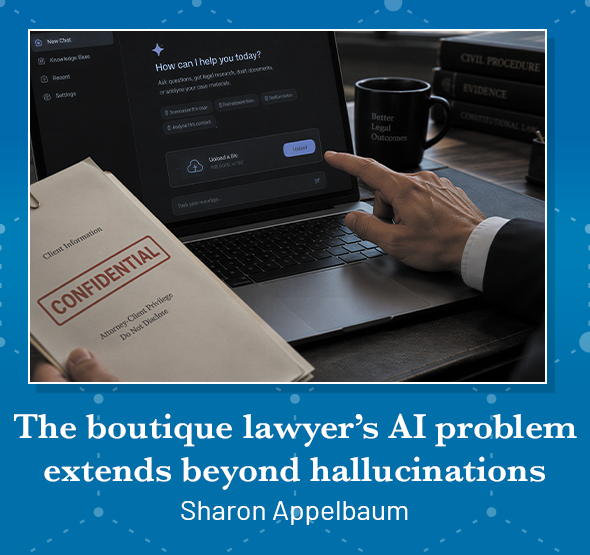
A grand jury subpoena arrives and a worried executive opens the company's AI assistant, types out the story and asks what to do. By morning, an account of events sits on servers the company controls. It is unlikely to be privileged and may be reachable by subpoena.
Most lawyers believe the ethical danger of artificial intelligence is the fabricated citation: the output. But for boutiques handling white-collar and other high-stakes matters, the fake citation is only the most visible risk. The harder, less-discussed questions are where client information goes, including through the firm's own vendors, what clients are told and whether the lawyer's judgment can be explained later. Used with discipline, AI can strengthen each of these rather than threaten them: it can protect a lawyer's judgment, check and record it, not replace it.
Protecting client confidences
Protecting a lawyer's judgment starts with protecting the information it rests on. Consulting an AI tool about a matter places client information in a system the AI provider controls. The duty of confidentiality attaches to what goes in, regardless of what comes out. ABA Formal Opinion 512 and the State Bar's 2026 guidance both address this. Before a tool touches client data, the firm should use an enterprise or commercial product, never a consumer version, and read the terms of service to learn whether the provider trains on the firm's data. Any protective order should be read before discovery is uploaded, and the lawyer should consider whether the client's informed consent is required.
Asking vendors what they use
Boutiques outsource much of what larger firms keep in-house: IT, bookkeeping, forensic imaging, investigation, translation. Each of those vendors may now be running the firm's matters through AI tools of its own, under contracts signed before anyone asked. An investigator's interview notes summarized by a consumer chatbot carry the same risks as the lawyer's own use, and California Rules of Professional Conduct rule 5.3 reaches nonlawyers the lawyer retains. Vendor agreements should be revisited to hold vendors to the firm's standard, require written approval before AI touches the firm's matters and require notice before tools or subcontractors change. A vendor that cannot meet that standard should not use AI on the firm's matters at all, and the agreement should say so.
Warning clients about their own AI use
Clients need a warning about their own AI use, and during an investigation that warning is urgent. The old adage about never putting something in an email you would not want read in court now extends to AI chats. In United States v. Heppner, 820 F. Supp. 3d 292 (S.D.N.Y. 2026), the court held that a defendant's exchanges with an AI tool were neither privileged nor work product. The law is unsettled. Heppner is a district-court decision and one a New York state court has already declined to follow. But an enterprise license likely will not help either: a client's solo chats are unlikely to be work product, and when company systems are subpoenaed or seized, the chats go with them.
Clients should be told to keep the matter out of every AI tool, including the company's, never to upload subpoenas, documents or correspondence from investigators, and to bring their questions to counsel, where the conversation is privileged. Putting that instruction in the engagement agreement, signed by the client, makes the warning part of the record and gives the lawyer options if the client ignores it, including withdrawal after a reasonable warning under rule 1.16(b)(5).
Verifying before anything is filed
Checking everything before it leaves the office is the standard. The lawyer should pull every cited case in Westlaw or Lexis and confirm it says what the brief claims, trace every fact to its source and recompute every number. The State Bar's 2026 guidance states plainly that the duty of candor to the tribunal cannot be delegated to AI.
The memo to file
Recording judgment is the most useful ethical application of AI, and the least discussed. When a lawyer works through a judgment call with the tool, the conversation becomes the raw material for a record of the decision. At the end, have the AI draft a memo to file on how the decision was reached, then revise it in the lawyer's own words. The memo should record the question presented, options considered and rejected, authority consulted and independently verified, decision and reasons for it, and the date and the lawyer who made it.
It takes 10 minutes. The memo is internal and never goes to the client. Because it reflects the lawyer's impressions and conclusions, it is core attorney work product under Code of Civil Procedure section 2018.030(a) and Penal Code section 1054.6 in criminal matters. It answers the client who asks a year later why the matter was handled a particular way and supports the lawyer in any later dispute over tactics. In a boutique, the lawyer who made the call is often the only one who knows why; the memo to file is where that judgment survives.
What the client is owed
The tools will keep improving and the obligations will not change. For boutique lawyers in high-stakes practice, AI is most valuable not as a substitute for judgment but as a way to protect, check and record it. What a client is owed is not the output. It is the judgment behind it, exercised personally and recorded well enough to be explained.
Sharon Appelbaum is founding attorney of Appelbaum Law, P.C.
For reprint rights or to order a copy of your photo:
Email
Jeremy_Ellis@dailyjournal.com
for prices.
Direct dial: 213-229-5424
Send a letter to the editor:
Email: letters@dailyjournal.com