


Environmental & Energy
Oct. 20, 2026
The devil in the details of Prop. 45
California's Proposition 45 promises faster development, but critics warn its fine print could gut environmental protections, sideline the public and weaken judicial oversight.


Douglas P. Carstens
Managing Partner
Carstens Black & Minteer LLP
Environmental, land use, municipal and natural resources law
Email: dpc@cbcearthlaw.com
UCLA SOL; Los Angeles CA
Carstens is board president of the Planning and Conservation League and managing partner of Carstens Black & Minteer LLP. His law firm specializes in environmental, land use, municipal and natural resources law.
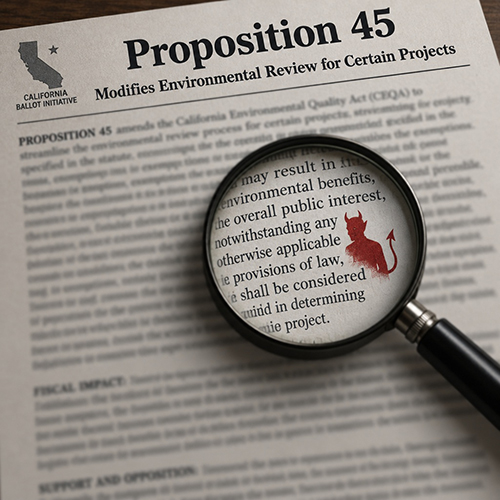
It is an often-repeated adage that "the devil is in the details." (E.g., Golden Door Properties, LLC v. County of San Diego (2020) 50 Cal.App.5th 467, 506.) With the vigorous debate going on about whether Proposition 45 (officially titled "Modifies Environmental Review for Certain Projects," also known as "BACA") on California's November ballot is a good idea, whether it includes data centers, and whether it will actually increase affordability of housing in California, there is a need to analyze its specific details.
Prop. 45 is a densely written and Byzantinely cross-referenced 16-page proposition at the end of the 173-page November ballot voter guide. (Full text of the proposition, pp. 157-173). Polling data from the Public Policy Institute of California showed that support for the proposition in concept plummeted from 73% in July 2026 to less than 50% in September 2026 after the details of the proposition became available. So those details are critically important to understand. While government efficiency promised by Prop. 45 is a bright and shiny goal on its surface, understanding what is under the hood is critically important.
The proposition is said to speed up review processes for essential projects. Which projects? It creates a confusing grab bag of provisions favoring certain projects for special treatment and specifically excluding others. It would likely apply to data centers because of its broadband provisions (section 21028 ["...transmit data to, and receive data from... internet endpoints"]), but not clearly so and not clearly excluded either. Learned attorneys and scholars have concluded it would apply. (Biber, McKerley and Frank). The proposition uses the word "affordable" in its title (section 21010) but has no affordability or inclusionary housing requirements or renter protections. The Legislature recently exempted most urban housing (up to 94%) from environmental review through AB 130 in 2025, but Prop. 45 would accord special treatment to even large sprawl housing development in wildfire areas. (Section 21028). It would apply to "transportation" projects but not high-speed rail. (Section 21028).
The proposition purportedly speeds project review at public agencies, but how does it do that? It does not allocate additional funding for expanded planning staff. Instead, it constrains public agency discretion by setting strict time limits on reviewing applications. (Section 21017). It creates a cause of action for proponents to sue agencies that do not approve projects quickly enough. (Section 21020(g).) It would cap the maximum amount of time that the public could review and comment about applications (section 21021), no matter how complex and impactful they may be. It requires responsible agencies to issue permits within one day of lead agency approval. (Section 21023(a)(3)). The Legislative Analyst's Office estimated costs to public agencies--which means taxpayers--of as much as $100 million annually or more to implement.
The proposition purportedly speeds project review by the courts, but how does it do that? Prop. 45 would direct that judicial review be conducted within 270 days, whether it is feasible or not (section 21027(a)(1)). It does not provide any funding for additional judges or staff. The Judicial Council historically opposes such measures as it did in an April 22, 2021, letter to legislative leadership regarding Senate Bill 7 (Atkins) stating 270 days is an "arbitrary and unrealistically short timeframe for California's trial courts to address all the issues." Prop. 45 also freezes laws in place at the time that an application is deemed complete. (Section 21022). It excludes some public comments from court proceedings but not comments from project proponents. (Section 21021).
Prop. 45 has provisions that are breathtaking in the scope of the power they would grab from the judiciary, from future Legislatures, and from the governor and attorney general. It overrides conflicting laws. (Section 21015). It would constrain court discretion in issuing injunctions or set aside project approvals. (Section 21027). It cannot be amended or fixed without a two-thirds vote of Legislature (section 21034). It changes emphasis from "fullest possible protection to the environment within the reasonable scope of statutory language" (Guidelines, section 15003, subd. (f); Comite Civico del Valle v. County of Imperial (2026) 122 Cal.App.5th 1171) to "fullest possible weight to the interest of... essential projects." (Section 21029 subd. (a)).
California's premier environmental statute, the California Environmental Quality Act (Pub. Resources Code section 21000 et seq., "CEQA"), is only one law among many that would be potentially overridden by Prop. 45 since it potentially affects the Permit Streamlining Act, Coastal Act, Planning and Zoning Law, the Endangered Species Act and others. (Section 21015). CEQA promotes the twin goals of environmental protection and public participation. (Concerned Citizens of Costa Mesa, Inc. v. 32nd Dist. Agricultural Assn. (1986) 42 Cal.3d 929, 936.)
Former Gov. Jerry Brown, a Jesuit seminarian dropout, made a one-line quip that has resurfaced many times in the Prop. 45 debate that "reforming" CEQA was "the Lord's work." (CalMatters commentary). Even before Brown's quip in 2013, world religious leaders emphasized the need for humankind to protect the planet rather than heedlessly exploit its resources. In 1997, the Orthodox Church's Patriarch Bartholomew pronounced good stewardship of creation as a moral imperative and that degradation of the natural world is a sin.
In "Laudato Si', on Care for Our Common Home," Pope Francis wrote "the Bible has no place for a tyrannical anthropocentrism unconcerned for other creatures." Pope Leo XIV echoed his predecessor's emphasis on protecting both the environment and our fellow creatures on earth. Similar precepts are evident in Judaism, Lutheranism; Protestantism, Native American beliefs, Islam, Buddhism, Hinduism, Druidism and other religions. Most atheists and agnostics say the Earth is sacred.
Therefore, in going about what former Gov. Brown called "the Lord's work," it is necessary to watch out for the "devil in the details" that reduce environmental protection and diminish public participation.
Submit your own column for publication to Diana Bosetti
For reprint rights or to order a copy of your photo:
Email
Jeremy_Ellis@dailyjournal.com
for prices.
Direct dial: 213-229-5424
Send a letter to the editor:
Email: letters@dailyjournal.com