


Education Law,
Civil Rights
Nov. 17, 2026
Can privilege buy a teachable moment for sexual assault in a college town?
Cornell's use of reflection essays to address sexual assault allegations against seven fraternity members raises troubling questions about whether wealth, privilege and institutional self-interest have replaced meaningful accountability.



Editor's note: This first article in a three-part series reflects public reporting, court filings and official records available as of Oct. 28, 2026. The matter is ongoing. The New York Attorney General's criminal investigation, pending challenges to her role as special prosecutor, motions in Jane Doe's civil action in New York Supreme Court, New York County, Cornell's outside review, and proposed amendments to New York's sexual-offense statutes may change the facts discussed below. All seven men named in the civil complaint deny wrongdoing, and none has been criminally charged.
Part I: The disciplinary dilemma
When I was a Teach for America corps member, I taught in an under-resourced, low-income public school. There, I quickly learned that how teachers handle discipline could determine whether a student graduates or ends up as part of the school-to-prison pipeline. The school-to-prison pipeline, a term popularized by scholars of the Harvard Civil Rights Project in 2003, describes how harsh school discipline pushes students out of the classroom and into the justice system. A teacher's response to behavioral problems determines whether a student stays or is removed through suspension or detention, losing valuable instructional time and becoming more susceptible to a path to prison. Our goal was simple: redirect misconduct that might otherwise lead to suspension or expulsion. To do that, we relied on a pedagogical concept known as the "teachable moment."
A teachable moment has no precise definition, but in practice, it's a teacher's brief, informal correction of misbehavior right when it happens, whether a private redirection at the student's desk, a pointed one-on-one conversation, or a short reflective essay. Each holds the student accountable while keeping them in class, specifically to avoid the out-of-classroom discipline that makes disadvantaged students more likely to enter the school-to-prison pipeline. It worked very well in my high school classroom for the rapid correction of minor behavioral infractions. For example, if a student responded dismissively to a classmate, interrupted someone speaking, or exhibited some form of undesirable conduct, a small offense earned a small response. I addressed the behavior in the moment so the student knew they were being held accountable, inspired reflection and discouraged a repetition of the action, all while the student remained in class and avoided the harsher penalties that cost instructional time and feed the school-to-prison pipeline.
In my classroom, teachable moments were appropriate to the behavior being corrected because the "light" discipline matched a relatively "light" offense. The behavioral deviance was enough to justify a brief redirection and not harsher disciplinary actions.
How, then, did a tool created for secondary classroom management get hijacked by an Ivy League institution to address allegations of severe sexual misconduct?
A classroom management tool built for high school students gets hijacked when an elite Ivy League institution decides those accused of participating in an alleged fraternity gang rape can be held accountable with reflection essays.
In the case of the Cornell 7, a former student alleges that seven members of the Chi Phi fraternity drugged and sexually assaulted her at their fraternity house in October 2024. Cornell handled the case through its own internal Title IX process, and it answered the aforementioned question by assigning a behavioral remedy so out of proportion to the allegation that, once it became public, it sparked national outrage. People sensed something was deeply wrong, even if few could articulate why.
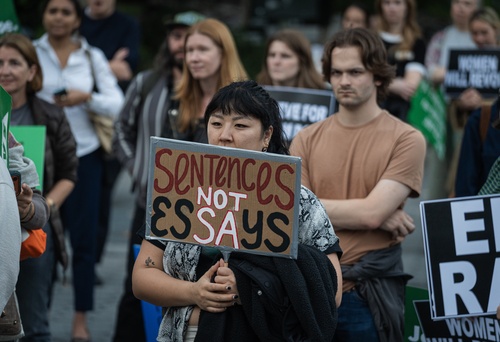
According to the civil complaint, the accused were "afforded the opportunity to mitigate their conduct by submitting essays." That is a teachable moment, the same remedy I assigned for something as inconsequential as talking back in class. One prompt went further, asking an accused student for "a detailed proposal for future University educational materials to train undergraduate students" on sexual harassment and bystander intervention. Cornell did not just offer a teachable moment. It made one of the students accused of gang rape the teacher. When administrators substitute a behavioral classroom management tool for legal accountability, they do more than misapply it; they teach every student on campus that the price of an alleged sexual assault is a writing assignment. This grants elite college students a level of protection that was never afforded to the marginalized youth I taught in an inner-city public school. Here is my attempt to name why: wealth, privilege and small-town dominance. The accused were members of a fraternity whose families, dues, and donor ties made them valuable to a university that is also the economic center of its town. Where those three forces intersect, an allegation of multi-assailant sexual assault can be partially remedied with a reflective essay.
The first of these forces is wealth, and it explains how a teachable moment became something that could be purchased. A public high school student brings no endowment capital or legacy network; if suspended or expelled, the district suffers no philanthropic blowback. A fraternity member paying thousands of dollars a semester in chapter dues and tens of thousands in tuition is paying clientele, backed by affluent alumni and prominent donors. The ties run deeper still: Tompkins County is now reviewing property-tax exemptions for eight Cornell-owned Greek houses worth an estimated $12.85 million combined.
The second of these forces is privilege. When institutional administrators supplement formal adjudication with private writing assignments, the substitution is driven by capital preservation. The university extends second chances to privileged students accused of multi-assailant felony sexual assault and drugging, while marginalized teenagers facing minor adolescent missteps are swiftly referred to juvenile courts. Under the guise of restorative pedagogy, higher education has commercialized grace, prioritizing tuition revenue and donor goodwill over campus safety and statutory compliance.
Geographical strongholds and the statutory policing dilemma
The third of these forces is small-town dominance. In a small city like Ithaca, the university isn't just one institution among many. It is the town's economic and civic center of gravity: the largest employer, a major landowner and the reason much of the town exists in its current form. In that setting, the line between campus discipline and public law enforcement blurs. Campus police, local officers, prosecutors and administrators often work alongside and rely on one another, and they share an unspoken interest in keeping the peace.
This dynamic is codified by state statutory structures that create a distinct jurisdictional vacuum. Under New York Education Law § 5709, Cornell's campus officers are appointed as special deputy sheriffs with peace-officer powers, including the authority to execute warrantless arrests and conduct criminal investigations. Yet, unlike municipal police departments, these officers do not answer to an elected mayor, an independent civilian oversight board, or a municipal police commission. Their operational reporting hierarchy terminates directly at the university's board of trustees and central administration.
When Cornell's police operate as a department of the private university, officers sworn to pursue justice ultimately answer to the institution with the strongest interest in protecting itself. These officers operate under conflicting duties: they are sworn to enforce state penal statutes, yet their employment depends on Cornell's administration, whose primary imperative is brand insulation.
When the university treats an allegation as an internal matter for reflection and growth, local authorities have little reason to push back, and when those authorities show little appetite to intervene, the university can point to their restraint as proof that its soft-touch response was proportionate. In this way, each institution's deference becomes the other's justification. When no one is held accountable, both can honestly say the decision was never theirs. The result is a closed loop in which an alleged crime is never named as one and is instead trivialized through a usurped high school behavioral redirection tool: the teachable moment.
A reflection essay is an educator's answer to misconduct. At Cornell, the essay was assigned, but no accountability came from it because no essay can deliver the consequences an allegation of sexual assault demands. A prosecutor asks a different question: whether an alleged crime was ever investigated the way the law demands, and why the case was declined before the evidence that could have answered it was ever gathered.
Submit your own column for publication to Diana Bosetti
For reprint rights or to order a copy of your photo:
Email
Jeremy_Ellis@dailyjournal.com
for prices.
Direct dial: 213-229-5424
Send a letter to the editor:
Email: letters@dailyjournal.com