


Criminal
Nov. 17, 2026
You cannot decline a case you have not read: The prosecutorial review, part 2
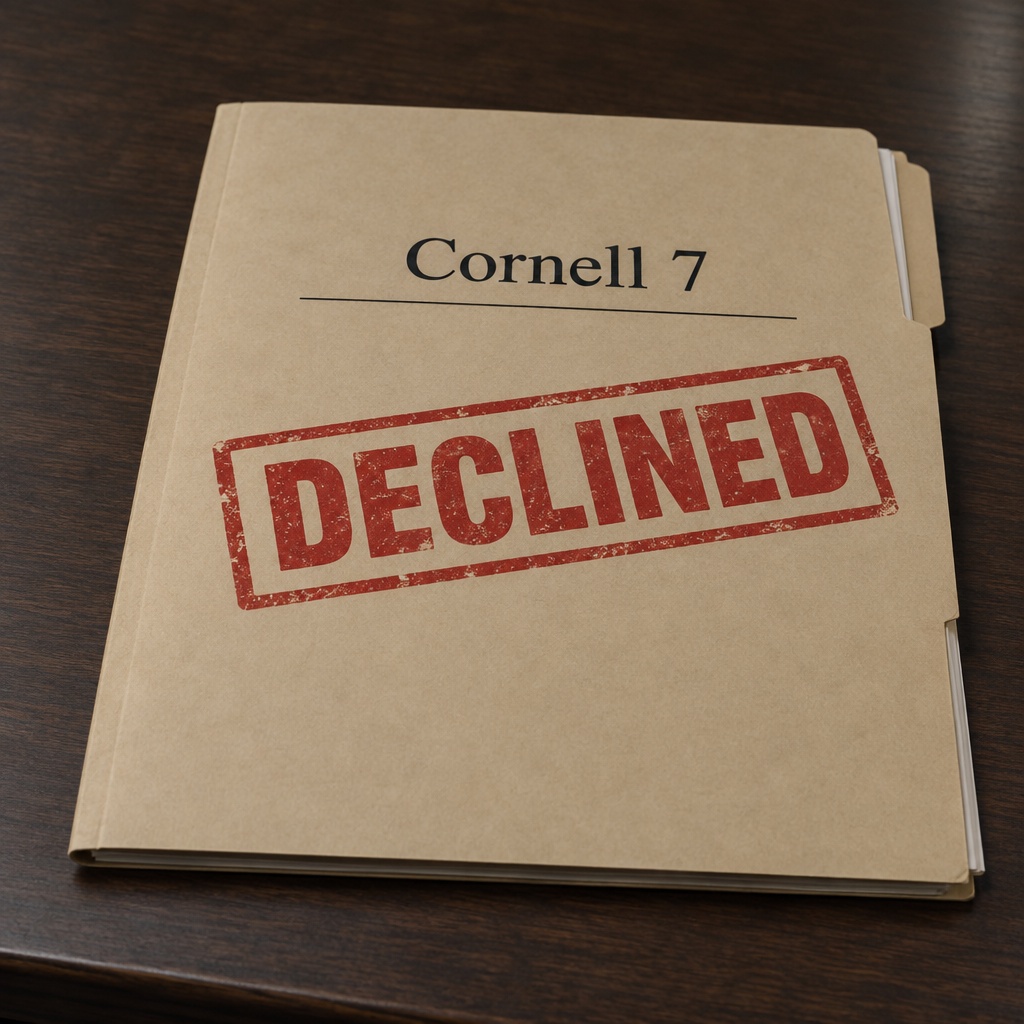
The Cornell Seven case shows why prosecutors must review the available evidence before declining charges. The complainant, the accused and the public deserve a competent investigation.


For nearly 17 years, I prosecuted crimes against some of society's most vulnerable victims. My job was never to believe every allegation; it was to find out what happened. By that standard, the original handling of the "Cornell Seven" case fell short.
Jane Doe, a former Cornell student, alleges in a civil complaint naming seven current and former members of Cornell's Chi Phi fraternity that she was drugged and sexually assaulted at the fraternity house on the night of Oct. 19, 2024. She reported to Cornell police on Nov. 8, 2024, and gave a sworn statement that month. The district attorney's office declined to prosecute, and on Sept. 16, 2026, she sued the men, Cornell and others. The DA reopened the case less than two weeks later, before the governor handed it to the attorney general. The men deny wrongdoing and have not been criminally charged. Their presumption of innocence matters. So does her right to a competent investigation.
Doe did not get one. When she first came forward, campus police recorded that she reported being "raped by 8-10 men." Cornell police then interviewed her over two days. She said, "I can say with 100% confidence I was raped." An officer condensed a roughly 120-page interview transcript into a six-page statement omitting that sentence. The statement, not the transcript, went to the district attorney. Doe corrected and signed it. Even that condensed statement said the night "felt like coercion" and described her being hit. District Attorney Matthew Van Houten acknowledges that his office based its 2024 decision on that document and did not "independently investigate." He says he found her credible. He also concluded that her account described no crime.
A police summary is a starting point, even one the witness adopts. Its gaps matter as much as its contents. Any conflict with the transcript is impeachment material, and it is far better to confront that before charging than to meet it at trial. The office had a chance to do exactly that. On Nov. 25, 2024, according to records first reported by The New York Times, a Cornell police investigator told the DA's staff about additional interviews. The office declined to look, saying attorneys had read the statement and agreed charges would not be pursued. The DA's office now says those "interviews" were the suspects declining to speak on advice of counsel. Whatever the call covered, an offer of more evidence tells a prosecutor the file is incomplete.
Cornell bears its own share of the blame. It first said its police had shared "all investigatory information" with the DA, then revised that to the sworn statement and a Snapchat screenshot. A prosecutor may rely on what police represent. Reliance is not abdication. The fair measure is what the office could have asked for in 2024: the full interview, the other witness interviews and the rest of the chat thread.
First disclosures in severe trauma cases are often incomplete. I saw it again and again. Victims, especially young ones, tell their story in stages. Memory fragments. Intoxication widens the gaps. Shame makes people downplay what happened, sometimes for weeks, sometimes for years. Jane Doe was a 20-year-old sophomore who went to campus police about three weeks after the alleged assault. Her first account was always likely to be partial.
The remedy is basic. Record the whole interview. Ask open-ended questions. Weigh inconsistencies against everything else you know. Boiling hours of interview down to a signed summary works against all of that. With no suspect in custody and no speedy trial clock running, a prosecutor has time to ask for the recording and watch it. None of this means believing everything. Details that surface later have to be tested like any other evidence.
New York law does create a real obstacle. Van Houten's public explanation stressed that New York does not treat voluntary intoxication as "mental incapacitation." He is right. Penal Law section 130.00(6) covers incapacity caused by an intoxicant "administered to [someone] without his consent." New York is in the national minority here, and victims who drank or took drugs willingly are less protected as a result. A bill to close that gap passed the state Senate 60-0 in June; Assembly Speaker Carl Heastie has instead convened a working group, and Gov. Hochul is aiming for the 2027 session. Even if it passes, it will not reach conduct from 2024.
But the statute is not the end of the analysis, and the DA did not run down the other routes. Physical helplessness under section 130.00(7) applies however the victim became intoxicated. A person "unable to communicate as a result of voluntary intoxication is considered to be physically helpless." People v. Bjork, 105 A.D.3d 1258, 1260 (3d Dep't 2013), lv. denied, 21 N.Y.3d 1040 (2013), cert. denied, 571 U.S. 1213 (2014); see also People v. Shevchenko, 175 A.D.3d 922 (4th Dep't 2019) (victim who had been drinking and had ketamine in her blood). A blackout is not necessarily unconsciousness, but it is a reason to pin down her condition during each act. If force compelled any act, that is forcible compulsion under section 130.00(8), and her own statement says she was hit. For some offenses, including third-degree rape, a clearly expressed lack of consent is enough. And because the alleged conduct postdates Sept. 1, 2024, New York's expanded rape definitions, which now reach oral and anal sexual contact, apply. Agreeing to one act is not agreeing to the next. A summary cannot settle any of these questions.
The evidence that could have answered them never reached the prosecutor. Campus police drafted preservation letters to Verizon and T-Mobile on Nov. 15, 2024, promising a signed warrant within 30 days; it is unclear whether the letters were sent or a warrant was ever sought. On Nov. 26, the day after the DA's office had already said no, police asked Snapchat for a fuller data history and eventually received 1,665 pieces of data from five accounts. A campus investigator later concluded that only three messages involved Doe or the incident and that none appeared criminal, a judgment no prosecutor ever reviewed. When police first spoke to the office, they had only part of the Snapchat thread, supplied by a witness, and Van Houten has said there was therefore "nothing to review." That is the problem. According to the DA's office, the accused men declined, through counsel, to speak with police, as is their right. Yet six of the seven gave interviews to Cornell's Title IX investigators. Their decision not to speak with police made the other evidence more important, not less. In a case built around a group chat, the phones are part of the crime scene, and experts consulted by The New York Times have asked why no one obtained warrants to seize them. Closing a multi-suspect sexual-assault case without reviewing what police had gathered, or seeking the devices, falls below professional standards.
The same goes for evidence that helps the accused. Four of the men acknowledge sexual contact but say it was consensual. The others say they were not involved. Most told Title IX investigators that Doe did not appear intoxicated, and one said he was the victim, because she performed oral sex on him while he was too incapacitated to consent. Each claim needs testing, and the law requires it. Where lack of consent rests only on incapacity, section 130.10(1) gives a defendant an affirmative defense if he did not know of the facts or conditions responsible for it. What each man knew is a question only the evidence can answer.
Van Houten has said his office does not investigate cases directly and relied entirely on the police. He says relying on police is common in upstate counties. Maybe so. But the minimum costs almost nothing. Ask for the full interview and the full file. Accept evidence when it is offered. Talk to the complainant before closing the case. It is not a complainant's job to make prosecutors read the evidence.
The response has come woefully late. On Oct. 1, Gov. Hochul appointed Attorney General Letitia James as special prosecutor. James has since spoken with Van Houten, who agreed to cooperate, and with Doe's lawyer, and she is retaining outside counsel. Two of the accused are challenging her role, citing in part a Sept. 28 social-media post, and those challenges remain pending. A special committee of Cornell's board has engaged former Deputy Attorney General Sally Yates to lead an outside review, and Cornell's Faculty Senate has moved ahead with a no-confidence vote on the administration's handling of campus sexual assault. On Oct. 20, Tompkins County legislators voted 14-2 to authorize up to $200,000 for an independent review of how the DA's office handles sexual-assault cases, though the resolution as passed excludes matters currently under investigation or prosecution, which may leave this case outside its scope. The reform that matters most is the one the resolution's sponsors put in writing: before declining a case, review all reasonably available evidence, or write down why you did not.
None of this is a judgment about whether any of these men is guilty. That determination belongs first to a grand jury, if the attorney general presents the case, and ultimately to a trial jury. The obligation is to do the work before deciding there is no case. For the complainant, the accused and the public, that should never have been too much to ask.
Submit your own column for publication to Diana Bosetti
For reprint rights or to order a copy of your photo:
Email
Jeremy_Ellis@dailyjournal.com
for prices.
Direct dial: 213-229-5424
Send a letter to the editor:
Email: letters@dailyjournal.com