


U.S. Supreme Court,
Constitutional Law
Dec. 23, 2025
The unitary executive needs a legislative counterweight
As the Supreme Court moves to expand presidential power by subordinating independent agencies to executive prerogatives, a proposed statute would restore congressional authority by creating expert advisory agencies that develop bipartisan legislation for fast-track congressional votes.



Ashutosh Bhagwat
Boochever and Bird Distinguished Professor of Law
UC Davis School of Law
Ashutosh is Martin Luther King, Jr. Professor of Law at UC Davis School of Law. He served as a law clerk for Justice Kennedy during the October 1991 term of the Supreme Court.

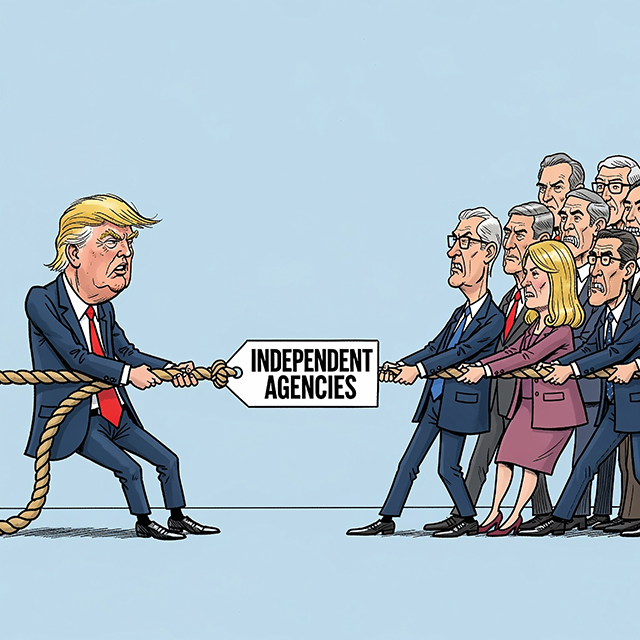
In recent years, the conservative
majority of the Supreme Court have been adopting a controversial legal theory
called "the unitary executive," which posits that the president alone must
control all activities of the executive branch. Supporters of this theory root
it in the foundational constitutional values of political accountability; a
value grounded in the acknowledgement in the Declaration of Independence that governments
derive "their just power from the consent of the governed." Opponents
argue that the unitary executive is in tension with another foundational value,
that of avoiding the concentration of unchecked power. This is the value that
underlies the separation of powers and checks and balances framework embedded
in the text of the Constitution.
This term, in the service of a
unitary executive, the Supreme Court is expected to overrule Humphrey's
Executor, the case that permits Congress to create independent agencies by
denying the Executive the power to fire the commissioners who run such agencies
simply because of policy disagreements. This doctrinal reversal arguably
furthers the value of political accountability because independent agencies,
once constituted, are not subject to conventional electoral review of their
policy judgements. The president under this theory is a political actor subject
to electoral sanctions. And the power to fire commissioners who deviate from
the president's political agenda effectively place these agencies under the president's
control, and so under voters' control.
The idea that subordinating the
so-called independent agencies to presidential control furthers political
accountability can be overstated. Presidents, for example, are not judged on
single actions but on broader judgments about their effectiveness, and in any
event are not exposed to direct electoral repercussions at all during their
second term in office. Still, independent agencies, as currently constituted by
design and operation are free from political control. The unitary executive
provides more political accountability than currently exists.
But the cost of the unitary
executive to the value of avoiding the concentration of unchecked power is
significant. Independent agencies set policy and engage in rule making. These
are delegated law-making functions, and they are often exercised in politically
delicate areas such as regulating financial markets or the media. The creation
of the agencies and the delegation of law-making power to them reflected the
reality that Congress on its own lacked the time and expertise necessary to
develop and evaluate complex legislative responses to the difficult and
intricate problems confronting a modern society. If previously independent
agencies are now subject to the control of the president, these law-making
powers and functions would come completely under the control of the president,
which would result in a substantial increase in the concentration of power.
To partially respond to this
disequilibrium and to restore some of Congress' status as a co-equal branch of
the national government, the statute we propose would authorize the creation of
advisory independent legislative agencies tasked with developing legislation to
be submitted to Congress for review and (if approved) enactment. These agencies
would have no authority to make rules or apply them in specific contexts.
Because their power is purely advisory, they would be subject to the exclusive
control of Congress and entirely free from Executive interference, just as the
staff of a legislative committee are currently. Further, the statute would
provide for direct and timely access to the floor of Congress for consideration
of the agencies' legislative submissions.
More specifically, the statute
would provide for the creation by Congress of expert legislative agencies,
whose membership would reflect a partisan balance, and who would have access to
expert staff. Congress would task such an agency with proposing legislation
addressing important and technically complex issues such as permitting reform
in the electricity sector, regulating crypto currency, and perhaps regulating
social media platforms (within constitutional limits, of course). Agencies
would be required to reach a bipartisan, supermajority consensus before
formally placing a proposal before Congress.
As part of our proposal, both
houses of Congress would also have to adopt internal rules to ensure that these
agency submissions do not die in Committee or fail to secure a vote (as is true
of most proposed legislation). The rules would require congressional leaders,
after a reasonable time for holding legislative hearings, to bring proposed
legislation to the floor for a straightforward up or down vote with no Senate
filibuster. If the legislation does pass both Houses, it would then have to be
presented to the president for signature or veto. These procedures are modeled
on a 1996 statute called the Congressional Review Act, which creates fast-track
legislative procedures enabling Congress to vote quickly on whether to override
major regulations adopted by administrative agencies.
There are many issues facing the
nation regarding which, we are firmly convinced, it is possible to reach
bipartisan consensus on how they should be addressed, if we replaced the
current political posturing with a dose of nonpartisan expertise. Our proposal
seeks to bring that expertise into the legislative process, while always
leaving the final word with our elected representatives in Congress and the
White House. As such, it seeks to combine the faith in expertise that drove the
original creation of independent regulatory agencies with real political
accountability, as opposed to the largely fictional form associated with the
"unitary executive."
Editor's Note: In the aftermath of Watergate, Congress enacted sweeping reforms to restore public trust and strengthen accountability, including campaign finance rules, the creation of the Federal Election Commission, the Ethics in Government Act, and the War Powers Resolution--measures that reshaped the balance of power and continue to shape American governance five decades later.
Against that backdrop, the Daily Journal invited constitutional law professors, legal historians, and good-government advocates--experts in constitutional structure and reform from across the ideological spectrum--to answer a timely question: If Congress were to enact a new round of reforms today, meant to endure for the next 50 years, what one reform would you propose, and why? This is the second installment in a six-part series.
Submit your own column for publication to Diana Bosetti
For reprint rights or to order a copy of your photo:
Email
Jeremy_Ellis@dailyjournal.com
for prices.
Direct dial: 213-229-5424
Send a letter to the editor:
Email: letters@dailyjournal.com