


California Supreme Court
Dec. 29, 2025
Newsom pick could shift balance in criminal cases on California Supreme Court
Gov. Gavin Newsom's choice to replace retiring Justice Martin J. Jenkins could determine whether the California Supreme Court maintains its resistance to challenges of convictions and sentences or strengthens a dissenting bloc pushing for greater scrutiny under the Racial Justice Act and death penalty jurisprudence.


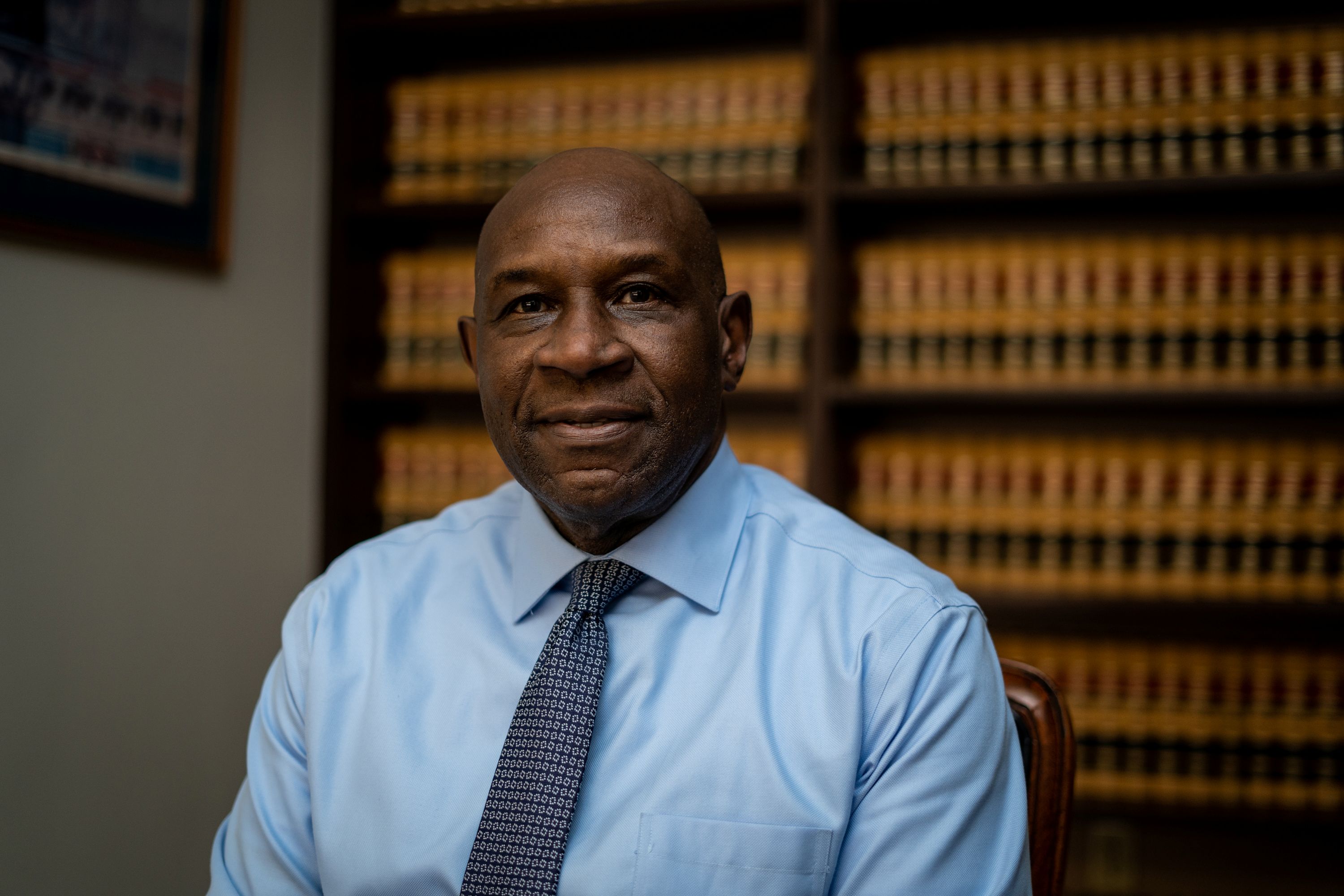
Gov. Gavin Newsom's choice to replace Justice Martin J. Jenkins on the state Supreme Court will either strengthen the majority that has resisted challenges to convictions and sentencing or provide support for Justice Goodwin H. Liu and Justice Kelli M. Evans, who have frequently dissented.
Jenkins, a Newsom appointee who retired at the end of October, was a mainstream liberal justice on a court dominated by the choices of Democratic governors, and almost always sided with the majority in affirming criminal convictions and sentences. He still will have votes on a few major cases in which the court has sought supplemental briefing, including three cases in which defense attorneys say prosecutors' use of discriminatory language during the trials invalidates the convictions and death sentences under the state's Racial Justice Act of 2020 and subsequent legislation signed by Newsom this year, AB 1071.
The state Supreme Court also has not decided a petition arguing the state death penalty is unconstitutional. Office of the State Public Defender v. Bonta, S284496 (Cal. S. Ct., filed April 9, 2024).
Attorney General Rob Bonta has argued the petitioners' case should be granted review and asked for appointment of a special master. Justices asked for more supplemental briefings in early January.
Legal experts are divided about whether the court will rule the death penalty unconstitutional in the end, although even an optimist about the petition's chances, Michael S. Romano of Stanford Law School's Three Strikes Project, said he does not expect a final decision in 2026.
David A. Carrillo, executive director of the California Constitution Center and lecturer-in-residence at UC Berkeley School of Law, said justices have been in no hurry to resolve that constitutional challenge, other death penalty cases, or how lower courts should treat the Racial Justice Act.
"The theme is slow and cautious," he said in a telephone interview. "The court is taking quite some time to make some significant decisions."
That might raise the stakes for Newsom's choice to replace Jenkins. The court is usually unanimous on civil cases, but it has grown increasingly divided on criminal law, especially how to treat alleged racial disparities in criminal trials or sentencing.
One of Newsom's appointees, Evans, has joined Liu in filing dissents when the court has denied review or writs of habeas corpus by people convicted of murder or attempted murder when they were teenagers. The two justices also dissented in cases in which they argued minority prospective jurors have been improperly excluded.
Liu dissented 69 times during the 2024-25 state Supreme Court term on decisions not to review appellate decisions, all but one in criminal cases. Evans dissented in 66 criminal cases, much more than any of the other justices.
Another of Newsom's appointees, Chief Justice Patricia Guerrero, has been a part of the court's majority in most cases. And when she has dissented, it has been to criticize Liu and Evans for vacating convictions or tough sentencing decisions, with Justice Carol A. Corrigan - the lone appointee of Gov. Arnold Schwarzenegger - on her side.
In two of those cases, Liu and Evans found allies with Jenkins, Justice Leondra R. Kruger and Justice Joshua P. Groban. People v. Collins, 2025 DJDAR 101 (Cal. S. Ct., filed May 2, 2023); People v. Fletcher et al., 2025 DJDAR 8064 (Cal. S. Ct., filed Aug. 4, 2023).
Groban, Kruger and the now-departed Jenkins have comprised the swing votes in several criminal cases. Newsom is expected to appoint a new justice sometime in 2026.
The court has asked for supplemental briefing in three death penalty cases, citing the Racial Justice Act and AB 1071. In all three cases, defense lawyers argue that prosecutors used racially discriminatory and dehumanizing language during trials.
Those cases are "likely to decide whether an RJA violation requires reversal of a conviction or a sentence even if the violation didn't affect the case's outcome," according to David S. Ettinger, of counsel with Horvitz & Levy LLP and the main writer of the At the Lectern blog. People v. Barrera, S103358 (Cal. S. Ct., filed May 7, 2012); People v. Bankston, S044739 (Cal. S. Ct., filed July 22, 2011); People v. Chhuon and Pan, S105403 (Cal. S. Ct., filed June 28, 2012).
Deputy Attorney General Louis W. Carlin argued in a supplemental brief Nov. 17 that the new statute, AB 1071, settles any uncertainty about the Racial Justice Act. "The most recent amendment of the RJA clarifies the Legislature's intent that for any violation of the statute, regardless of prejudice, the death penalty is categorically prohibited," he wrote.
But Kent S. Scheidegger - an attorney with the Criminal Justice Legal Foundation, which filed an amicus brief opposing the state's position - countered in an email that Attorney General Rob Bonta's support of the Racial Justice Act leaves only amici to point out what he says are its constitutional flaws.
"The lack of vigorous advocacy on the part of the AG is a problem in this case," he wrote in an email.
Scheidegger, in his brief in Chhuon and Pan, wrote that the statutes are not sufficient to reverse a death penalty judgment. "Reversal of a judgment in the absence of prejudicial error is forbidden by Article VI, Section 13 of the California Constitution," he wrote.
Evans and Groban are up for a retention vote in 2026 and could be joined by Newsom's choice for a new justice, depending on when the term-limited governor makes the appointment. Neither incumbent justice is expected to face a serious challenge.
While more supplemental briefs are filed, at the state Supreme Court's request, advocates on both sides wait.
Craig Anderson
craig_anderson@dailyjournal.com
For reprint rights or to order a copy of your photo:
Email
Jeremy_Ellis@dailyjournal.com
for prices.
Direct dial: 213-229-5424
Send a letter to the editor:
Email: letters@dailyjournal.com