


Art Law
Jan. 16, 2026
Tariffs and the definition of art
Long before today's trade wars, tariff disputes helped shape the legal definition of art--forcing courts to draw lines between culture and commerce.



Hall of Justice
Simon J. Frankel
Judge
Criminal Trials/ Veterans Justice Court
Yale Law School
Simon serves as chair of the firm's Intellectual Property Rights practice.
Most of us have probably thought more about tariffs in the
past year than we did in the past few decades. Yet few people today know that
tariffs played a critical role in shaping the legal definition of art in the
United States.
For many decades in the late 19th and early 20th centuries,
tariffs on imported goods occupied an outsized role in American fiscal and foreign
policy as the U.S. government's primary source of revenue. A permanent federal
income tax began only in 1913 with ratification of the 16th Amendment to the
Constitution.
Over 100 years ago, tariffs also played (as they do today)
an important role in our economy and foreign relations. Goods (and their
countries of origin) that are subject to no or low tariffs are favored, while those
subject to higher tariffs are disfavored. We have seen this dynamic play out
recently as President Trump has included, then excluded, then included certain
goods subject to higher tariffs such as smartphones, computers and some
automobiles.
How U.S. Customs assessed import duties played an
important chapter in the early history of law and visual art. Historically, works
of art were tariffed at a lower rate than utilitarian objects or raw materials.
When in doubt, the Customs Service classified imported objects as subject to
higher tariff rates; the importers sought the opposite. In ensuing litigation,
the courts had to decide what qualified as art, as defined by statute.
As of 1890, Congress imposed a 45% duty on "all stained or
painted window glass and stained or painted glass windows," while "paintings,
in oil or water colors," were subject to 15% duty. In
the 1890's, an importer of artistic painted windows argued such works should be
classified as works of art and tariffed as "paintings," as they were "works of
art," in contrast to ordinary stained glass windows
that were "the work of an artisan, the product of handicraft."
In United States v. Perry (1892), the Supreme Court
acknowledged that "painted windows of foreign cathedrals and churches" were
indeed "works of art," though not "in the same category with the works of
Raphael, Rembrandt, Murillo." But because Congress had specifically subjected
painted or stained glass windows to a higher duty, the
Court held such windows--no matter how beautiful or artistic--could not be
considered "paintings" subject to a lower duty.
A later case before the Customs Court, United States v.
Olivotti (1916), involved ecclesiastical marble fonts and seats created by
professional sculptors based on precedents found in Italian churches and the Vatican museum. At the time, Congress had tariffed "[w]orks
of art, including paintings in oil or water colors,
pastels, . . . statuary, sculptures, or copies, replicas or reproductions
thereof" at 15%. In contrast, "[m]arble, breccia, onyx, alabaster, and jet,
wholly or partly manufactured into monuments, benches, vases, and other
articles" were subject to a 45% duty.
The court held the fonts were not "sculptures" because
"[s]culpture as an art is that branch of the free fine arts which chisels or
carves out of stone or other solid material or models in clay . . . imitations
of natural objects, chiefly the human form, and represents such objects in
their true proportions of length, breadth, and thickness, or of length and
breadth only." The court reasoned, "[i]t can not be said that the font,
considered as an entirety, portrays any natural object." Having found the fonts
were not sculptures, the court reasoned they could not be "works of art"
because this category includes "only those productions of the artist which are
something more than ornamental or decorative and which may be properly ranked
as examples of the free fine arts, or possibly that class only of the free fine
arts imitative of natural objects as the artist sees them, and appealing to the
emotions through the eye alone."
Although the marble seats included armrests "carved into
the form of lions' heads . . . sustained by supports terminating in . . .
carved lions' paws," and had "an artistic beauty which otherwise they would not
possess," those features were only secondary. As the court said, "no one gazing
upon them can forget that they are seats or chairs and that they are not the
expression of the sculptor's impulse to imitate some object in nature as he
conceived it to be, but a conception brought to material form primarily and
principally to serve a useful purpose, and not to please." As "articles of
utility," the seats were not works of art--and, so, were subject to the higher
duty.
This struggle between the Customs Service and art forms
reached its apotheosis in 1927-28 at a trial before the Customs Court, leading
to a decision that set the stage for a much broader definition of art. The
American photographer Edward Steichen imported into the U.S. Constantin
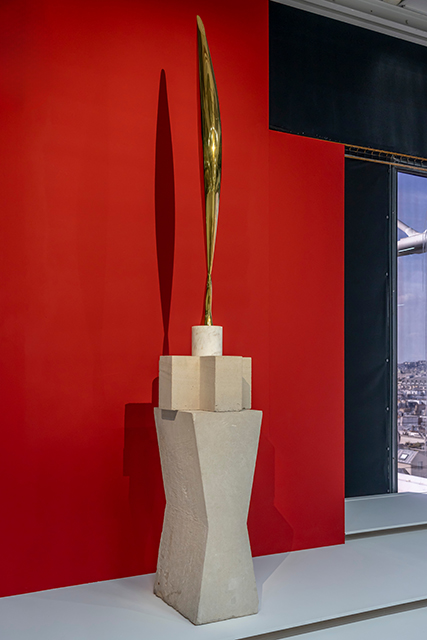
Brancusi's sleek, modernist bronze sculpture Bird in Space. Customs
denied the work the duty-free entry then applicable to works of art, including
"original sculptures," and levied a 40% duty, determining the work to belong to
the category of "[a]rticles or wares not specially provided for ... if composed
wholly or in chief value of iron, steel, lead, copper, brass, nickel, pewter,
zinc, aluminum, or other metal ... whether partly or wholly manufactured."
Steichen challenged the Customs determination with
financial backing from the sculptor, art collector, and heiress Gertrude
Vanderbilt Whitney. The case went to trial before a three-judge panel in the
Customs Court over whether Bird in Space was an "original sculpture or
statuary" under the 1922 Tariff Act. That statute defined those terms "to
include professional productions of sculptors only" and to exclude "any
articles of utility, nor such as are made wholly or in part by stenciling or any
other mechanical process." So the focus in the trial
was whether Bird in Space--present in the courtroom during trial--was an
"original sculpture or statuary" and the "professional production of a
sculptor," as opposed to "an article of utility."
After trial, the Customs Court held in Brancusi v.
United States that the work was created by someone recognized as an artist,
and the result of a process that was artistic. But did this make it a work of
art under the tariff law? The court recognized that Bird in Space "would
have been rejected as a work of art" under earlier decisions, particularly
given the holding in Olivotti that sculpture generally reflects
"imitations of natural objects, chiefly the human form, and represents such
objects in their true proportions of length, breadth, and thickness, or of
length and breadth only."
However, the Brancusi court reasoned that Olivotti
was handed down in 1916. In the meanwhile, there has been
developing a so-called new school of art, whose exponents attempt to portray
abstract ideas rather than to imitate natural objects. Whether or not we are in
sympathy with these newer ideas and the schools which represent them, we think
the fact of their existence and their influence upon the art world as
recognized by the courts must be considered.
The object now under consideration is shown to be for
purely ornamental purposes, its use being the same as that of any piece of
sculpture of the old masters. It is beautiful and symmetrical in outline, and
while some difficulty might be encountered in associating it with a bird, it is
nevertheless pleasing to look at and highly ornamental, and as we hold under
the evidence that it is the original production of a professional sculptor and
is in fact a piece of sculpture and a work of art according to the authorities
above referred to, we sustain the protest and find that it is entitled to free
entry . . . .
This decision was a sea change in how courts defined art,
allowing for recognition of non-representational--abstract--art as subject to
privileged legal treatment. The court's focus on whether Brancusi was
recognized as an artist, using means associated with artistic creation,
continues to be employed (though not always explicitly) by courts discerning if
an object is a work of art under various statutory definitions. Later in the 20th
century and into this one, as courts struggled to apply the First Amendment and
statutes to artworks, the broader approach to the scope of art by the Brancusi
court led to greater constitutional and statutory protection for a wide range
of artistic expression.
But maybe not always, at least not in this country. An
intriguing case from Britain arose 20 years ago when a gallery sought to import
works by artists including Dan Flavin into the United Kingdom. Flavin's works
were sculptures, each comprised of numerous fluorescent light tubes. Works of
art imported into the UK were usually subject to 5% VAT, with exemption from
customs duty, but HM Revenue and Customs classified the Flavin works as
lighting fittings, subject to 17.5% VAT plus customs duty. The case went all
the way to the European Commission, which held that Flavin's pieces were not
sculptures, because "it is not the installation that constitutes a 'work of art' but the result of the operations (the light effect)
carried out by it." So the works were treated as
lighting, subject to higher VAT and customs duty. (In an odd and arguably
inequitable inconsistency, it appears the European Commission treated the value
of the Flavin works for tax purposes on their value as works of art, not as
constituent fluorescent lightbulbs--so the pieces were taxed as non-art, based
on their higher value as art.)
These cases are a reminder that while tariffs may serve to
raise revenue and protect domestic industry, they are also inevitably tools of
social policy--favoring some products and industries over others, for reasons of
social benefit or otherwise. Stepping back, one could ask why art should be a
favored category of imported goods at all. Why privilege "art" (however
defined) over utilitarian objects? This historic distinction was presumably
intended to encourage the importation of objects that offered the public cultural
or aesthetic benefit beyond the commercial. Happily, at least for the moment, most
works of art remain subject to little or no tariff on importation to the US.
Submit your own column for publication to Diana Bosetti
For reprint rights or to order a copy of your photo:
Email
Jeremy_Ellis@dailyjournal.com
for prices.
Direct dial: 213-229-5424
Send a letter to the editor:
Email: letters@dailyjournal.com