


Labor/Employment
Sep. 10, 2026
When discovery changes the forum: The 9th Circuit's EFAA ruling and what follows
The 9th Circuit's Ding decision clarifies when later-discovered sexual harassment claims can shift a case from arbitration to court, while making knowledge and waiver central to the forum analysis.



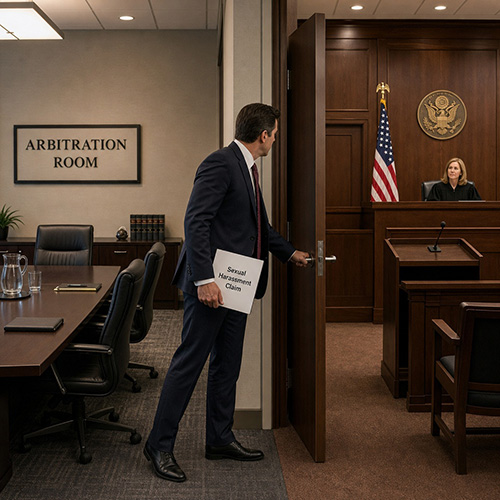
The 9th U.S. Circuit Court of Appeals has held that an employee who starts arbitration on other claims does not forfeit the right to move a later-discovered sexual harassment case into court. Ding v. Structure Therapeutics, Inc., No. 25-1532 (2026), decided Aug. 19, is the court's fullest treatment of the timing question at the center of the Ending Forced Arbitration of Sexual Assault and Sexual Harassment Act of 2021, known as the EFAA.
Dr. Ding Ding became chief financial officer of Structure Therapeutics USA, Inc. in December 2021 and was terminated on March 22, 2022, two weeks after telling the chief executive she had been injured in a domestic violence incident. He recommended her termination to the board 10 days after the incident and, per the complaint, gave no performance reason while citing her domestic situation as a factor. Her offer letter required binding arbitration. In October 2022, she filed a JAMS demand asserting discrimination, retaliation and harassment based on national origin and her status as a domestic violence victim. Over roughly a year, the parties held preliminary hearings, began discovery, stipulated to a protective order and litigated discovery disputes. Discovery surfaced material Ding had not seen: an email in which the chief executive described his "ideal phenotype" for the role and offered two men as examples, evidence that the board wanted gender diversity in the hire to appeal to investors, and testimony that male bankers' complaints that she "lecture[d] them" factored into the termination. She withdrew from arbitration, then sued in state court under California's Fair Employment and Housing Act. Structure removed and moved to compel arbitration, which the district court denied.
The 9th Circuit affirmed. Writing for the majority, Judge Gabriel Sanchez started with the operative text, which permits invalidation of a predispute arbitration agreement "at the election of the person alleging conduct constituting a sexual harassment dispute." 9 U.S.C. Section 402(a). Because Ding was not alleging such conduct when she filed her demand, the majority reasoned, that filing could not have triggered the statutory election. On this reading, she made the election at the time she filed in court. The employer's reading, the court added, would cause a plaintiff to lose access to court before knowing she had a claim. The court rejected the argument that a federal policy favoring arbitration compelled a narrower reading, citing Morgan v. Sundance, Inc., 596 U.S. 411 (2022), for the point that the Federal Arbitration Act treats arbitration contracts like other contracts rather than favoring them.
The majority did not open the door indefinitely. EFAA rights remain subject to ordinary waiver, meaning the intentional relinquishment of a known right. A plaintiff who knows the facts supporting a sexual harassment claim and then either delays through intentional acts or chooses to pursue it in arbitration can waive the court option. The outcome turned on a factual finding rather than a legal rule: the district court found no record evidence that Ding knew she had a plausible sexual harassment claim and elected not to bring it.
Judge Johnnie Rawlinson dissented. In her view, the statute supplies one election, and Ding made it when she chose arbitration. The dissent stressed that Ding withdrew for a reason unrelated to the EFAA, citing the employer's late payment of arbitration fees. She drew on the court's election-of-remedies cases, including Teutscher v. Woodson, 835 F.3d 936 (2016), and on the mirror-image line holding that a party waives arbitration by substantially litigating in court, such as Hill v. Xerox Business Services, LLC, 59 F.4th 457 (2023). She read the same legislative history the majority relied on as confirming a single choice, noting that supporters described "a real choice" of whether to go to court or to arbitrate, and observed that Congress declined to make the act retroactive, which she took as evidence that ongoing arbitrations were not meant to be disturbed.
A second holding may prove equally consequential. The EFAA defines a sexual harassment dispute by reference to "applicable Federal, Tribal, or State law." 9 U.S.C. Section 401(4). The court held that a sex-based hostile work environment claim under the FEHA qualifies even when the conduct is not sexual in nature, relying on Lyle v. Warner Bros. Television Productions, 38 Cal.4th 264 (2006), and Roby v. McKesson Corp., 47 Cal.4th 686 (2009). And because the statute invalidates the agreement as to a "case" rather than a claim, one qualifying claim carries the entire action into court.
The practical consequences are substantial. An executed arbitration agreement, and even an arbitration well underway, does not settle the forum. Structure spent a year in arbitration and still faces a court action. Waiver is now the operative defense, and it rises or falls on district court fact findings reviewed deferentially, so it is imperative to determine what the claimant knew and when. Document production carries added exposure because a single email can convert a national origin case into an EFAA case. The decision also rewards prompt action once discovery surfaces a sex-based theory, since delay after knowledge is the conduct the majority identified as waiver.
Submit your own column for publication to Diana Bosetti
For reprint rights or to order a copy of your photo:
Email
Jeremy_Ellis@dailyjournal.com
for prices.
Direct dial: 213-229-5424
Send a letter to the editor:
Email: letters@dailyjournal.com